

If you sell cosmetics made by someone else, you are not off the hook. The EU Cosmetics Regulation gives shops, pharmacies, salons and online sellers their own duties, and cosmetic distributor obligations start before a product reaches the shelf. This article turns Article 6 of Regulation (EC) No 1223/2009 into a practical goods-in checklist, explains when a retailer quietly becomes the responsible person and shows what to do when something looks wrong.
Contents
- The short answer
- Who counts as a distributor?
- What Article 6 asks of you
- Goods-in checklist: what to look at on every delivery
- Red flags that should stop a sale
- What to ask your suppliers
- Storage and transport
- When something goes wrong
- Traceability: who did you buy from, and to whom did you sell?
- Private label and relabelling: when you become the responsible person
- Online sales and marketplaces
- Frequently asked questions
- Key takeaways
The short answer
A distributor must act with due care, check the key labelling points before making a product available, keep storage and transport conditions from damaging compliance, and act, inform and cooperate if a product is or may be non-compliant. You do not have to run safety assessments yourself, but you cannot simply trust that the supplier did everything. The brand or importer carries the main responsibility; you are the last check before the consumer.
Who counts as a distributor?
In the regulation, a distributor is anyone in the supply chain, other than the manufacturer or the importer, who makes a cosmetic product available on the EU market. That covers wholesalers, retail chains, independent shops, pharmacies, beauty salons that sell products, and online shops. If you buy directly from a supplier outside the EU, you are probably the importer, which carries heavier duties; the regulation deals with importers in a separate article.
Read also How to Sell Cosmetics in the EU: Step-by-Step Checklist
What Article 6 asks of you
The article can be summarised in four duties:
- Due care. Act with due care in relation to the applicable requirements when you make a product available.
- Verify before supplying. Check the required labelling, the language requirements and the date of minimum durability (see the checklist below).
- Do not sell what you believe is non-compliant. Hold the product back until it has been brought into conformity.
- Protect compliance while it is yours. Storage and transport conditions must not jeopardise compliance.
On a reasoned request from a competent authority, you must also provide the information and documents showing that the labelling is in conformity, and cooperate on actions to remove risks.
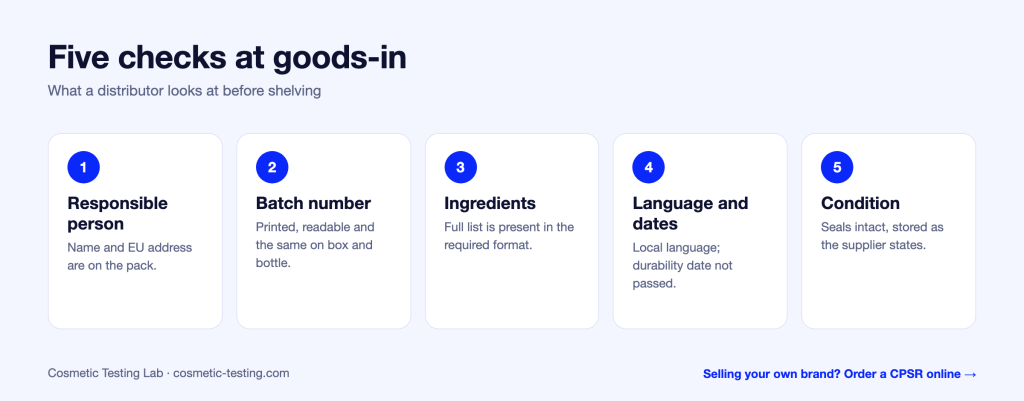
Goods-in checklist: what to look at on every delivery
The regulation points to specific labelling items. In practice, check each new product or batch like this:
- Responsible person. A name and address of the responsible person in the EU is on the pack.
- Batch number. A batch number or other reference allowing identification is printed on the pack, where practical on the container as well as the outer pack.
- Ingredients. A list of ingredients preceded by the word “Ingredients” is present, or the allowed alternative for tiny packs is used.
- Language. The mandatory information is in the language required in the country where you sell. If you sell in several countries, check each one.
- Date. The minimum durability date or the period-after-opening symbol is shown, and the date has not passed.
- Precautions and function. Warnings and the function of the product are visible and legible. See also our article on label warnings.
- Packaging condition. Seals are intact and containers are undamaged and clean.
Red flags that should stop a sale
- No address in the EU, only a non-EU address or only a website.
- No ingredient list, or an ingredient list in a language nobody can check.
- Mismatching batch codes between the bottle and the box.
- Products marked as testers, samples or “not for sale”.
- Claims that sound medical, such as treating or curing a disease.
- Foreign-language packs with no label in your market’s language, or stickers that cover the original text.
- Prices or discounts that look implausible for the brand, a possible sign of counterfeit or grey-market goods.
A single red flag does not prove a product is illegal, but it is a reason to stop, ask questions and document the answers.
Read also Cosmetic Launch Testing Checklist: Tests to Finish Before You Sell
What to ask your suppliers
The regulation does not make the distributor the keeper of safety files, and you are not obliged to hold the CPSR yourself. It is good practice to request, and keep on record, a short supplier file:
- The name and EU address of the responsible person for each product.
- Written confirmation that the product has been notified in the CPNP and that a product information file with a valid CPSR exists and is available to the authorities at the responsible person’s address.
- Contact details for complaints, undesirable effects and recalls.
- For batches with special storage needs, the required conditions.
If a supplier refuses to confirm the basics, treat that as a red flag. A brand that has a proper CPSR and product information file is usually happy to say so.

Storage and transport
Heat, frost and light can damage a cosmetic product. Creams can separate, emulsions can break and preservatives can lose effect. Keep products within the supplier’s stated conditions, avoid warehouse spaces with large temperature swings and rotate stock with a first-expired, first-out approach. Products that spent time in a hot vehicle or an unheated unit should be checked before sale. Brands rely on stability testing to define their conditions, which is why those conditions matter on your side.
When something goes wrong
If you consider or have reason to believe that a product is not in conformity, the regulation expects you to act:
- Stop selling the affected batch and separate the stock.
- Inform the responsible person and, where there is a risk, the competent authorities of the Member States where the product is available.
- Take corrective measures: bring it into conformity, withdraw or recall as appropriate.
- Where a serious undesirable effect occurs, notify the competent authority without delay. This duty is shared by the responsible person and distributors.
Keep a log of complaints, with dates, batch numbers and photographs. A well-run log protects you and helps the brand to investigate.
Read also How to Choose a Cosmetic Contract Manufacturer
Traceability: who did you buy from, and to whom did you sell?
On request from an authority, distributors must be able to identify the person who supplied them with a product and the businesses to which they supplied it. The obligation applies for a period after the batch was made available to you, which is three years under the regulation. Purchase records, invoices and delivery notes with batch numbers are enough, if you can find them quickly.
Private label and relabelling: when you become the responsible person
A distributor is treated as the responsible person if it places a product on the market under its own name or trademark, or modifies a product already on the market in a way that may affect compliance. This applies to private-label ranges, to relabelling and to repackaging. In those cases you need everything the brand would need: a notified product, a product information file and a CPSR signed by a qualified assessor. Our CPSR service covers that for your own-brand lines.
Online sales and marketplaces
The same duties apply when you sell at a distance: the product must meet the labelling and language requirements of the country you deliver to, and the listing should not make claims you could not support on the pack. Online platforms may add their own conditions and other EU rules may apply to marketplace sellers; check these separately.
Frequently asked questions
Do I need to see the CPSR for products I resell?
Not as a rule. The responsible person keeps the product information file. You should still confirm that one exists and that you know who to contact.
Do I have to check the CPNP notification?
The regulation’s distributor checks are about the labelling, language and date. Asking for confirmation of notification is a sensible extra step, not a legal checklist item.
Am I liable if the brand is at fault?
The responsible person carries the main duties, but distributors have their own obligations and authorities can require them to act. This is general information, not legal advice.
Key takeaways
- Distributors have their own legal duties under Article 6, not only the brand.
- Check the responsible person, batch number, ingredient list, language and dates on every delivery.
- Stop, report and document when something looks wrong; keep supply records for three years.
- Your own brand or relabelled product makes you the responsible person.