
Before any laboratory can start work, it needs your product in the right state. Getting the cosmetic sample requirements for a lab wrong is the most common reason a test starts late or has to be repeated. This guide explains in plain language how much product to send, how to pack it, what the sample must be labelled with and how to avoid the usual mistakes.
Contents
- The short answer
- Why the sample matters so much
- Which batch should you send?
- Final packaging, not a substitute container
- How much product do you need to send?
- What must the sample be labelled with?
- Include the formula and the right documents
- Storage and shipping conditions
- Common mistakes that delay a test
- A quick checklist before you ship
- Frequently asked questions
- Key takeaways
The short answer
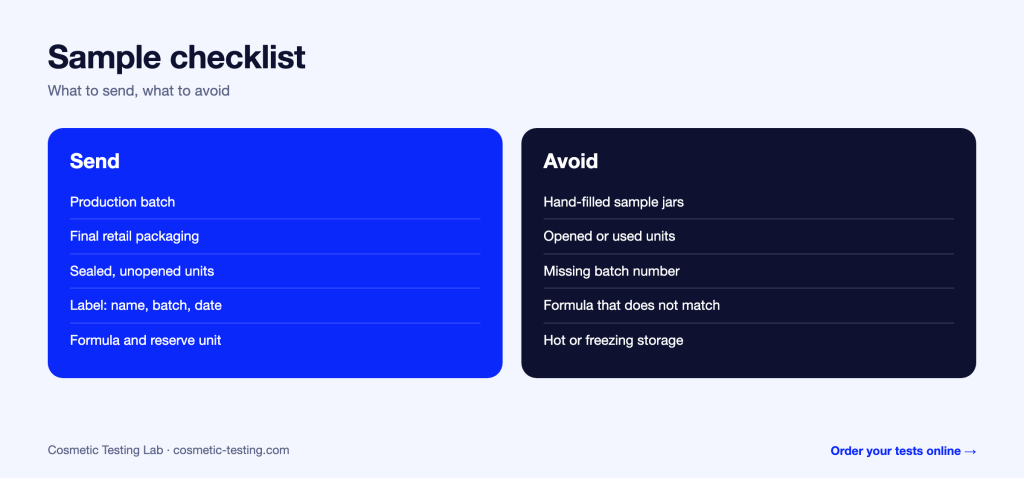
Send the finished product exactly as you plan to sell it: from a real production batch, in its final retail packaging, unopened, clearly labelled with product name, batch number and date, and in the quantity stated for your order, plus a small reserve. The lab tests what it receives, so the sample must represent what a consumer will buy. A sample that was hand-poured into a jar, topped up from another batch or stored in a hot car tells you nothing reliable about your real product.
Why the sample matters so much
Every result in a signed report applies only to the sample that was tested. If that sample is not typical of the batch, the result cannot support your safety documentation. Under Regulation (EC) No 1223/2009 the responsible person must be able to show that the product is safe and that it was made under good manufacturing practice. Test reports are part of that evidence, and the safety assessor who signs your CPSR relies on them. A weak sample therefore weakens the whole file.
Read also Cosmetic testing process in Cosmetic Testing Lab (from start to finish)
Which batch should you send?
Use a batch made with the same formula, process and equipment as the product you will sell. A pilot or lab-scale batch is acceptable for early development tests, but for the tests that go into your final file, a production batch, or a batch that clearly represents production, is the safer choice. If you later change the formula, supplier of a key raw material or the process, the earlier results may no longer apply and some tests may need repeating.
Always note the batch number. It links the report to a physical lot, which matters if an inspector or a retailer asks you to prove which product was tested.
Final packaging, not a substitute container
Send the product in the container that consumers will receive. Packaging is part of the test, not just transport:
- A stability and compatibility test checks how the formula behaves in contact with the real jar, bottle, pump or tube. A glass sample jar would hide problems such as discolouration, leaching, pump clogging or a lid liner that reacts with the formula.
- A challenge test and a microbiological test are also influenced by the packaging, because a jar that you open daily exposes the product differently from an airless pump.
- Where you sell several sizes or materials, the worst case is usually the one that matters. Ask whether one pack can represent the range.
Sealed, unopened units are best. If a unit has been opened, tell the lab, because it may change the microbiological result.
How much product do you need to send?
The amount depends on the test, the number of conditions and the pack size. Each test has its own requirement, shown when you order, so follow that figure rather than guessing. A few general principles help:
- Count the tests first. A challenge test uses several portions of product, a stability plan needs separate units for each storage condition and time point, and a patch test needs enough for the volunteers.
- Send complete units. If the retail pack is small, send several packs rather than decanting.
- Add a reserve. A spare unit allows a repeat if something goes wrong in the lab, and avoids a second shipment.
- Different variants are different samples. A fragrance-free and a scented version, or two colours with different pigments, usually need separate samples unless a bracketing approach is agreed.
Read also How to Choose a Cosmetic Testing Lab: A Practical Guide
What must the sample be labelled with?
A clear label prevents mix-ups. At a minimum, mark every unit or the outer bag with:
- Product name exactly as on your order
- Batch or lot number
- Date of manufacture
- Your company name and a contact person
- Your order or reference number
Use a permanent marker or a label that survives moisture and cold. Write on the outer packaging or a bag, not over any printed text you want to keep legible. If you send many similar products, add a short code and keep a list that matches code and product name; a simple sheet inside the box works well.
Include the formula and the right documents
Most tests need information beyond the physical sample. The lab typically asks for the full formula with ingredient names and percentages, the intended use, the target consumer group and the pack type. For safety documents it also helps to include the ingredient list as printed on the label and the safety data sheets of raw materials. Keep this information consistent between order form, label and formula, because inconsistencies are one of the most common reasons for queries. Our guide on safety data sheets explains which documents travel with a formula.

Storage and shipping conditions
Keep samples at normal room temperature, away from direct sunlight, and ship them as soon as they are packed. Do not leave them in a warehouse that gets very hot or freezes. For products with a special storage requirement, such as a refrigerated product, say so clearly on the order. Pack the units so they cannot leak or break: wrap each unit, add filler and use a sturdy box. A sample that arrives leaking or broken cannot be tested, and a leaking pack may also be a sign that the packaging itself needs a closer look.
We offer free DHL sample pickup from your door, so you only need to pack the box and book the collection when you order.
Read also How to Send Cosmetic Samples to a Lab: A Step-by-Step Guide
Common mistakes that delay a test
- Sending a product in a plain sample jar instead of the real pack.
- Sending too little product and then having to ship again.
- Missing or unreadable batch number.
- A formula that does not match the sample, for example after a last-minute ingredient change.
- Sending products that were opened, used or stored for months in poor conditions.
- Mixing several variants in one unlabelled bag.
A quick checklist before you ship
- Production batch, final formula confirmed.
- Final retail packaging, sealed, undamaged.
- Quantity matches the order, plus a reserve unit.
- Each unit labelled with name, batch number, date and order reference.
- Formula and ingredient list included and consistent.
- Stable storage until pickup, sturdy box, no leaks.
Frequently asked questions
Can I send a sample from a small test batch?
For early development, yes, but tell the lab it is a development batch. For the tests that support your final safety assessment, use a production batch or one made with the same formula and process.
Does the sample have to be in the final packaging?
Whenever possible, yes. Packaging influences stability, compatibility and microbiological behaviour. If you cannot yet send the final pack, say so and agree what the report can claim.
What if my product is reformulated after testing?
Results apply to the tested formula. A change to ingredients, levels or packaging may require repeat tests, so decide the formula before you order.
Key takeaways
- Send finished product from a representative batch, in final, sealed packaging.
- Follow the quantity stated at order and add a reserve unit.
- Label every unit with name, batch, date and order reference, and include the formula.
- Pack carefully and keep samples at room temperature until pickup.