
Cosmetic testing is the set of laboratory checks that show a cosmetic product is safe, stable and clean enough to sell. If you are launching a cream, serum, shampoo or balm, you will hear about stability tests, challenge tests, patch tests and a safety report, often all at once. In short: in the EU and UK, cosmetic testing means testing the finished product (never on animals) so that your safety assessor has the data needed to sign a CPSR, and the tests you need depend on your formula, packaging and intended use. This guide explains what each test does, why you need it and how to plan the tests in the right order.
Contents
- The short answer
- What does “cosmetic testing” actually mean?
- Why brands test: law, buyers and peace of mind
- The core tests at a glance
- Which tests does your product need?
- In what order should you test?
- How long does cosmetic testing take?
- What cosmetic testing does not include
- How to prepare samples
- Common mistakes to avoid
- A quick checklist before you order
- Frequently asked questions
- Key takeaways
The short answer
Most water-based cosmetics need four things before launch: a stability and compatibility test, a microbiological test, a challenge test (preservation efficacy) and a CPSR signed by a qualified safety assessor. A patch test is optional but often added for leave-on products and for products aimed at sensitive skin. Anhydrous products such as oils, balms and lipsticks often need fewer microbiological tests, but the safety assessor makes that call, not the brand. Plan your timeline around the longest test, which is usually stability.
What does “cosmetic testing” actually mean?
The phrase is often confused with animal testing. In the EU, testing finished cosmetic products on animals has been banned since 2004 and testing cosmetic ingredients since 2009, with a full marketing ban since 2013. Today, cosmetic testing for a brand means laboratory work on your finished product and its packaging.
The legal reason is Regulation (EC) No 1223/2009. Article 3 says a cosmetic must be safe under normal or reasonably foreseeable conditions of use. Article 10 requires a safety assessment before the product is placed on the market, and Annex I lists the information that assessment must contain, including stability, microbiological quality and the toxicological profile of the ingredients. Testing is how you produce much of that information. The UK applies a very similar framework.
Read also Cosmetic Testing Services: A Complete Overview of the Tests
Why brands test: law, buyers and peace of mind
- Legal compliance. Without data, an assessor cannot sign the CPSR, and without a CPSR you cannot complete your Product Information File (PIF) or notify the product in the CPNP.
- Retailers and marketplaces. Many distributors, pharmacies and online marketplaces ask for test reports before they list a product.
- Fewer surprises. A mouldy jar or a cream that separates on the shelf costs far more than the test that would have caught the problem.
- Better decisions. Results tell you which shelf life and period after opening (PAO) you can realistically print on the label.
The core tests at a glance
Stability and compatibility test
The stability test stores your product under accelerated conditions (heat, cold, light, temperature cycles) and checks appearance, odour, pH, viscosity and the interaction with the packaging. It supports your shelf life and PAO.
Microbiological test
The microbiological specifications test checks how clean the product is right now: total counts of bacteria, yeasts and moulds, and the absence of specific pathogens. It answers the question “was this batch made hygienically?”
Challenge test
The challenge test deliberately contaminates the product with five reference microorganisms and follows them for 28 days, usually under ISO 11930. It answers a different question: “will the preservative system protect the product while consumers use it?”
Patch test
The patch test applies the finished product under an occlusive patch to the skin of human volunteers for 48 hours to check skin tolerance. It confirms what the safety assessment predicts; it does not replace it.
Safety report and safety data sheet
The CPSR combines all of the above with the ingredient data into Part A (safety information) and Part B (the assessor’s conclusion). An SDS is a different document: it is mainly meant for raw materials, bulk and workers, not for finished consumer cosmetics, although some partners and transport companies ask for one.
Which tests does your product need?
There is no single list for every product. These typical patterns help you plan, but your safety assessor makes the final decision:
- Water-based creams, lotions, serums, gels and shampoos: stability, microbiological test and challenge test. A patch test is recommended for leave-on products.
- Anhydrous oils, balms and lipsticks: stability and usually a microbiological test. A challenge test is often not needed because water activity is very low, provided the assessor documents the risk assessment.
- High-alcohol perfumes: stability and packaging compatibility; the microbiological risk is usually low.
- Products for children under three or for the eye area: stricter microbiological limits apply, and assessors tend to ask for more complete data.
- Rinse-off products such as liquid soaps and shower gels: stability, microbiology and, if water-based, a challenge test. Exposure is lower, which the assessor takes into account.
Read also Advantages of testing cosmetics with us
In what order should you test?
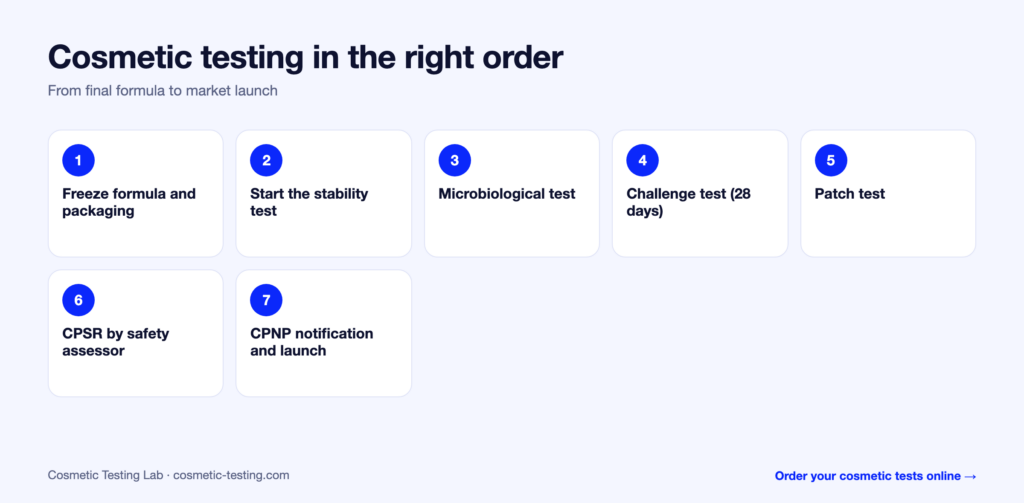
- Freeze the formula and choose the final packaging. Changing either later can make results unusable.
- Start the stability test first, because it usually runs the longest.
- Run the microbiological test and the challenge test in parallel on the same batch.
- Add the patch test once the formula is final.
- Send all reports and the formula to the safety assessor for the CPSR.
- Notify the product in the CPNP and place it on the market.
How long does cosmetic testing take?
Expect weeks, not days. The microbiological test takes about five days after the lab receives the sample. The challenge test runs for 28 days plus reporting. A patch test takes about two weeks in total. Stability depends on the plan you choose. Once all data is complete, a CPSR takes about ten business days. Because the tests can run in parallel, the critical path is usually the stability test followed by the CPSR.

What cosmetic testing does not include
Some tests are often mentioned in the same breath but belong to other areas:
- Efficacy and claim tests (for example “reduces wrinkles in four weeks”) prove a claim, not safety. They are run by specialist claim-testing labs.
- SPF and UVA tests for sunscreens follow their own ISO methods and are carried out by specialised sun-care labs.
- Animal tests are banned for cosmetics in the EU and the UK.
- Ingredient toxicology normally comes from supplier data, scientific opinions and literature, not from new tests commissioned by the brand.
Read also Cosmetic testing process in Cosmetic Testing Lab (from start to finish)
How to prepare samples
Send product from a representative batch in the final packaging, labelled with the product name and batch number. Tell the lab whether the product contains water, which preservatives it uses and how it is applied. A near-final formula from a pilot batch is fine for early checks, but the reports in your file should match the product you actually sell.
Common mistakes to avoid
- Testing in a lab jar and then launching in a pump or a tube.
- Changing the fragrance or the preservative after the tests have finished.
- Ordering a challenge test without knowing whether the formula is stable.
- Assuming a supplier’s report on a base formula covers your modified version.
- Waiting for one test to finish before ordering the next.
A quick checklist before you order
- Final formula with INCI names and percentages
- Final packaging, including the closure
- A batch number on every sample
- A target launch date with at least two months of buffer
- A safety assessor who confirms which tests and standards they need
Frequently asked questions
Is cosmetic testing mandatory?
The law requires a safety assessment based on adequate data, not a fixed list of tests. In practice, the data on stability and microbiological quality almost always comes from laboratory tests.
Can I use test results from my manufacturer?
Yes, if the reports cover exactly your formula, your packaging and a representative batch. Check the dates, the standard used and the signature.
Do I need to retest if I only change the label?
Not for a label-only change. A change to the formula, the packaging material or the manufacturing process can require new data, so ask your assessor.
Key takeaways
- Cosmetic testing means testing the finished product, never on animals.
- Most water-based products need stability, microbiological and challenge tests before the CPSR.
- Run tests in parallel and start stability first.
- Your safety assessor decides which data is enough for your product.