

A safety report no longer means weeks of e-mails and attachments sent back and forth. Today you can order a CPSR online, enter your formula in a form, upload your documents and receive a signed PDF. The process is fast when your data is ready and slow when it is not: about 10 business days once everything is complete, with most delays caused by missing supplier documents or missing product tests. This guide shows what to prepare before you click order, what happens after and how to judge any online CPSR provider.
Contents
- The short answer
- Before you order: lock the formula and packaging
- What to prepare: the formula
- What to prepare: supplier documents
- What to prepare: product tests
- What happens after you order
- How long does it take?
- Which tier will my report be?
- After you receive the report
- What a CPSR does not cover
- How to judge an online CPSR provider
- A realistic timeline
- Common mistakes when ordering online
- Frequently asked questions
- Key takeaways
The short answer
To order a CPSR online you need four things: a final formula with INCI names and exact percentages, supplier documents for your raw materials, test reports on the finished product (stability, microbiology and, for water-based products, a challenge test), and basic product information such as type, use and packaging. You place the order, fill in the form, upload documents, answer any questions from the assessor and receive a report with Part A and Part B, signed by a qualified safety assessor.
Before you order: lock the formula and packaging
A CPSR describes one specific product. If the formula or packaging changes after the report is signed, parts of the assessment may need to be redone. Before ordering, make sure:
- the formula is final, including fragrance and preservative levels;
- the packaging is chosen, because it affects stability, contamination risk and exposure (a pump, a jar and a spray are assessed differently);
- you know the product type, target group and application area, for example a leave-on face cream for adults.
Read also How Much Does a CPSR Cost in 2026? Price Factors Explained
What to prepare: the formula
List every ingredient by INCI name with its exact percentage, so that the total is 100%. Trade names alone are not enough; an assessor needs to know what is actually inside. If an ingredient is a blend, such as a preservative system or a botanical extract in a carrier, give its composition. If you sell several shades on the same base, say so: one report can often cover them when the differences are clearly described.
What to prepare: supplier documents
Ask your suppliers early. Gathering documents is what usually takes longest. Typical requests are:
- specifications or technical data sheets for each raw material;
- safety data sheets and certificates of analysis, especially for preservatives, colorants, UV filters and other restricted ingredients;
- for fragrances, the allergen declaration and IFRA certificate;
- information on impurities where relevant, for example heavy metals in mineral pigments.
What to prepare: product tests
Annex I of the Cosmetics Regulation asks for information on the stability and microbiological quality of the finished product, and for the result of a preservation challenge test where relevant. If you do not have these reports yet, order them together with the CPSR:
- a stability and compatibility test to support shelf life or PAO and check the packaging;
- a microbiological specifications test, with results about 5 days after we receive the samples;
- a challenge test to ISO 11930 or USP 51 for water-containing products, which runs for 28 days.
Samples are collected from your door with free DHL pickup. The reports are signed PDFs ready for your CPSR and PIF.
Read also What Is a CPSR? Cosmetic Product Safety Report Explained
What happens after you order
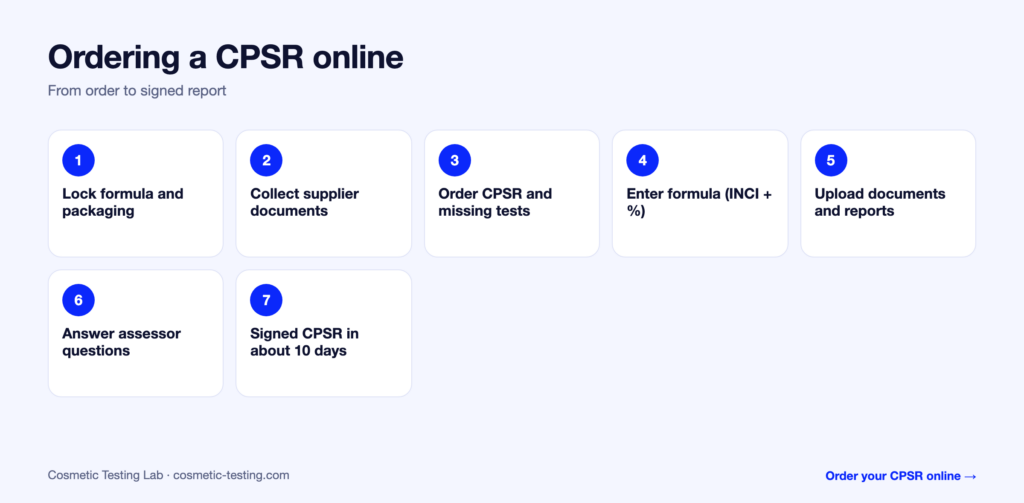
- Formula and product details. You enter the formula and product information in the online form. The report tier follows from your formula, so you do not have to work it out yourself.
- Documents. You upload supplier documents and any existing test reports.
- Data check. The assessor reviews completeness. If something is missing or unclear, you get a specific question rather than a general request.
- Assessment. Once the data is complete, the assessor checks each ingredient against the annexes, calculates exposure and margins of safety, and evaluates the test results.
- Report. You receive the signed CPSR as a PDF, with Part A (data) and Part B (conclusion, warnings, reasoning, assessor credentials).
How long does it take?
A CPSR is delivered in about 10 business days after all data is complete. The calendar time before that depends on you and your suppliers. If you still need product tests, plan for the longest one: a challenge test alone takes 28 days, and stability plans take longer. Starting tests and document collection in parallel is the simplest way to save weeks.

Which tier will my report be?
We prepare CPSRs in three tiers by formula complexity: Simple (up to 10 ingredients), Standard (11–25 ingredients) and Complex (26 or more, or containing a fragrance). A fragrance counts as complex because each allergen in it must be evaluated. The tier is set by the formula you enter.
Read also SDS vs CPSR: Which One Do You Need?
After you receive the report
- Check the label. Any warnings or instructions in Part B must appear on the packaging.
- Complete the PIF. The CPSR goes into the Product Information File with the product description, manufacturing method, proof of claimed effects and animal testing data.
- Notify the product. The responsible person notifies it in the CPNP before it is placed on the market.
- Keep it current. A change in formula, packaging or the legal status of an ingredient can mean an update of the report.
What a CPSR does not cover
A CPSR is the safety report, not the whole compliance package. It does not notify your product in the CPNP, appoint a responsible person or substantiate your marketing claims, and it is not legal advice. If you sell outside the EU and UK, other markets may have their own registration or documentation rules that you should check with a local partner. Business customers, warehouses or carriers may also ask for an SDS, which is a separate document.
How to judge an online CPSR provider
- Who signs? Ask for the assessor’s name and qualifications. The regulation requires a university qualification in pharmacy, toxicology, medicine or a similar discipline.
- Does it use your test data? A report that does not refer to stability, microbiology and preservation results for your product is incomplete.
- Is the reasoning visible? Part B should explain how the conclusion was reached, not just state it.
- Is it specific? Product name, product type, exposure and warnings should match your product.
A realistic timeline
A brand launching a water-based body lotion orders the CPSR together with stability, microbiological and challenge tests in week one, and the samples are picked up the same week. While the tests run, the brand collects supplier documents and enters the formula. The microbiological result arrives within days, the challenge test after its 28-day cycle and the stability data as the plan progresses. Once the last report is in, the CPSR follows in about 10 business days. Starting everything at once, rather than one step after another, is what keeps the launch on schedule.
Common mistakes when ordering online
- Ordering before the formula is final and then changing the fragrance.
- Entering trade names without INCI names or percentages.
- Uploading test reports made on a lab sample in a different container.
- Forgetting the allergen declaration for the fragrance.
Frequently asked questions
Do I need to send samples for a CPSR?
Not for the report itself. Samples are needed for the product tests that the report relies on, and these can be collected free of charge by DHL.
Can I use test reports from my manufacturer?
Yes, if they cover exactly your formula in comparable packaging and are signed. Upload them with your order.
Is there a discount for new customers?
Create a free account to unlock 10% off your first order and 20% on bundles.
Key takeaways
- Ordering a CPSR online is fast when the formula, documents and tests are ready.
- Lock the formula and packaging before you order.
- Start product tests and supplier requests in parallel to save time.
- Always check who signs the report and whether it uses your own test data.