
If you have ever seen “clinically proven mild” or “tested on human volunteers” on a label, the study behind it was very often a repeat insult patch test, known as HRIPT. This guide explains what the test is, how it runs, what the results do and do not tell you, and how it differs from the single patch test that most cosmetic files rely on.
Contents
- The short answer
- What is the purpose of an HRIPT?
- How does the study run?
- The HRIPT step by step
- Who takes part, and how is safety ensured?
- What do the results mean?
- HRIPT vs a single patch test
- Does the EU require an HRIPT?
- Using HRIPT results in claims
- How to choose a laboratory
- Common mistakes
- Frequently asked questions
- Key takeaways
The short answer
A repeat insult patch test (HRIPT) is a human safety study in which a product is applied under a patch to the same skin site repeatedly over about three weeks, followed by a rest period and one challenge patch on a fresh site, to check whether it causes irritation or induces skin allergy (sensitisation). The whole study typically takes around six weeks and uses a panel of volunteers, commonly around 100 or more. It is a confirmatory study, not a replacement for the safety assessment.
What is the purpose of an HRIPT?
Two different reactions matter. Irritation is a direct, dose-related effect on the skin: redness, dryness, stinging. Sensitisation is an immune reaction: the first exposures teach the body to recognise a substance, and later exposures trigger allergic contact dermatitis, with redness, swelling, itching and sometimes blisters. A single short patch can show irritation but is poorly suited to showing that a product has not induced allergy. The HRIPT deliberately repeats and exaggerates exposure to give the immune system every chance to react.
Read also Patch Test Volunteers: How Many Are Needed?
How does the study run?
Protocols differ between laboratories, but the classic design has three phases:
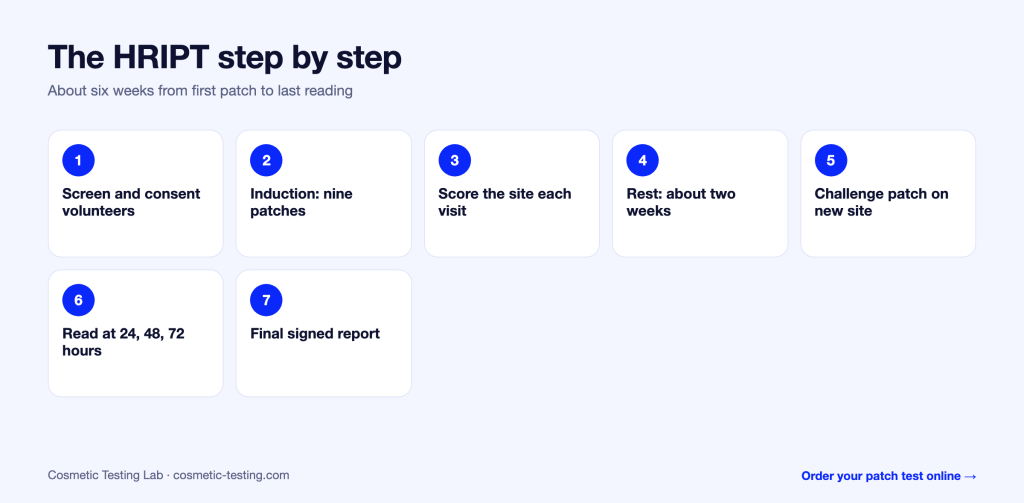
- Induction phase. Patches with the test product are applied to the same site, typically nine times over about three weeks. Each patch is usually occlusive or semi-occlusive and stays on for around 24 hours. The site is scored before each new application.
- Rest phase. Roughly two weeks with no product, during which any allergy that was induced has time to develop.
- Challenge phase. A single patch is applied to a new, untreated site. The skin is read at about 24, 48 and 72 hours after removal, and sometimes at 96 hours.
Each reading is scored by a trained evaluator, often a dermatologist, on a defined scale, from no reaction up to strong reactions with swelling or blisters.
The HRIPT step by step
The graphic shows the sequence in the order it happens.
Who takes part, and how is safety ensured?
Volunteers are adults without relevant skin disease, screened against inclusion and exclusion criteria, who give informed consent before any patch is applied. Reputable laboratories work under ethics-committee approval and follow the principles of the Declaration of Helsinki, with the right to leave the study at any time. Test sites are examined throughout, and a participant with a significant reaction stops patching.
Human testing is not a way to discover whether something is dangerous. The SCCS guidance on safety evaluation expects human studies to be considered only when the available data already suggest the product is safe, and to be properly designed and justified. If a formula is likely to be a strong irritant or sensitiser, that should be seen in the formula review and ingredient data well before volunteers are involved.
Read also What Is a Cosmetic Patch Test (and Is It Required)?
What do the results mean?
A clean result means that, in this panel and at this exposure, no one showed irritation or developed an allergy to the product. That is valuable evidence and supports a claim such as “dermatologically tested” when the wording matches what was actually done. It is not proof that nobody will ever react.
The reason is statistics. With a panel of about 100 people, a reaction rate of well under one in a hundred can easily go unseen. A large review of fragrance-material studies covering over 16,000 volunteers found sensitisation induction to be rare, but the authors also stress that the test cannot precisely predict potency. Treat an HRIPT as strong confirmation, not as a guarantee.
HRIPT vs a single patch test
These are different tools for different questions:
- HRIPT: multi-week, repeated exposure, aimed at irritation and allergy induction, larger panel, higher effort.
- Single patch test: one application, read after the patch is removed, aimed mainly at irritation and immediate tolerance, smaller effort. Our patch test is a single 48-hour occlusive patch test, with about two weeks from start to signed report.
For many brands, especially for rinse-off products or a formula of well-known ingredients, the safety assessor will find a single patch test together with the ingredient data adequate. An HRIPT becomes attractive when you plan a strong tolerance claim, a new or unusual ingredient, a product for babies or sensitive skin, or when retailers ask for it.

One caution: the EU technical document on hypoallergenic claims prefers repeated open application designs on finished products over the HRIPT, and treats HRIPT-based hazard assessment of ingredients as unethical. Discuss the study design with your safety assessor before commissioning anything.
Does the EU require an HRIPT?
No. Regulation (EC) No 1223/2009 requires a safety assessment of the finished product but does not list HRIPT as a mandatory test. The CPSR is built from ingredient toxicology, exposure, formula and, where appropriate, supporting product data. Because animal testing of cosmetics is banned in the EU, ingredient data on sensitisation come from non-animal methods and existing evidence, and human studies such as the HRIPT are used as confirmation when the assessor considers them useful. The safety assessor decides what the file needs.
Read also Patch Test Cost for Cosmetics and How Long It Takes
Using HRIPT results in claims
Claims in the EU must meet the common criteria of Regulation (EU) No 655/2013, including evidential support and honesty. If you say “dermatologically tested”, the testing must be real, relevant to the product and described accurately. A study on a similar formula, a different concentration or a different body area may not support the statement. Do not stretch results into words such as “allergy-free” or “100% safe”; they are not supportable. Our related guides on hypoallergenic and sensitive-skin claims go deeper.
How to choose a laboratory
- Ethics approval and informed-consent procedures documented.
- Written protocol with panel size, application schedule, scoring scale and stopping rules.
- Dermatological supervision and qualified evaluators.
- Control of the study product: batch number, concentration and storage.
- A final report that states the panel, the method, every reaction and the conclusion.
Ask early how the laboratory handles volunteer drop-outs and unexpected reactions, because these decide whether a study is still valid. Allow time for ethics approval and recruitment when you plan your launch calendar.
Common mistakes
- Testing an early prototype, then selling a changed formula.
- Using a study of one product to support claims on a different one.
- Writing a claim stronger than the report allows.
- Skipping the safety assessment on the assumption that a human study replaces it.
- Not checking whether a single patch test would answer the question for a fraction of the effort.
Frequently asked questions
How long does a repeat insult patch test take?
Typically about six weeks of volunteer participation, plus planning, ethics approval and reporting before and after.
Is an HRIPT the same as a skin prick or allergy test at the doctor?
No. A clinical patch test checks a person with suspected allergy against selected allergens. An HRIPT is a product-safety study on healthy volunteers to see whether the product induces irritation or allergy.
Can I use an HRIPT instead of a CPSR?
No. The study can be one supporting document inside the product information file, but the signed safety report assesses the whole product and its ingredients.
Key takeaways
- An HRIPT repeatedly patches volunteers over about three weeks, rests, then challenges a new site.
- It checks for irritation and induced allergy, and gives strong but not absolute reassurance.
- It is not legally mandatory in the EU; the safety assessor decides what the file needs.
- Any claim based on it must match exactly what was tested.