
Before a single jar is filled, you have already bought dozens of ingredients: oils, emulsifiers, actives, preservatives, fragrance. Each one arrives with a label, and many should arrive with a safety data sheet too. If you are looking for the SDS for cosmetic raw materials, the questions are simple but important: which suppliers must send one, what must it contain and how do you check it before you rely on it? This guide answers them in practical terms, from a brand’s point of view.
Contents
- The short answer
- What the law requires from a supplier
- Delivery, language and updates
- What if the raw material is not classified?
- What else to ask for besides the SDS
- How to check a raw material SDS on arrival
- When an SDS says “industrial use only”
- How the SDS feeds your CPSR
- Keeping your SDS library current
- A worked example
- Common mistakes
- Frequently asked questions
- Key takeaways
The short answer
Under REACH, the supplier of a hazardous substance or mixture must give its customer a safety data sheet, free of charge, in the official language of the country where it is sold, no later than the first delivery. You are the customer, so you are entitled to a current 16-section SDS for every classified raw material. For raw materials that are not classified as hazardous, an SDS is usually not mandatory, but the supplier must still pass on certain information, and in some cases you can request one. Your own SDS for a finished product is a separate matter.
What the law requires from a supplier
Article 31 of the REACH Regulation (EC) No 1907/2006 sets the main duties. In practice, a supplier must provide an SDS when the substance or mixture:
- meets the criteria for classification as hazardous under the CLP Regulation;
- is persistent, bioaccumulative and toxic, or very persistent and very bioaccumulative;
- is included on the Candidate List of substances of very high concern.
For certain mixtures that are not classified, an SDS must be supplied on request when they contain a hazardous substance above set concentration thresholds. The exact limits depend on the type of hazard and are listed in the Article. The SDS has to follow the format in Annex II of REACH, as amended by Regulation (EU) 2020/878, with 16 numbered sections.
Read also SDS vs CPSR: Which One Do You Need?
Delivery, language and updates
- Free of charge, on paper or electronically, no later than the first delivery.
- In an official language of the country where the material is placed on the market, unless that country provides otherwise.
- Kept up to date: when new hazard information or a classification change appears, the supplier must revise the SDS and send it to customers who received the material in the previous twelve months.
- Retained: suppliers and users generally have to keep the information for at least ten years.
What if the raw material is not classified?
Many cosmetic ingredients, such as glycerin or a plain vegetable oil, are not classified as hazardous. For these, an SDS is usually not required, but Article 32 of REACH still obliges the supplier to pass on information such as a registration number where one exists, whether the substance is subject to authorisation or restriction, and other available information needed for safe handling. Many suppliers send an SDS or an equivalent data sheet anyway. Ask for it. It is a small request for the supplier and saves you questions later.
What else to ask for besides the SDS
The SDS is a safety document for handling and transport. It does not tell your safety assessor everything. For a complete raw material file, also request:
- the technical data sheet (TDS) and certificate of analysis (CoA) for each batch;
- the full composition and INCI name, or a confidentiality route to your assessor;
- the allergen declaration and, for fragrance, the supplier’s compliance certificate;
- statements on CMR substances, nanomaterials, animal origin and GMO status where relevant;
- declarations on heavy metals, residual solvents and other impurities;
- the microbiological specification, especially for natural and water-based materials.
Read also Do Cosmetics Need a Safety Data Sheet (SDS)?
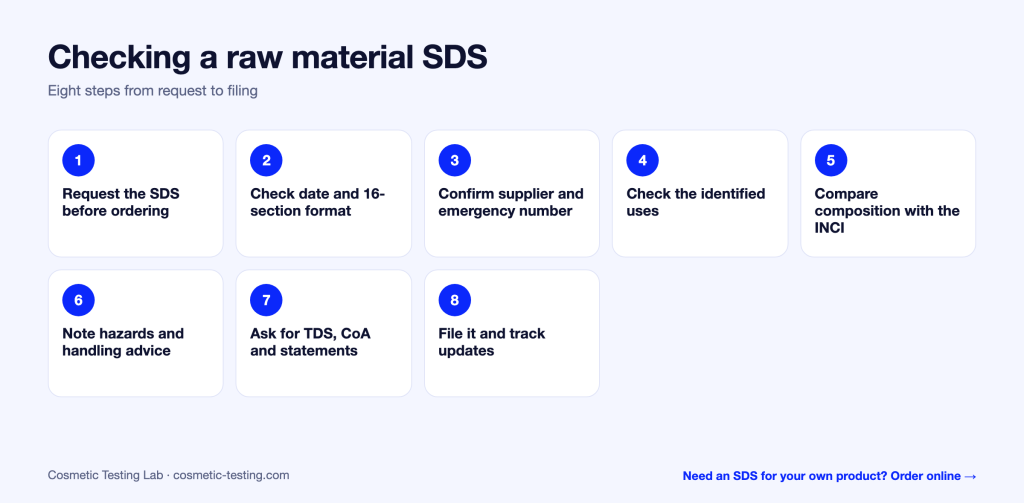
How to check a raw material SDS on arrival
- Date and version. A recent revision date and the Annex II format with 16 sections show that the document is maintained.
- Supplier identity. Section 1 should name the supplier with address and an emergency phone number.
- Identified uses. Check whether cosmetic or personal-care use is covered, or at least not excluded.
- Composition. Section 3 usually lists only the hazardous components, so compare it with the INCI and the specification.
- Classification and handling. Sections 2, 7 and 8 tell you how to store the material, what protection staff need and whether special labelling applies to it.
- Physical data. Section 9 gives pH, flash point and appearance, which help formulation and storage.
- Toxicological data. Section 11 can support your assessor, although it is not a substitute for a toxicological profile.
- Transport. Section 14 shows whether the material is regulated for shipping.
When an SDS says “industrial use only”
Some SDS list only industrial or professional uses in section 1.2. That does not automatically mean the material is unsuitable for cosmetics, because SDS describe the supplier’s registered uses. It does mean you should ask the supplier for a written statement that the material is suitable for cosmetic use and meets the Cosmetics Regulation, and your assessor will want to see that statement. If the supplier cannot give it, treat the material as unconfirmed.

How the SDS feeds your CPSR
Raw material SDS contribute to the quantitative and qualitative composition, to hazard information that the assessor considers, and to physical and chemical characteristics. They do not replace the supplier specification or toxicological data. When you order a CPSR, hand the assessor the full raw material file, not only the SDS. It also helps to keep the SDS with the results of your stability test, so a reviewer can trace every ingredient to a current document.
Read also CPSR Annex I Checklist: Every Element a Safety Report Must Contain
Keeping your SDS library current
Create a simple register with the material, supplier, SDS date and next check. Review it at least once a year and whenever you change supplier or grade. If a supplier sends a revised SDS, replace the old one and note what changed, particularly in classification. Staff who handle concentrated materials, flammable solvents or fragrance oils in your workshop should have access to the SDS and follow the handling advice.
A worked example
A small brand buys a citrus fragrance oil and a preservative blend. The fragrance is classified as a skin sensitiser and flammable, so the supplier sends a 16-section SDS and an allergen declaration. The preservative blend is classified for eye damage, with a long document that includes use limits. Both SDS name cosmetic use. The brand also receives a CoA with each batch, files everything in one folder and sends it to the safety assessor. When the fragrance supplier revises the SDS the following year, the brand replaces the file and informs its assessor of the new classification.
Common mistakes
- Treating a missing SDS as proof that a material is harmless.
- Using an SDS in the wrong language or from an unknown revision.
- Assuming that section 3 is the full composition.
- Filing SDS but never updating them.
- Relying on an SDS alone and skipping the specification, CoA and statements.
Frequently asked questions
Do all cosmetic raw materials come with an SDS?
No. A supplier must provide an SDS for classified or otherwise regulated materials. Non-classified materials may come with a data sheet voluntarily or on request.
Can I use an SDS from a non-EU supplier?
Only if it meets the EU format and language requirements for the market where you buy. If it does not, ask the EU importer or distributor for a compliant version.
Who needs an SDS for the finished product?
Not every brand, but it is often requested for bulk, transport and business customers. Our REACH-compliant SDS is available in more than 30 languages.
Key takeaways
- Suppliers must provide a current SDS for classified raw materials, free of charge, in your language.
- Unclassified materials may not need one, but ask for a data sheet and the supplier statements anyway.
- Check date, supplier, uses, composition and classification on arrival, and keep a register.
- The SDS supports your CPSR but does not replace specifications, CoA and cosmetic-use statements.