

India’s beauty market is large, young and growing quickly, and imported brands are popular online and in modern retail. If you want to sell cosmetics in India from abroad, one step comes before everything else: an import registration certificate from the Central Drugs Standard Control Organisation (CDSCO). Without it, goods should not clear customs. This guide explains who can apply, what the dossier looks like, the import bans to check first, labelling and where your EU documents help. It is a practical overview, not legal advice; confirm the details with the CDSCO or your Indian partner.
Contents
- The short answer
- Who regulates cosmetics in India?
- Indian Standards and your formula
- Who can apply for import registration?
- What goes into the application?
- How long does the certificate last?
- Import bans to check first
- Animal testing: India’s position
- Labelling for the Indian market
- What your EU documents give you
- India market checklist
- Common mistakes
- How Cosmetic Testing Lab helps
- Frequently asked questions
- Key takeaways
The short answer
To sell imported cosmetics in India, each product must be covered by an import registration certificate (Form COS-2), applied for online in Form COS-1 on the CDSCO’s SUGAM portal, usually by the manufacturer’s authorised agent or importer in India. The product must meet Indian standards, must not have been tested on animals after 12 November 2014, and needs a label with the Indian importer’s details. Your EU file supplies much of the evidence, but the Indian dossier and declarations are separate.
Who regulates cosmetics in India?
Cosmetics are regulated under the Drugs and Cosmetics Act, 1940, and the Cosmetics Rules, 2020, notified in December 2020. The CDSCO, through the Central Licensing Authority, registers imported cosmetics. State licensing authorities license manufacturing in India. Indian Standards published by the Bureau of Indian Standards (BIS) define many technical requirements, including lists of raw materials that may not be used in cosmetics.
Read also Selling Cosmetics in Slovenia: Rules, Authorities and Labels
Indian Standards and your formula
The Rules expect cosmetics to meet the relevant Indian Standards. These cover, for example, the raw materials that may not be used in cosmetics, permitted colours and product-specific requirements for creams, shampoos or toothpastes. The lists overlap with EU rules but are not a copy of them. Ask your agent to compare the full formula with the current Indian Standards before you file, because a single unlisted colourant can hold up the whole application.
Who can apply for import registration?
According to the CDSCO guidance, the application in Form COS-1 can be made by the foreign manufacturer itself, its authorised agent in India, an Indian importer, or an Indian subsidiary authorised by the manufacturer. The Rules define the authorised agent as a person in India authorised by the manufacturer, responsible for the manufacturer’s business in India, including compliance with the Rules.
In practice, most foreign brands appoint an Indian importer or regulatory partner as authorised agent through a power of attorney. Choose carefully: the certificate is issued to that party, and changing it later means paperwork.
What goes into the application?
The exact checklist is published by the CDSCO and is updated from time to time. Typical items include:
- the power of attorney or authorisation from the manufacturer;
- a free sale certificate or similar proof that the product is marketed in the country of origin;
- the full ingredient list with percentages;
- product specifications and test methods;
- label artwork and, where used, the package insert;
- declarations, for example on animal testing and on prohibited substances.
One registration certificate can cover several products from the same manufacturer and manufacturing site. Processing is not instant: the CDSCO’s own target times for new registrations are counted in months, and queries extend them. Build this into your launch plan.
Read also Selling Cosmetics in the USA: MoCRA Step by Step
How long does the certificate last?
Under the Cosmetics Rules, 2020, the import registration certificate no longer simply expires after a fixed term. It stays valid as long as the holder pays the required retention fee on time, which the Rules link to five-year periods. Product changes, such as a new formula or a new manufacturing site, may need an endorsement or a new application, so tell your agent before you change anything.
Import bans to check first
Before you prepare any paperwork, check that the product is not caught by one of the import bans in the Rules. According to legal summaries of the Cosmetics Rules, 2020, these include:
- cosmetics tested on animals after 12 November 2014;
- cosmetics whose sale is prohibited in the country of origin;
- products with less than six months left before their use-before date at the time of import;
- products containing hexachlorophene.
A cosmetic with a novel ingredient, one not used anywhere in the world before or not recognised for cosmetic use, is a “new cosmetic” and needs separate approval before import, with safety data under the relevant Indian Standard.

Animal testing: India’s position
India banned the import of cosmetics tested on animals in November 2014, through an amendment to the old Drugs and Cosmetics Rules, and the Cosmetics Rules, 2020, kept the ban. India had also already moved to end the testing of cosmetics on animals within the country. For EU brands this is rarely a problem, because the EU has its own ban, but you will typically need to declare it, so make sure your ingredient suppliers can confirm their position too.
Read also Selling Cosmetics in Croatia: Rules, Authorities and Labels
Labelling for the Indian market
The Rules set out what an imported cosmetic’s label must show. Typical required items include the product name, the name and address of the manufacturer, the name and address of the importer and the import registration certificate number, net content, the list of ingredients, the batch number, the manufacturing date and the use-before or expiry date, and any warnings. Labels are usually in English. Importers often apply a sticker with the Indian details, but it must not cover mandatory information, so check the final pack with your agent.
What your EU documents give you
- A CPSR documents the safety of each ingredient and the product, which supports your declarations and answers CDSCO questions.
- A stability test supports the use-before date, which matters for the six-month remaining shelf-life rule.
- A microbiological specifications test supports the specifications and test methods in your dossier.
- A challenge test shows the preservative system works in a hot, humid climate.
- A safety data sheet helps your importer with transport and storage.
India market checklist
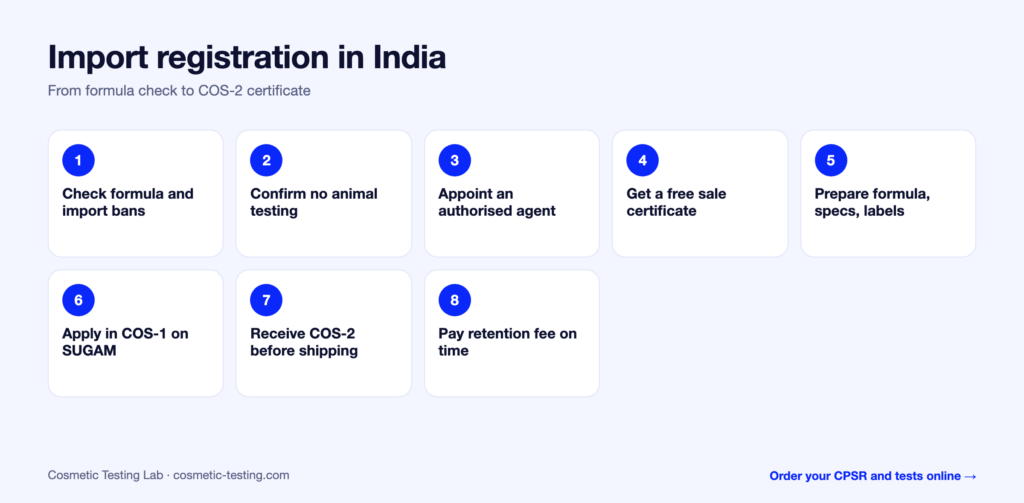
- Check the formula against Indian Standards and the import bans.
- Confirm no animal testing after 12 November 2014.
- Appoint an authorised agent or importer in India.
- Obtain a free sale certificate from the country of origin.
- Prepare the formula, specifications, test methods and labels.
- Apply in Form COS-1 on the SUGAM portal and answer queries.
- Receive the COS-2 certificate before shipping.
- Diary the retention fee and report product changes.
Common mistakes
- Shipping goods before the registration certificate is issued.
- Sending stock with short remaining shelf life.
- Letting a distributor hold the registration without a clear agreement.
- Forgetting the importer’s details and registration number on the label.
How Cosmetic Testing Lab helps
We do not apply to the CDSCO, act as your authorised agent or import products into India. We provide the safety and quality evidence that supports the registration: stability, microbiological, challenge and patch tests, a CPSR signed by a qualified safety assessor and a REACH-compliant 16-section SDS in more than 30 languages. DHL collects samples free from your door, you order online and receive signed PDF reports. Create a free account to unlock 10% off your first order and 20% on bundles.
Frequently asked questions
Can a foreign company apply for registration directly?
The manufacturer can be an applicant, but in practice an authorised agent, importer or subsidiary in India handles the application and holds responsibility locally.
Does India require animal testing?
No. India bans the import of cosmetics tested on animals after 12 November 2014 and bans cosmetic animal testing in India.
Is my EU CPSR enough for India?
Not on its own. It is strong supporting evidence, but India needs its own application, declarations, specifications and labels.
Key takeaways
- Imported cosmetics need a CDSCO registration certificate (COS-2) before shipping.
- Apply in Form COS-1 on SUGAM, usually through an authorised agent.
- Check the import bans, including animal testing and remaining shelf life.
- Labels must carry the importer’s details and registration number.