

The United States is the largest beauty market many brands dream of, and since the Modernization of Cosmetics Regulation Act of 2022 (MoCRA) it has a clearer rulebook. If you want to sell cosmetics in the USA, there is still no pre-market approval for most cosmetics, but there are now filings, records and label details that the FDA expects from you. This step-by-step guide walks an EU or UK brand through the order of work, from checking that your product really is a cosmetic to setting up adverse event reporting.
Contents
- The short answer
- Step 1: Is it a cosmetic, a drug or both?
- Step 2: Decide who the responsible person is
- Step 3: Check ingredients and colour additives
- Step 4: Build your safety substantiation
- Step 5: Register the manufacturing facility
- Step 6: List every product
- Step 7: Adapt the label for the US market
- Step 8: Set up adverse event reporting
- What about GMP, fragrance allergens and small businesses?
- Common mistakes when entering the US
- Frequently asked questions
- Key takeaways
The short answer
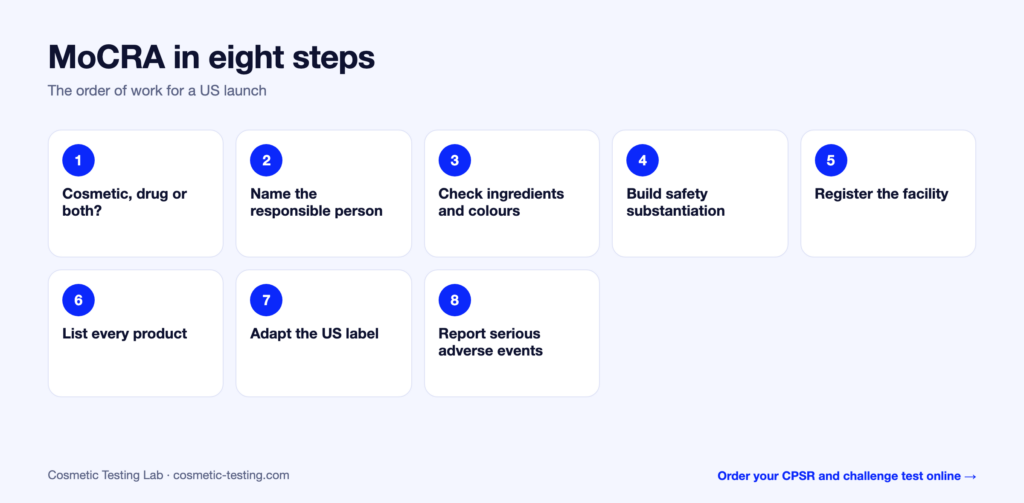
To sell cosmetics in the USA, confirm that the product is a cosmetic and not a drug, name the responsible person on the label, check ingredients and colour additives against US rules, keep records that substantiate safety, register the manufacturing facility and list each product with the FDA, adapt the label to US requirements including a US contact for adverse events, and report serious adverse events within 15 business days. An EU safety file is a strong starting point, but FDA filings and the US label are separate work. This is general information, not legal advice.
Step 1: Is it a cosmetic, a drug or both?
In the US, the intended use decides the category, and the claims you make show the intended use. A moisturiser is a cosmetic. A sunscreen, an antiperspirant, an anti-dandruff shampoo or an acne treatment is an over-the-counter (OTC) drug, or a cosmetic and a drug at the same time, and must meet drug rules as well. Claims such as “treats eczema” or “regrows hair” also turn a cosmetic into a drug. True soap that is mainly alkali salts of fatty acids and makes only cleansing claims is regulated differently again. Sort this out first, because everything that follows depends on it.
Read also Selling Cosmetics in Slovenia: Rules, Authorities and Labels
Step 2: Decide who the responsible person is
Under MoCRA, the responsible person is the manufacturer, packer or distributor whose name appears on the label. This company is accountable for product listing, safety substantiation and adverse event reporting. Unlike the EU, the US does not require this company to be US-based, but the label must give a US contact point for adverse events (see step 7). Many EU brands keep their own name on the label and appoint a US partner or agent for practical tasks.
Step 3: Check ingredients and colour additives
The US has a short list of prohibited and restricted cosmetic ingredients in its regulations, much shorter than the EU Annexes. That does not mean an EU-compliant formula is automatically fine:
- Colour additives must be approved by the FDA for the intended use, and many need batch certification by the FDA. A colourant allowed in the EU may not be approved in the US, or not for use around the eyes.
- Ingredients restricted in the US include, for example, mercury compounds, chloroform and certain propellants. Your formulator should check the current list.
- State laws add their own restrictions. Several states have rules on certain chemicals or on animal-tested cosmetics, so check the states where you will sell.
Step 4: Build your safety substantiation
MoCRA requires the responsible person to make sure, and keep records showing, that there is adequate substantiation of safety for each product. The FDA does not prescribe a fixed format, and animal testing is not required. In practice, a well-built EU file is excellent evidence:
- a signed CPSR with the safety assessment of each ingredient;
- a stability and compatibility test supporting shelf life;
- a challenge test, which we run to ISO 11930 or USP 51, the standard many US partners ask for;
- a microbiological specifications test on the finished product;
- a patch test if you make skin-tolerance claims.
Keep these records organised; the FDA may request access to certain safety records under defined conditions.
Read also Selling Cosmetics in Croatia: Rules, Authorities and Labels
Step 5: Register the manufacturing facility
Facilities that manufacture or process cosmetics for US distribution, including facilities outside the US, must register with the FDA and renew the registration every two years. The FDA uses the FDA Establishment Identifier (FEI) as the registration number, so obtain an FEI first. Registration is filed electronically, for example through the FDA’s Cosmetics Direct portal. A foreign facility gives the details of a US agent. If you use a contract manufacturer, confirm who registers; it is usually the facility owner or operator.
Step 6: List every product
The responsible person lists each marketed cosmetic product with the FDA, including its ingredients, the facility where it is made and the product category. Listings must be updated annually. Plan your product structure so each listing matches what is on the shelf; shade ranges and variants need careful handling.

Step 7: Adapt the label for the US market
A US label follows different rules from an EU label, even if much of the content overlaps:
- Principal display panel: a statement of identity (what the product is) and the net quantity of contents, in both metric and US customary units.
- Ingredient declaration: in descending order of predominance, using the names required in the US, which are close to but not always identical with EU INCI names.
- Name and place of business of the manufacturer, packer or distributor, with a qualifier such as “Distributed by” when needed.
- Warnings where US rules require them, for example for certain aerosol products.
- MoCRA contact: a domestic US address, US phone number or electronic contact, such as a website, through which the responsible person receives adverse event reports.
Claims follow US truth-in-advertising law. Avoid drug-like claims unless the product meets the drug rules.
Read also Selling Cosmetics in China: NMPA Filing and Animal Testing
Step 8: Set up adverse event reporting
The responsible person must report serious adverse events to the FDA within 15 business days of receiving the information, with a copy of the label, and send new medical information received within a year in the same timeframe. Records of all adverse events must be kept, typically for six years, with a shorter period for qualifying small businesses. Assign someone to monitor the contact channel printed on your label.
What about GMP, fragrance allergens and small businesses?
- GMP: MoCRA asks the FDA to set good manufacturing practice regulations, but they have not been finalised. Following ISO 22716 is the sensible benchmark meanwhile.
- Fragrance allergens: MoCRA requires labelling of fragrance allergens, but the FDA rule had not been finalised at the time of writing. Watch for the final rule.
- Small businesses: some small businesses are exempt from registration, listing and GMP, but not for products that contact the eye’s mucous membrane, are injected, are for internal use or change appearance for more than 24 hours.
- Recalls: the FDA can order a mandatory recall if a company refuses a voluntary one and there is a serious risk.
Common mistakes when entering the US
- Shipping an SPF day cream as a cosmetic, although sunscreens are OTC drugs in the US.
- Using an EU-approved colourant that is not approved by the FDA.
- Printing an EU-style label without US units, the US ingredient names or a US contact.
- Assuming the contract manufacturer has registered the facility without checking.
Frequently asked questions
Do cosmetics need FDA approval before sale?
No, apart from colour additives, which must be approved, and products that are also drugs. Registration and listing are filings, not approvals.
Can I use my EU CPSR for the US?
Yes, as safety substantiation it is valuable. The FDA filings, US label and adverse event system are still needed.
Which challenge test standard do US buyers expect?
Many ask for USP 51, others accept ISO 11930. Ask your partner before you order.
Key takeaways
- Check first whether your product is a cosmetic, a drug or both.
- Register facilities every two years and update product listings yearly.
- Adapt the label, including a US contact for adverse event reports.
- Keep safety records: an EU CPSR and lab reports are strong evidence.