
Before you ship anything to the lab, you will ask the practical question: how much sample do you need for a challenge test? Send too little and the lab cannot run the test; send the wrong thing and the result may not describe your real product. This guide explains the challenge test sample size, what to send and how to pack it, so your order starts without delays.
Contents
- The short answer
- Why does a challenge test need so much product?
- What is the typical quantity?
- Send the product in its final packaging
- Use a real, representative batch
- Unopened, clean and correctly stored
- One formula, one sample set
- What about concentrates, powders and anhydrous products?
- Do not forget the other tests
- How to pack and ship the sample
- Common mistakes to avoid
- Checklist before you send
- Frequently asked questions
- Key takeaways
The short answer
Send finished, unopened units from one production batch, in the final retail packaging, and in a total quantity that comfortably covers all test portions. As a rule of thumb, labs need roughly 100–200 g (or ml) per formula, but the exact amount depends on the lab and the test plan, so always follow the quantity shown when you place the order. Never send a single tiny sample or a laboratory-prepared dilution instead of the real product.
Why does a challenge test need so much product?
A challenge test does not look at the product once. The lab deliberately contaminates separate portions of your formula with five reference microorganisms (three bacteria including Gram-negative and Gram-positive species, a yeast and a mould, in line with ISO 11930:2019 and similar methods) and then counts the survivors at set times over 28 days. Each microorganism needs its own portion, and the portions must be big enough to be mixed evenly and sampled repeatedly. A quantity that looks generous on your shelf can be used up quickly once five separate containers are filled.
Read also What Is a Cosmetic Challenge Test? Preservative Efficacy Testing Explained
What is the typical quantity?
There is no single legal figure. The standards describe the method, not the amount you must send. In practice, laboratories ask for enough product to fill five test containers with a reasonable portion each, plus a reserve for a repeat if a result is unclear. For most creams, lotions, gels and serums, that means a few packs or one larger pack that adds up to about 100–200 g or ml. Very viscous products, products with several phases or large-volume items such as shampoos may need slightly more. Treat these numbers as a planning guide and check the quantity requested in the order form.
Send the product in its final packaging
Whenever possible, send complete, sealed units in the packaging that will reach consumers. Packaging influences preservation. A pump, a tube or a jar exposes the product to air in different ways, and some plastics absorb preservatives. If you plan to fill several pack sizes, tell the lab which pack is the worst case, usually the one with the biggest opening or the most air contact. If you only have bulk product, say so clearly on the order, because the report should state what was actually tested.
Use a real, representative batch
The sample must have the final formula, including fragrance, colour and the exact preservative system and dose. A pilot batch is fine, provided it is made with the same ingredients and process as production. Do not send a “base” without fragrance or a formula you still plan to change. The result belongs to that formula only. If you later change a supplier, a preservative level or an ingredient that affects water activity or pH, expect to repeat the test. Make a note of batch number and manufacturing date.
Read also Challenge Test Cost: What Affects the Price
Unopened, clean and correctly stored
Choose units that were never opened, dipped into or used. Opened products already carry unknown microorganisms and can distort the result. Keep the units at room temperature, away from direct sun, heat and frost, until the courier collects them. Do not send products that have separated or look contaminated unless you want to show exactly that problem. If your product needs cooling, mention it when you order.
One formula, one sample set
Every formula variant is a separate test. A product line with three fragrances is three formulas unless the lab agrees that one represents the worst case for the others, and that is a decision to make together with your safety assessor. Do not mix several variants in one parcel without clear labels. Name each sample exactly as it appears in your order, and write the name on the outside of the pack too, so the sample is linked to the right test without any doubt.
What about concentrates, powders and anhydrous products?
Water-based products carry the highest risk and are the main subject of the challenge test. Concentrates that are diluted before use are normally tested in the form consumers will use or in the concentrated form, depending on the question you want answered, so describe the use instructions in the order. Products without free water, such as oils, balms and powders, often have low microbial risk and may not need a challenge test, although they still need a microbiological specifications test. If you are unsure which route applies, ask before you send anything.
Read also My Product Failed the Challenge Test: What to Do Next
Do not forget the other tests
The challenge test is one piece of the safety file. Your safety assessor will also expect data from the microbiological test of the finished product and from the stability test. These use separate portions, so the quantities add up. If you plan several tests for the same formula, add the amounts together and send them in one parcel with a clear list. This also saves courier time. All results are needed for the CPSR.
How to pack and ship the sample
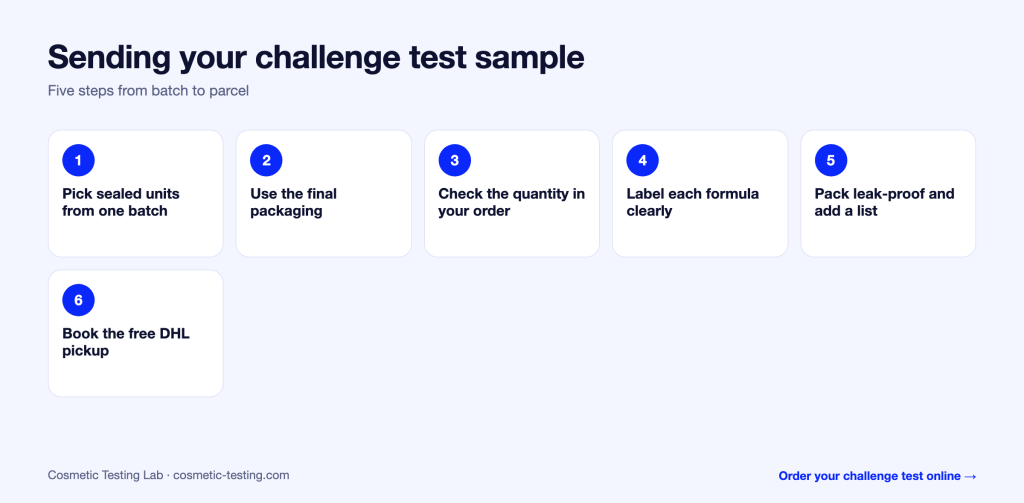
- Close every unit tightly and put it in a leak-proof bag.
- Use padding so glass and pumps cannot break or open in transit.
- Add a sheet with the product name, batch number, test requested and your order number.
- Keep the box small and sturdy, and do not stack heavy items on top of tubes.
- Book the free DHL sample pickup from your door when you order, so the parcel travels quickly and in the right condition.
Common mistakes to avoid
- Sending one tiny sample, so the lab has to ask for more and the schedule stops.
- Sending a sample without the final preservative system or without fragrance.
- Sending products from different batches under the same name.
- Sending used or opened jars.
- Sending decanted product in an unsuitable container, such as a pipette bottle that was never part of the product.
- Forgetting to say which pack size or variant the sample represents.
Checklist before you send
- Confirm the exact quantity shown in your order.
- Choose sealed units from one documented batch.
- Use final packaging where possible.
- Label each unit and list them on a sheet.
- Pack safely and book the pickup.
Frequently asked questions
Can I send a tester or a mini size?
Only if that is the real packaging, and only if the total quantity still covers the test. A mini size is fine when the product will be sold in that size. Otherwise the test result may not describe your main pack.
Do I need to send the sample in several packs?
Not necessarily. One large unit can be enough, but several smaller sealed units are often easier because the lab can open a new one for each portion. Ask when you order if you are unsure.
Is the sample returned?
Do not count on it. Remaining product is normally kept for a limited time and then disposed of, so keep reserve units from the same batch yourself.
Key takeaways
- Send unopened, finished units from one batch, in the final packaging.
- Plan roughly 100–200 g or ml per formula, and follow the quantity shown in your order.
- Each formula variant is a separate test, so label samples clearly.
- Add the quantities for other tests if you order several in one parcel.