
“Clinically proven to reduce wrinkles by 40%.” Claims like this sell products, and they are also among the first things authorities, competitors and consumer groups examine. A clinically proven claim for cosmetics is only acceptable when real human data stand behind the exact words on your pack. This guide explains what evidence is expected in the EU, how to choose the right wording and which tests help you build a file that holds up.
Contents
- The short answer
- What the law says about cosmetic claims
- What does “clinically proven” imply to the consumer?
- What makes the evidence acceptable?
- Match the wording to the data
- Instrumental, clinical and consumer studies
- Where a patch test fits in
- Safety first: claims do not replace the CPSR
- Common mistakes
- A practical workflow for building claim evidence
- Frequently asked questions
- Key takeaways
The short answer
“Clinically proven” means a documented study on human volunteers, run with a sound method on the finished product or a representative formula, showing a result that matches the claim. If your study cannot show that, use softer wording that you can support, such as “consumer perception” or “instrumentally measured” with the study details in your product file.
What the law says about cosmetic claims
Article 20 of Regulation (EC) No 1223/2009 prohibits texts, names, trademarks, pictures and other signs that imply characteristics or functions the product does not have. Regulation (EU) No 655/2013 then lists six common criteria that every claim must meet:
- Legal compliance: the claim does not suggest the product is something it is not, for example a medicine.
- Truthfulness: the claim is true for the product as sold.
- Evidential support: the claim is backed by adequate and verifiable evidence.
- Honesty: the claim does not exaggerate the benefit.
- Fairness: the claim does not denigrate competitors or ingredients unfairly.
- Informed decision-making: the claim helps the consumer make a decision on a clear basis.
The general rules on unfair commercial practices also apply, so a misleading claim can be challenged even if the product itself is perfectly safe.
Read also Vegan and Cruelty-Free Claims: What You Can Say
What does “clinically proven” imply to the consumer?
Consumers read “clinically proven” and “clinically tested” as proof from a clinical study with real people, often under professional supervision. They do not read it as “a lab test of one ingredient” or “a survey of friends”. Because the wording signals strong evidence, the bar is high, and authorities look at the study behind it.
The same applies to “dermatologically tested”. It suggests that a skin specialist was involved and that the product was assessed on skin, and it should not be used as a promise that the product is suitable for everyone or free of reactions.
What makes the evidence acceptable?
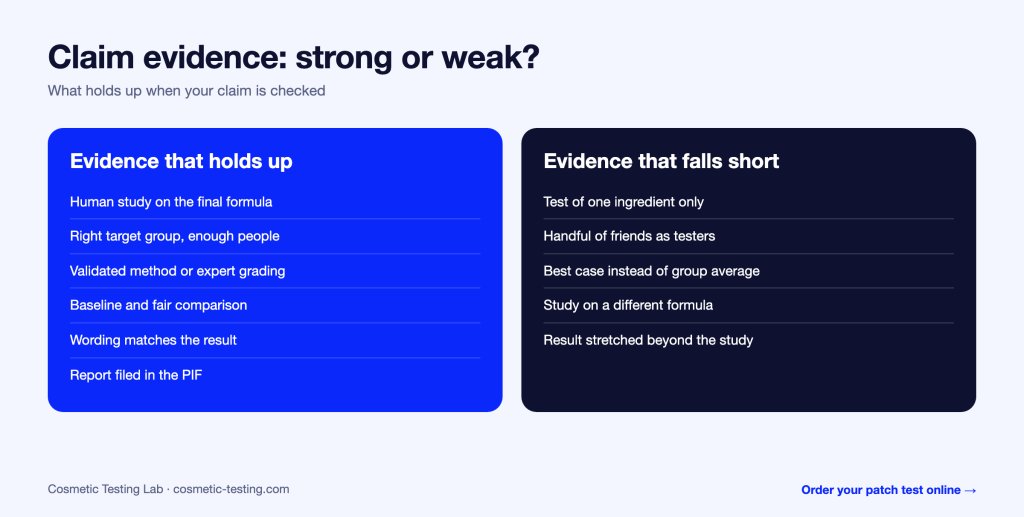
Your safety assessor and any inspecting authority will look at the study, not just the headline figure. A study that supports a claim usually shows the following:
- The right product. The tested formula is the one on sale, or a justified equivalent.
- The right people. Volunteers match the target group in age, skin type and condition, and the group is large enough to support the result.
- A suitable method. The endpoint is measured with a validated instrument or a standardised grading scale, ideally by someone independent of the brand.
- A fair comparison. There is a baseline, and where the claim compares, a control, a placebo or an untreated area.
- Realistic use. Dose, frequency and duration in the study correspond to the usage directions on the pack.
- Honest statistics. Results are analysed with an appropriate method, and the figure you print can be traced back to the report.
Match the wording to the data
The most common failure is a gap between what was measured and what the pack says. Consider these examples:
- A 4-week study showing smoother skin cannot support “permanently removes wrinkles”.
- A questionnaire in which 87% of 30 users “agree” supports “87% of users said their skin felt smoother”, not “clinically proven smoother skin”.
- Data on an ingredient in a test tube do not show that your finished cream does the same.
- A result after 8 weeks cannot be advertised as “visible in 7 days”.
When a percentage is printed, add the context in a footnote, such as the number of participants, the duration and the type of study. This is good practice and helps the claim meet the honesty criterion.
Read also Non-Comedogenic Claim: What Testing and Proof You Need
Instrumental, clinical and consumer studies
Efficacy claims are usually supported by one of three study types, and the wording should name the right one.
- Instrumental measurement (for example skin hydration or elasticity measured with a device): objective, good for “instrumentally proven” or “skin hydration increased by X% after Y hours”.
- Clinical evaluation by an expert (a dermatologist grades redness, dryness or wrinkle depth): supports “clinically proven” or “dermatologist assessed”.
- Consumer perception study (users answer a questionnaire): supports claims that begin with “X% of users felt…”, not objective ones.
Mixing the three is fine, as long as each claim points to the right dataset.
Where a patch test fits in
A patch test is a safety and tolerance study, not an efficacy study. A single 48-hour occlusive patch test on volunteers shows whether the finished product irritates or sensitises skin under controlled conditions. It supports statements such as “dermatologically tested” or “tested for skin tolerance”, and it is a valuable part of the safety evidence in the CPSR. It does not prove that the product smooths wrinkles or hydrates skin.
Claims such as “hypoallergenic” or “suitable for sensitive skin” need extra care. They suggest a lower risk of reaction, so combine a well-founded formula with relevant tolerance data and keep wording modest. Never say “allergy-free”.

Safety first: claims do not replace the CPSR
A claim study does not replace the safety assessment. Before you test anything on volunteers, the product must already be safe for use, which means a completed CPSR or at least a safety assessment that allows human testing. The claim evidence then goes into the product information file (PIF), together with the stability, microbiological and challenge test data. A stability test also matters for claims: if the active degrades before the end of shelf life, the efficacy shown at day one may no longer be true.
Read also Ophthalmologically Tested: Claim Requirements Explained
Common mistakes
- Using “clinically proven” for an ingredient-level study.
- Printing the best result of the best participant instead of the group average.
- Changing the formula after the study and keeping the claim.
- Quoting a supplier’s study on a raw material as proof for the finished product.
- Omitting footnotes where the context changes how the claim is read.
- Translating a claim into new markets without checking national expectations on evidence.
A practical workflow for building claim evidence
- List every claim on the pack, website and marketing material.
- Decide which are objective, which are perception-based and which are simply descriptive.
- Choose the study type that fits each objective claim and agree the protocol before the study starts.
- Run the study on the final formula, in final packaging if relevant.
- File the report, protocol and raw data summary in the PIF.
- Re-check the claim whenever the formula, dosage or target group changes.
Frequently asked questions
What is the difference between “clinically tested” and “clinically proven”?
“Clinically tested” says a study took place; “clinically proven” says the study demonstrated the result. The second therefore needs stronger evidence, including a significant outcome that matches the claim.
Can I use a study on a similar formula?
Possibly, if the formulas are very close and the differences are justified by a qualified person. Document the reasoning. A study on a distinctly different formula is not valid evidence.
Do I need a patch test to say “dermatologically tested”?
You need documented evidence that the product was evaluated on skin under dermatological supervision. A patch test is a common way to provide it, but keep the wording modest and avoid implying suitability for all skin.
Key takeaways
- “Clinically proven” needs a human study on the right product with a result that matches the exact claim.
- Regulation 655/2013 asks for evidential support, honesty and truthfulness in every claim.
- A patch test shows tolerance, not efficacy, and the CPSR must come first.
- Keep every protocol and report in the PIF and re-check the claim after each formula change.