

“Vegan” and “cruelty-free” are two of the strongest purchase triggers in beauty, and two of the claims most often used loosely. Shoppers assume they are regulated, regulators assume you can prove them, and the two words do not even mean the same thing. This guide explains what you can say in a vegan cruelty free cosmetics claim, what evidence to keep and how to avoid wording that gets a product into trouble.
Contents
- The short answer
- Vegan and cruelty-free are not the same
- What does EU law say about animal testing?
- Which ingredients make a product non-vegan?
- The supply chain check, step by step
- How to word the claim
- Certification schemes and logos
- Selling in markets outside the EU
- Reformulating to be vegan: test again
- Common mistakes
- Frequently asked questions
- Key takeaways
The short answer
Neither “vegan” nor “cruelty-free” has a legal definition for cosmetics in the EU, so both are judged as claims under the Cosmetics Regulation and the common criteria: they must be truthful, supported by evidence and not misleading. “Vegan” is usually understood as no animal-derived ingredients, and often no animal testing. “Cruelty-free” is about animal testing. Define exactly what you mean, check your whole supply chain and keep documents for each ingredient. Certification by a recognised scheme can help, but it is optional.
Vegan and cruelty-free are not the same
This is the first trap. A vegan product contains no ingredients of animal origin, but a vegan formula can still include an ingredient that was tested on animals somewhere in its history. A cruelty-free product has not been tested on animals, but it can contain beeswax, lanolin or carmine. Many consumers expect “vegan” to cover both. Certification schemes, such as the Vegan Society trademark, address this by combining criteria for ingredients and for animal testing. If you use only one word, make sure your wording does not suggest the other.
Read also “Free From” Claims: Legal Risks and Best Practice
What does EU law say about animal testing?
Regulation (EC) No 1223/2009 contains the ban that sits behind every cosmetic sold in the EU. In plain terms, it prohibits testing finished cosmetic products and their ingredients on animals within the EU, and it prohibits placing on the EU market products whose final formulation or ingredients were tested on animals in order to meet the requirements of the regulation. These bans have been fully in force since 2013. Because they apply to all cosmetics, an EU brand does not become special by obeying them.
That is why a statement such as “not tested on animals” needs care. If it implies an advantage over competitors that follow the same law, it can mislead. Regulators generally expect you to be able to show that no animal testing was carried out or commissioned by you or by your suppliers for the finished product and for its ingredients. Ingredients may also be tested on animals under other laws, such as chemicals legislation, and how that affects your claim is a question that certification schemes and authorities may treat differently. Do not assume the answer.
Which ingredients make a product non-vegan?
Animal-derived ingredients appear in places that are easy to miss. Typical examples include:
- beeswax, honey, propolis and royal jelly
- lanolin from sheep’s wool
- carmine (a red colour from insects) and guanine (a pearly shimmer from fish scales)
- collagen, elastin, keratin and silk proteins
- milk proteins, shellac, squalane from shark liver and animal-derived glycerin or stearic acid, such as those made from tallow
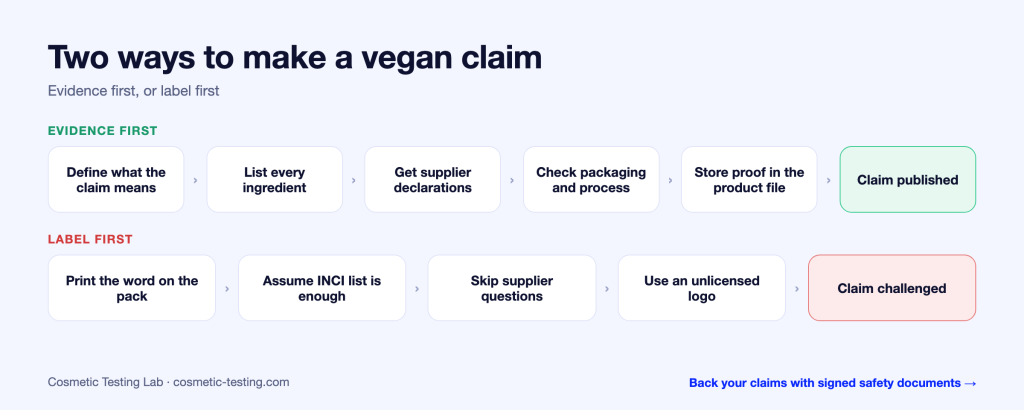
Some of these appear under their own INCI names, but others hide in derivatives, so the INCI list alone is not enough proof. A supplier declaration should state the origin of each ingredient: plant, mineral, synthetic, microbial or animal.
The supply chain check, step by step
- List every ingredient and every component of a complex raw material, including carriers, solvents, stabilisers and processing aids.
- Ask each supplier for a written declaration on origin, covering animal-derived content and animal testing.
- Check the unclear ones. Glycerin, stearates, fatty acids, colours, pearlescent pigments and vitamins can come from animal or plant sources.
- Review manufacturing. Ask whether shared equipment could introduce traces of animal-derived material, and decide what your claim promises about that.
- Review packaging and extras. Capsules, gelatin, brush bristles in kits and some adhesives can be of animal origin.
- Store the evidence in the product information file and review it whenever you change a supplier or a formula.
Read also Clinically Proven Claims for Cosmetics: What Evidence Is Needed
How to word the claim
Choose wording that matches what you can prove:
- “Vegan: contains no animal-derived ingredients” is clear and checkable.
- “Cruelty-free” works best when you explain it, for instance “no animal testing by us or our suppliers on this product or its ingredients”, and when you can document it.
- “Not tested on animals” alone is a weaker choice, for the reasons given above.
State in your own records what each word covers: ingredients only, or also testing, and whether manufacturing contamination is addressed. Avoid adding “100%” or “guaranteed” unless you can show a strict control system.
Certification schemes and logos
Several organisations offer certification. The Vegan Society runs a vegan trademark. The Leaping Bunny programme, run by Cruelty Free International, requires companies to commit to eliminating animal testing at every stage of product development, to recertify every year and to remain open to independent audits. Each scheme has its own rules and fees, and its logo may only be used under licence. A logo is not a legal requirement, but retailers often ask for one. Using a certification logo you do not hold, or a lookalike symbol, is a serious misleading-claim risk.
Selling in markets outside the EU
If you export, check each market before you claim cruelty-free. Some countries have required animal testing for certain imported cosmetics, and although rules have been changing, the details depend on the product category and the route to market. A cruelty-free claim that is true in the EU may become false if you start selling somewhere that requires testing. Rules on what can be said also differ, so review the claims for every country.
Read also Non-Comedogenic Claim: What Testing and Proof You Need
Reformulating to be vegan: test again
Replacing beeswax, lanolin or milk proteins changes a formula. Plant waxes behave differently in emulsions, and a new emulsifier or film former can shift viscosity, colour and the preservative system. Treat a vegan reformulation as a new version of the product: run a stability test to check texture and packaging compatibility, a challenge test for water-based products and a microbiological test on the finished product. Update the CPSR so that the safety assessor sees the final formula. A patch test can be useful when the new ingredients are plant extracts that might irritate sensitive skin.
Common mistakes
- Using “vegan” and “cruelty-free” as if they were the same claim.
- Relying on the INCI list and never asking suppliers about origin.
- Forgetting colours, fragrance compounds and capsules.
- Printing a certification logo before certification is granted.
- Claiming cruelty-free for all markets while selling where testing may be required.
- Changing a supplier without repeating the origin check.
Frequently asked questions
Can I call a product vegan without certification?
Yes, there is no legal obligation to certify. The claim must still be true and supported, so keep supplier declarations for every ingredient and be clear about what “vegan” means for your product.
Is cruelty-free the same as not tested on animals?
Not exactly. Cruelty-free is a broader promise, usually covering the finished product, ingredients and suppliers. Because EU law already bans animal testing for cosmetics, explain what your claim adds rather than repeating a legal minimum.
Does a vegan claim mean the product is natural or safer?
No. Vegan describes origin only. A vegan product can contain synthetic ingredients and still needs a full safety assessment, testing and notification like every other cosmetic.
Key takeaways
- “Vegan” and “cruelty-free” are different promises with no legal EU definition, so define yours and prove it.
- Collect written origin and animal-testing declarations from every supplier, including colours and processing aids.
- Use certified logos only under licence, and check each export market before claiming cruelty-free.
- Retest stability and preservation after a vegan reformulation and update the CPSR.