

Brands ask us the same questions again and again, so we collected the most common ones in one place. This cosmetic testing FAQ answers 25 questions in plain language, from which tests you need to how samples, timing and reports work. Jump to the group that fits your situation, or read straight through if you are preparing a first launch.
Contents
The short answer
In the EU and the UK, a cosmetic product needs a safety assessment by a qualified person before it is sold, and that assessment relies on test data such as microbiological quality, preservation efficacy and stability, and sometimes human skin tolerance. Which tests you need depends on the formula, the type of product and the claims you make. The answers below explain the most common cases.
Which tests do I need?
1. Which tests does a cosmetic product need?
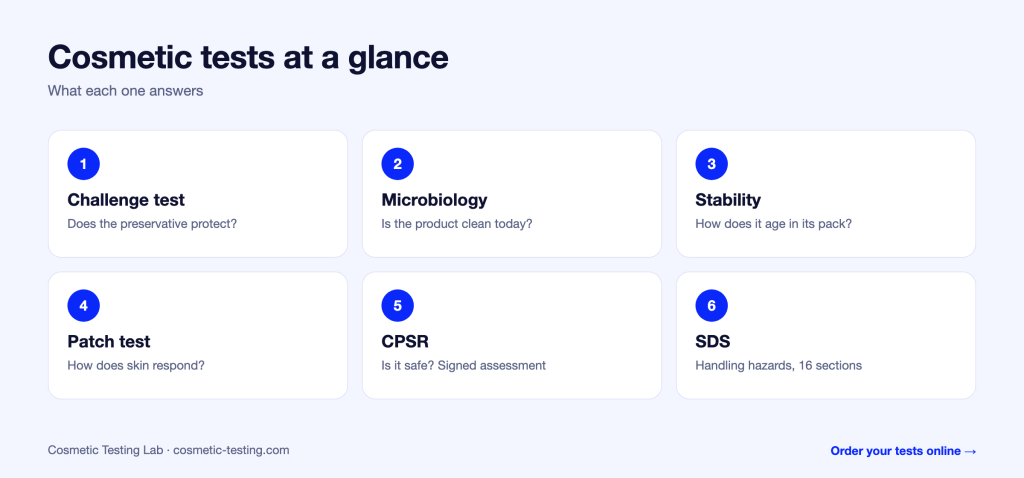
That depends on the product. Most need microbiological quality data, stability and compatibility data and, for water-based products, a challenge test. A patch test is added when skin tolerance evidence is useful. The safety assessor tells you which data the file needs, and it is far cheaper to ask before you start than to repeat a test later because one was missing.
2. What is a challenge test?
It tests whether the preservative system protects the product. The sample is deliberately contaminated with five reference microorganisms and checked over 28 days, following ISO 11930:2019 or USP 51. Our challenge test comes as a signed PDF report.
3. What does a microbiological specifications test show?
It shows the microbial quality of the finished product today, for example counts of bacteria, yeast and mould, and the absence of specified organisms. Results arrive about 5 days after we receive your samples.
4. What is a stability and compatibility test?
It predicts how the product changes over time and whether it works with its packaging. Accelerated plans (Basic, Standard, Full) support shelf life and period after opening. See the stability test.
5. What is a patch test?
A single 48-hour occlusive patch applied to volunteers, followed by skin assessment. The whole process takes about two weeks. Details are on the patch test page.
6. Do I need every test for every product?
No. A dry powder has different risks from a cream, and an anhydrous balm may not need a challenge test. The assessor decides based on the formula, so share it early. Tell us the product type, the water content, the pack and the intended use, and you will get a clear list of what applies.
Read also CPSR FAQ: 20 Questions Brands Ask Before Ordering a Report
The safety report and the safety data sheet
7. What is a CPSR?
The cosmetic product safety report is the signed safety assessment required before a product is placed on the EU or UK market. It has Part A (safety information) and Part B (the assessment). Read more on CPSR.
8. Who signs the CPSR?
A qualified safety assessor with the education the regulation requires. Our reports are signed by such an assessor.
9. How is the CPSR tiered?
By formula complexity: Simple up to 10 ingredients, Standard 11 to 25, and Complex for 26 or more or any fragrance. More ingredients mean more to assess, and a fragrance adds allergen and exposure questions. The tier is shown when you order.
10. What data does the CPSR need from me?
The full formula, specifications, intended use, packaging details and test reports for stability, microbiology and, where relevant, challenge testing. Missing data delays the report, so it helps to collect everything before you place the order. A complete ingredient list with percentages is the most important single item.
11. Is a safety data sheet the same as a CPSR?
No. A safety data sheet is a 16-section REACH document about hazards in handling and transport, available in 30+ languages. A CPSR assesses safety for the consumer. They answer different questions.

Samples and ordering
12. How much product should I send?
The amount depends on the tests and is shown when you order. Add a spare unit so a repeat does not need a second shipment.
13. Should samples be in final packaging?
Yes, whenever possible. Packaging affects stability and microbiology, so test what the consumer will receive, sealed and labelled with name, batch and date. A sample poured into a plain jar can hide problems such as discolouration or a reacting lid liner.
14. How do I send samples?
Order online, pack the units carefully and we collect them from your door by DHL, free of charge.
15. Can I test several variants at once?
Yes, but each variant is usually a separate sample. Very close variants may be grouped if the assessor agrees, so ask before ordering.
16. Do you give legal advice?
No. We provide tests and signed reports; interpreting the law for your business is outside our service.
Timing and reports
17. How long does each test take?
Microbiological testing takes about 5 days after samples arrive, a patch test about two weeks, a challenge test 28 days, and a CPSR about 10 business days after complete data. Stability depends on the plan you choose and runs from weeks to months. These times begin when we receive your samples, so careful packing and quick pickup keep the project moving.
18. Can a test be rushed?
Not where the method sets the duration. Challenge and stability tests need their time. You save most by ordering tests together and sending complete samples and data.
19. What does the report look like?
A signed PDF naming the sample, method, conditions, results and conclusion. It is written to be used in your CPSR and product information file.
20. What if a test fails?
Treat it as information. Usually the formula, preservative system or packaging needs adjusting, then the test is repeated. A failed result should never be ignored or filed away quietly; the CPSR cannot rely on data that shows a product is not protected. Our guide on failed challenge tests explains the usual fixes.
21. How long must I keep the reports?
The product information file, which includes test reports, is kept for ten years after the last batch is placed on the market.
Read also Advantages of testing cosmetics with us
Regulation and launch
22. Is a small or handmade brand exempt?
No. The EU and UK rules apply by product, not by company size. Small producers need the same safety assessment before selling.
23. Do tests make my claims valid?
Not automatically. Safety tests do not prove an efficacy claim. Claims need their own evidence and must meet the common criteria of the Claims Regulation (EU) 655/2013: legal compliance, truthfulness, evidential support, honesty, fairness and informed decision-making.
24. If I change the formula, must I retest?
Often yes. Results apply to the tested formula and packaging, so changes to ingredients, levels or the pack may require repeating some tests and updating the CPSR. Even a change of supplier for a key raw material is worth mentioning to the assessor before you launch the new version.
25. Where do I start?
Fix the formula, choose the final packaging, then order microbiological, challenge and stability tests together and ask for the CPSR once data is complete. Our guide on how to sell cosmetics in the EU covers the steps after that.
Key takeaways
- The tests you need depend on formula, product type and claims, and the safety assessor decides what the file requires.
- Order tests together, send sealed final-pack samples with full formula data, and fix the formula first.
- Timing differs: about 5 days, two weeks, 28 days or about 10 business days, with stability by plan.
- Keep signed reports in your product information file for ten years after the last batch.