

Many founders ask whether a cosmetic can really be proven safe without testing it on animals. In the EU and the UK, the question is settled by law. Cosmetic testing without animals is not a choice but a legal requirement: safety is shown with existing ingredient data, validated in vitro and computer-based methods (mostly at ingredient level), laboratory tests on the finished product and, as a final confirmation, controlled tests on human volunteers such as a patch test. This article explains how these pieces fit together and which of them a brand actually orders.
Contents
- The short answer
- What the EU ban on animal testing covers
- How safety is proven without animals
- Which in vitro methods are used?
- Does a brand need to order in vitro tests?
- Finished-product tests that never involve animals
- Where human testing fits
- The REACH caveat
- A word on “cruelty-free” claims
- Common misconceptions
- Frequently asked questions
- Key takeaways
The short answer
Your safety assessor builds the safety case from ingredient data that already exists, supported where needed by non-animal methods such as reconstructed human skin models. On top of that, you test the finished product in the lab for stability, microbiological quality and preservation, and you can add a human patch test to confirm skin tolerance. None of these steps involves animals, and together they give the assessor what is needed to sign the CPSR.
What the EU ban on animal testing covers
Regulation (EC) No 1223/2009 contains two kinds of ban:
- Testing ban. Testing finished cosmetic products on animals has been prohibited in the EU since 11 September 2004, and testing cosmetic ingredients or combinations of ingredients since 11 March 2009.
- Marketing ban. Since 11 March 2009 it has been forbidden to sell cosmetics in the EU if the product or its ingredients were tested on animals to meet the Regulation’s requirements. For repeated-dose toxicity, reproductive toxicity and toxicokinetics, the marketing ban followed on 11 March 2013, regardless of whether alternative methods existed.
The marketing ban applies wherever in the world the animal test was carried out, which is why it matters to brands that import products or ingredients. The UK kept equivalent rules after leaving the EU.
Read also Advantages of testing cosmetics with us
How safety is proven without animals
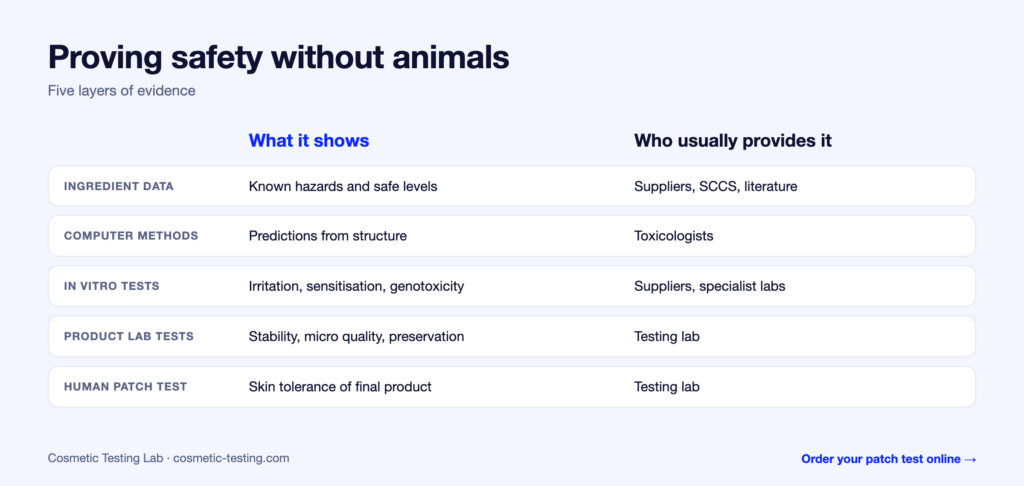
A safety assessment is not one test. It is a structured argument, and the evidence comes in layers:
- Existing ingredient data. Opinions of the Scientific Committee on Consumer Safety (SCCS), the restrictions in the annexes of the Regulation, supplier dossiers and published literature. For most common ingredients, this is where the toxicological profile comes from.
- Computer-based methods. Structure-based predictions and read-across from similar, well-studied substances help fill gaps.
- In vitro and in chemico methods. Validated tests on cells, tissues or proteins that replace animal studies for specific questions.
- Finished-product lab tests. Stability, microbiological quality and preservation of your actual product.
- Human confirmation. Ethically controlled tests on volunteers, such as a patch test, once the assessment already indicates that the product is safe.
Which in vitro methods are used?
Several non-animal methods are adopted as OECD Test Guidelines and are widely accepted by regulators. Typical examples include:
- Skin irritation and corrosion with reconstructed human epidermis models (OECD TG 439 and TG 431).
- Eye irritation with reconstructed human cornea-like epithelium (TG 492) or the bovine corneal opacity test using slaughterhouse material (TG 437).
- Skin sensitisation with methods such as DPRA (TG 442C), KeratinoSens (TG 442D) and h-CLAT (TG 442E), which can be combined in the defined approaches of OECD Guideline 497.
- Phototoxicity with the 3T3 neutral red uptake test (TG 432).
- Genotoxicity with in vitro tests such as the bacterial reverse mutation (Ames) test (TG 471) and the in vitro micronucleus test (TG 487).
Some areas, especially long-term systemic toxicity, still have no full non-animal replacement. Assessors then rely on existing data, exposure calculations and conservative safety margins.
Does a brand need to order in vitro tests?
Usually not. In vitro toxicology is mostly done at ingredient level by raw material suppliers and specialist laboratories, and the results reach your file through supplier documentation. A brand typically needs them only when it uses a novel ingredient with little data, and in that case a toxicologist should design the strategy. Cosmetic Testing Lab does not perform in vitro toxicology tests; we focus on the tests your finished product needs.
Read also Cosmetic testing process in Cosmetic Testing Lab (from start to finish)
Finished-product tests that never involve animals
Most of what a brand orders is lab work on the product itself:
- A stability and compatibility test shows how the product behaves over time and in its packaging.
- A microbiological test checks that a batch is clean.
- A challenge test shows that the preservative system protects the product during use.
These tests feed directly into Part A of the CPSR, together with the ingredient data.
Where human testing fits
Tests on human volunteers are not a way to discover hazards. Under the SCCS guidance and accepted ethical principles, they are only appropriate as confirmation, once the ingredients and the formula have been assessed and the product is expected to be well tolerated. Volunteers give informed consent and are selected and monitored by qualified staff.
The most common example is the patch test: the finished product is applied under an occlusive patch for 48 hours, and the skin is then graded for any irritation. Our patch test takes about two weeks in total and ends with a signed PDF report that your safety assessor can use in the CPSR. It shows that the product is tolerated on human skin under exaggerated conditions; it does not prove efficacy, and it does not replace the safety assessment.
The REACH caveat
The cosmetics ban is not the only law that applies to chemicals. Under the REACH regulation, substances may still need data for worker and environmental safety, and in some cases authorities have required animal studies for substances also used in cosmetics. In 2023 the EU General Court confirmed in the Symrise cases that REACH requirements can apply even to ingredients used only in cosmetics. Brands rarely control this directly, but it is worth asking suppliers how their ingredient data was generated.
Read also Outsource Cosmetic Testing or Test In-House? A Practical Guide
A word on “cruelty-free” claims
Because animal testing for cosmetics is banned across the EU, every compliant product meets that legal minimum. Under the common criteria of Regulation (EU) No 655/2013, a claim should not suggest a special advantage when the product only complies with the law, so claims such as “not tested on animals” need careful wording. Private certification schemes have their own rules, which may also cover suppliers.
Common misconceptions
- “Non-animal testing is less thorough.” Modern safety assessment combines many sources of evidence and conservative safety margins.
- “A patch test proves my product is safe.” It confirms tolerance; the assessor’s evaluation remains the basis.
- “I need to commission toxicology tests for every ingredient.” For common ingredients, existing data is normally enough.
- “Animal testing is fine if it happens outside the EU.” The marketing ban applies wherever the test took place.
Frequently asked questions
Is animal testing for cosmetics banned in the UK too?
Yes. The UK kept equivalent testing and marketing bans in its own cosmetics regulation after leaving the EU.
Can a patch test be used instead of an in vitro irritation test?
They answer different questions. In vitro methods characterise ingredient hazards; a patch test confirms tolerance of the finished product once it is already expected to be safe.
Do I need to prove my ingredients were not tested on animals?
Your file should rely on lawful data. Ask suppliers for statements on how their data was generated, especially for newer ingredients.
Key takeaways
- In the EU and UK, cosmetic testing without animals is the law, not an option.
- Safety comes from ingredient data, non-animal methods and finished-product tests.
- Human tests such as a patch test only confirm what the assessment predicts.
- Most brands order stability, microbiological, challenge and patch tests, not in vitro toxicology.