

The skin around the eyes is thinner, more reactive and sits right next to a mucous membrane, so an eye cream is judged more strictly than an ordinary face cream. If you are planning eye cream testing, the core EU file stays the same – a signed safety report backed by lab data – but several points tighten: microbiological limits, preservation, ingredient restrictions, packaging and claims. This guide explains what changes for eye creams, eye gels, eye serums and eye balms, and which tests make sense before launch.
Contents
- The short answer
- Why does the eye area get extra attention?
- Is an eye cream a cosmetic at all?
- Stricter microbiological limits
- Preservation: why the challenge test matters even more
- Ingredients restricted near the eyes
- Stability and packaging
- Eye irritation: what can and cannot be tested
- Claims on eye products need evidence
- Checklist before you launch an eye cream
- Common mistakes with eye creams
- Frequently asked questions
- Key takeaways
The short answer
An eye cream needs the same EU basics as any cosmetic – a responsible person, a CPSR, a product information file and a CPNP notification – but the safety assessor treats it as a product for a sensitive area. Expect stricter microbiological limits (commonly at most 100 CFU per gram), a challenge test for water-based formulas, stability and packaging data, a careful check of ingredients restricted near the eyes, and evidence for every “gentle” or “ophthalmologist tested” claim. A skin patch test is a useful extra for skin tolerance, but it does not test the eye itself.
Why does the eye area get extra attention?
The EU Cosmetics Regulation asks the safety assessor to consider where a product is applied and who uses it. The Commission guidelines on the safety report (Implementing Decision 2013/674/EU) single out products used around the eyes, on mucous membranes and on children under three as cases that call for particular care. There are three practical reasons:
- Thin, sensitive skin. Eyelid skin is among the thinnest on the body, so irritation shows up faster and is more visible.
- Migration into the eye. Creams warm up and spread. Some product can reach the eye during the day or overnight, especially rich, oily textures.
- Infection risk. Microorganisms that reach the eye can cause real harm, which is why contamination limits are lower.
Read also Baby Cosmetics Safety Testing: What the File Must Show
Is an eye cream a cosmetic at all?
Usually yes. An eye cream applied to the skin around the eye to moisturise, smooth or reduce the look of puffiness is a cosmetic. A product placed into the eye, such as eye drops, or one that claims to treat a disease like conjunctivitis, is not; it may fall under the rules for medicines or medical devices. Keep your wording on the cosmetic side: “reduces the appearance of dark circles” is a cosmetic claim, “treats eyelid inflammation” is not.
Stricter microbiological limits
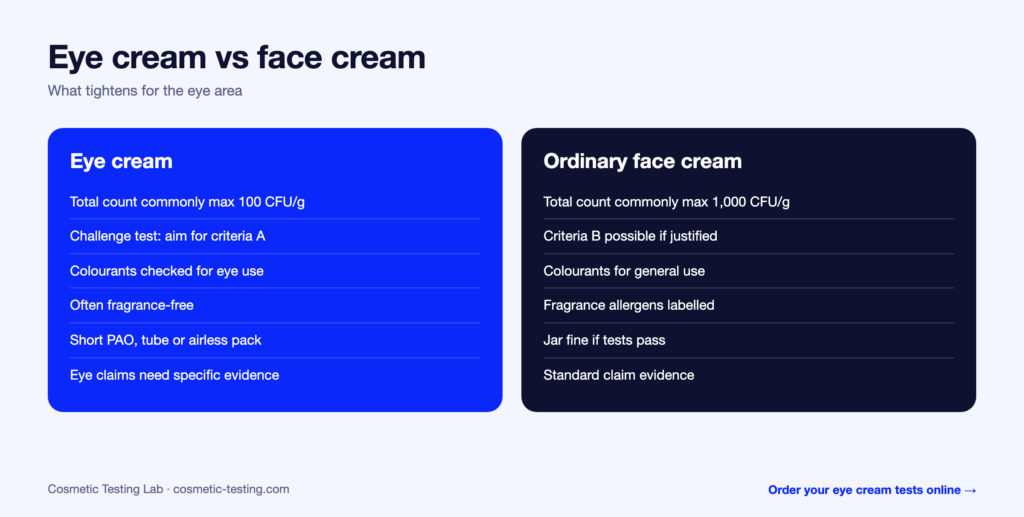
EU practice, based on the SCCS Notes of Guidance and ISO 17516, puts products for the eye area in the strictest category, together with products for children under three and for mucous membranes. For this category the total count of aerobic mesophilic microorganisms is commonly limited to 100 CFU per gram or millilitre, compared with 1,000 CFU for other cosmetics. Specified microorganisms such as Pseudomonas aeruginosa, Staphylococcus aureus and Candida albicans must not be detected. Some countries write these limits into national law; Slovenia, for example, refers to ISO 17516 in its implementing decree.
A microbiological specifications test on the finished product shows whether a batch meets these limits today. Test a batch that represents what you will sell, ideally filled into the final packaging.
Preservation: why the challenge test matters even more
Most eye creams and eye gels contain water, and many are touched with a fingertip twice a day for months. A challenge test under ISO 11930 shows whether the preservative system copes with that contamination over 28 days. For an eye product, aim for criteria A. Assessors are reluctant to accept the weaker criteria B for a sensitive-area product without a strong justification, such as packaging that protects the formula.
The balance is delicate. Some preservatives and fragrance components can sting the eyes, so formulators often reduce them in eye products. A lower dose is fine only if the challenge test still passes.
Read also Lip Balm Safety Testing: What Lip Products Need Before Sale
Ingredients restricted near the eyes
Check every ingredient against the Annexes of Regulation (EC) No 1223/2009 with the eye area in mind:
- Colourants (Annex IV): some colourants are not allowed in products applied in the vicinity of the eyes. Tinted eye creams and concealer-style products need a careful check.
- Restricted substances (Annex III): some entries carry conditions of use or warnings about the eyes, for example “avoid contact with eyes”.
- Fragrance and essential oils: many eye products are fragrance-free for good reason. If you do use fragrance, allergens above the labelling thresholds must be named on the label.
- Actives: retinoids, exfoliating acids and high levels of some botanical extracts are more likely to sting near the eye. The assessor looks closely at concentration and exposure.
Stability and packaging
Eye products often come in small tubes, airless pumps, jars, or pens with metal or ceramic applicator tips. A stability and compatibility test checks that colour, odour, texture, pH and viscosity stay within specification and that the formula does not react with the packaging. Applicator tips deserve attention: metal can interact with some formulas, and a tip that touches the skin repeatedly is an extra contamination route. Tubes and airless packs reduce contamination compared with open jars, and your assessor will weigh this together with the challenge test result.
The results support the shelf life and the period-after-opening (PAO) symbol on your label. A relatively short PAO is common for eye products.

Eye irritation: what can and cannot be tested
The EU bans animal testing for finished cosmetics and their ingredients, so eye irritation is assessed differently today. Ingredient suppliers rely on validated non-animal methods, such as the OECD test guidelines using reconstructed human cornea-like tissue, and the safety assessor builds on that ingredient data, the concentrations used and experience with similar products. Some brands also commission in-use studies supervised by an ophthalmologist to support specific claims; that is a specialised clinical service which we do not offer.
What a patch test adds is evidence of skin tolerance. A single 48-hour occlusive patch on volunteers shows whether the formula irritates normal skin. It does not replace the safety assessment for the eye, but assessors and retailers value it as part of the file, and it can support wording such as “dermatologically tested” when the claim honestly describes the study.
Read also Deodorant Testing Requirements: What Deodorants and Antiperspirants Need
Claims on eye products need evidence
Under Regulation (EU) No 655/2013, every claim must be truthful and supported by evidence. Typical eye-cream claims and what they usually need:
- “Dermatologically tested”: a skin study such as a patch test, described accurately.
- “Ophthalmologist tested” or “suitable for contact lens wearers”: a study supervised by an eye specialist with a suitable design.
- “Reduces puffiness” or “smooths fine lines”: efficacy data, which is outside our test range.
- “Fragrance-free”: true only if no fragrance ingredient is used, including masking fragrances.
Checklist before you launch an eye cream
- Freeze the formula and the packaging, including any applicator tip.
- Run stability and compatibility testing in the final pack.
- Run the challenge test on a water-based formula and aim for criteria A.
- Check microbiological quality against the strict eye-area limits.
- Add a patch test for skin tolerance, especially if you plan a “dermatologically tested” claim.
- Check colourants, restricted substances and allergens against the Annexes.
- Send everything to your safety assessor for the CPSR, then notify the product in CPNP.
Common mistakes with eye creams
- Reusing a face-cream safety report for an eye cream without a new assessment.
- Testing in a jar and then launching in a pen with a metal tip.
- Using a tinted base with a colourant that is not allowed near the eyes.
- Printing “ophthalmologist tested” without a study behind it.
Frequently asked questions
Does an eye cream need a different CPSR from a face cream?
Yes. Each product needs its own safety assessment, and the assessor considers the eye area as the site of use, even if the formula is close to your face cream.
Is a patch test enough to show that an eye cream is safe?
No. It shows tolerance on normal skin. Eye safety is judged by the safety assessor from ingredient data, the formula and all test results together.
Which microbiological limit applies to eye creams?
Products for the eye area are commonly held to the strictest category: at most 100 CFU per gram for the total count, with specified microorganisms not detected.
Key takeaways
- Eye creams follow the normal EU rules but are assessed as products for a sensitive area.
- Expect stricter microbiological limits and aim for challenge test criteria A.
- Check colourants, restricted substances and fragrance for use near the eyes.
- Back every claim; a patch test supports skin tolerance, not eye safety.