
“Is a challenge test mandatory, or is it just something labs like to sell?” It is one of the most common questions from new brands, and the honest answer depends on where you sell and what you make. In the EU and UK the law requires the results of a preservation challenge test in the cosmetic product safety report, so for almost every water-based cosmetic it is effectively mandatory; only products with a documented low microbiological risk can do without it. In the US no federal rule names the test, but you must still be able to show your product is safe and not contaminated. Here is what the rules actually say and what follows from them.
Contents
- The short answer
- What EU law actually says
- “Mandatory” or “required unless justified”?
- Which products almost always need it
- Which products may not need it
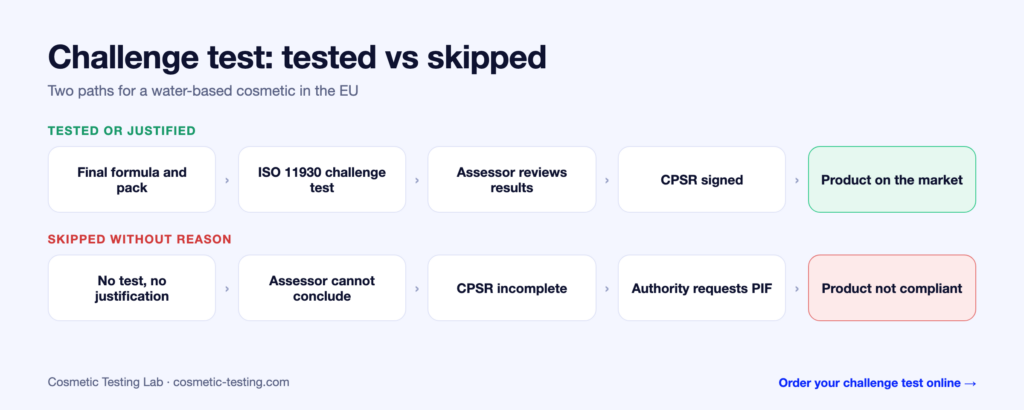
- What happens if you skip it
- The UK and Northern Ireland
- The United States
- When do you need to repeat it?
- How to make it painless
- Common misconceptions
- Frequently asked questions
- Key takeaways
The short answer
If you place a cream, lotion, shampoo, serum, gel or other water-containing cosmetic on the EU or UK market, plan a challenge test. Your safety assessor needs the result to sign the CPSR, and without a signed CPSR the product cannot legally be sold. A test can be skipped only when the assessor concludes, in writing, that the product is microbiologically low risk, for example an anhydrous oil or a high-alcohol perfume.
What EU law actually says
The Cosmetics Regulation (EC) No 1223/2009 requires a safety assessment for every cosmetic product before it is placed on the market (Article 10), documented in a cosmetic product safety report that forms part of the Product Information File (Article 11). Annex I sets out what the report must contain. Under Part A, section 3, “Microbiological quality”, it lists the microbiological specifications of the raw materials and the finished product and the results of the preservation challenge test. It also asks for particular attention to products used around the eyes, on mucous membranes, on damaged skin, on children under three, on elderly people and on people with weakened immune responses.
The regulation does not prescribe a method. The Commission guidelines on Annex I (Implementing Decision 2013/674/EU) explain how to fill in each section, and in practice assessors expect ISO 11930, the international standard for evaluating the antimicrobial protection of a cosmetic.
Read also What Is a Cosmetic Challenge Test? Preservative Efficacy Testing Explained
“Mandatory” or “required unless justified”?
Strictly speaking, the regulation requires the assessment to cover preservation, and the challenge test is the standard way to provide that evidence. Where the microbiological risk is low, the assessor can justify why a test is not needed instead. ISO 29621 describes the factors that can make a product low risk, such as:
- very low water activity, as in anhydrous oils, balms and powders;
- a high content of ethanol or other alcohols;
- an extreme pH, very acidic or very alkaline;
- a filling process or packaging that prevents contamination, such as single-use units or pressurised containers.
The justification has to be written down by the assessor and kept in the file. It is a scientific decision, not a shortcut a brand can take on its own.
Which products almost always need it
- Emulsions: creams, lotions, body milks, sunscreens.
- Rinse-off products with water: shampoos, conditioners, shower gels, liquid soaps.
- Gels, serums, toners and micellar waters.
- Wet wipes and sheet masks.
- Eye products such as mascara and eyeliner, and products for babies, where the risk to the user is higher.
Which products may not need it
Pure oil blends, lip balms without water, loose powders, high-alcohol perfumes and aerosol products are typical candidates for a risk-based waiver. Even then, the assessor looks at real use: an oil cleanser used with wet hands in the shower, or a balm that is applied with fingers, can pick up water and contamination. The decision is made per product, not per category.
Read also Challenge Test Cost: What Affects the Price
What happens if you skip it
- The CPSR cannot be completed. A careful assessor will not sign without preservation evidence or a justification.
- The product is not compliant. Without a valid safety assessment, the responsible person cannot lawfully place the product on the market.
- Inspections expose the gap. Market surveillance authorities can request the Product Information File, and a missing test is easy to spot.
- Real contamination risk. Microbial contamination is a recurring reason for cosmetic recalls, and contaminated products can harm users.
- Lost listings. Retailers and marketplaces increasingly ask for test reports before listing a product.
The UK and Northern Ireland
Great Britain kept the EU rules when it left the EU, as the UK Cosmetics Regulation. The safety report requirements of Annex I, including the challenge test results, apply in the same way. Northern Ireland continues to follow the EU regulation. For brands selling in both markets, the same ISO 11930 report can usually support both safety reports.
The United States
The FDA does not have a rule that names a challenge test for cosmetics. Companies are, however, responsible for the safety of their products, and a cosmetic must not be adulterated, which includes being contaminated with harmful microorganisms. MoCRA, the Modernization of Cosmetics Regulation Act of 2022, added a duty to keep records that substantiate product safety and directed the FDA to issue good manufacturing practice rules. In practice, preservative efficacy data is the usual way to substantiate that a water-based product stays safe in use, and many US partners require a USP 51 or ISO 11930 report by contract. Products regulated as OTC drugs in the US, such as sunscreens, follow drug rules.
Read also My Product Failed the Challenge Test: What to Do Next
When do you need to repeat it?
A challenge test is done per formula, not per batch. Repeat it when something changes that can affect preservation: the preservative system, the water content, the pH, key surfactants or emulsifiers, or the packaging type. Routine production batches are checked instead with a microbiological specifications test, which confirms the batch meets the limits for microbial counts.
How to make it painless
- Finish the formula and choose the final packaging first.
- Ask your assessor which standard they want, usually ISO 11930.
- Order the challenge test early: the test itself takes 28 days, plus time for the final counts and the report.
- Run a stability test in parallel, so both results are ready together.
- Send all reports to your assessor for the CPSR.
Common misconceptions
- “Natural products do not need it.” Water-based natural or preservative-free products are often more vulnerable, not less.
- “A clean microbiological test is enough.” A clean batch today says nothing about how the product copes with contamination during use.
- “Small batches are exempt.” Volume makes no difference to the obligation.
- “The preservative is approved, so it works.” Listing in Annex V means the preservative is allowed up to a maximum concentration; it does not prove that it protects your formula.
Frequently asked questions
Is a challenge test mandatory for small or handmade brands?
The rules are the same for every size of business. A handmade cream needs the same evidence as an industrial one. Some handmade products, such as solid soaps or oil balms, may qualify for a low-risk justification.
Does every batch need a challenge test?
No. The challenge test covers the formula. Batches are released with microbiological limit tests.
Can I use my preservative supplier’s data instead?
Supplier data shows how a preservative performs in model formulas. Your safety assessor usually needs evidence on your own finished product, because other ingredients and the packaging change the result.
Key takeaways
- EU and UK law require challenge test results in the CPSR; skipping them needs a written low-risk justification.
- Water-based cosmetics almost always need the test; anhydrous and high-alcohol products may not.
- The US has no named requirement, but safety must be substantiated and partners often demand a report.
- Test once per formula and packaging, and repeat after relevant changes.