
Many brands test the finished product once and assume the job is done. But contamination often enters earlier, through water, powders, plant extracts or clay, and it can differ from one batch to the next. Microbiological testing of raw materials, combined with release testing of every batch, is how a careful brand keeps quality predictable. This guide explains what to test, how often, and what to do with the results.
Contents
- The short answer
- Why raw materials matter
- Which raw materials are higher risk?
- What do you test for?
- What limits should you set?
- Certificate of analysis or own testing?
- Testing the water and the line
- Batch release testing for finished products
- How to sample correctly
- What to do when a result is out of specification
- Common mistakes
- Frequently asked questions
- Key takeaways
The short answer
You should check the microbiological quality of raw materials that carry a real contamination risk (water, natural and botanical ingredients, powders, clays, thickener gums) and release each batch of finished product against written microbiological specifications. For many materials a supplier certificate of analysis plus periodic own checks is enough; for higher-risk ones, test on receipt. The EU Cosmetics Regulation requires the safety assessment to cover microbiological quality, and good manufacturing practice (ISO 22716) expects documented quality control of materials and products. The legal text does not fix a testing frequency, so the plan is a risk-based decision you document.
Why raw materials matter
A preservative system is designed to protect a product against the small contamination that occurs during normal use. It is not designed to cope with a heavily contaminated ingredient. If a raw material arrives with a high microbial load, the preservative may be used up before the product even reaches the customer. Worse, some contaminants produce by-products that stay in the formula after the organisms themselves are gone.
This is why a good challenge test result does not replace incoming control. The challenge test shows the product can withstand a defined contamination; incoming control keeps that contamination from being large in the first place.
Read also ISO 17516 Cosmetics: Microbiological Limits Explained
Which raw materials are higher risk?
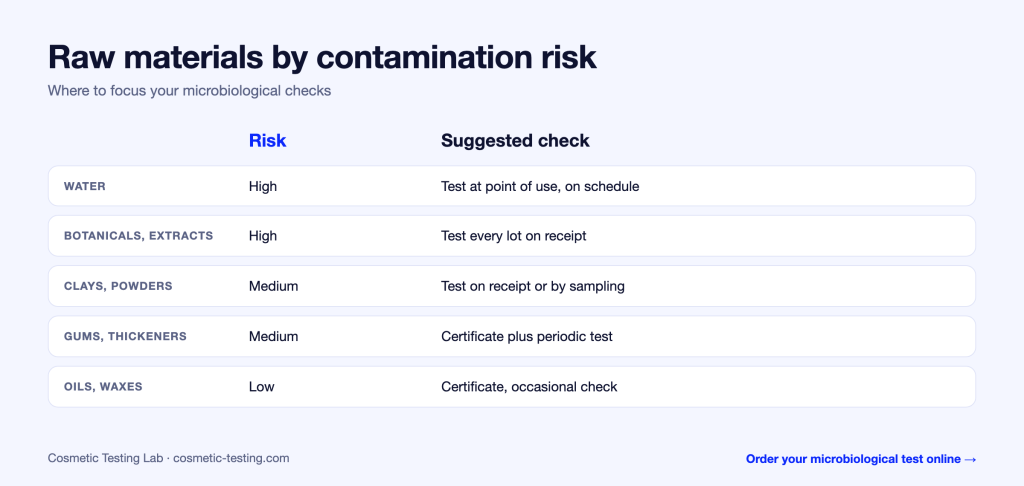
Not everything needs the same attention. A simple way to rank materials is by water content, origin and processing:
- Water: the most common source of problems in water-based products. Purified or deionised water systems can grow biofilm in pipes and tanks.
- Botanical and natural ingredients: plant extracts, powders, honey, proteins and hydrolysates start with a natural microbial load.
- Clays, minerals and starches: dry, but often carry spores and moulds from the ground.
- Thickeners and gums: hydrated gels are an ideal medium once water is added.
- Low-risk materials: pure oils, waxes, alcohols and many synthetic raw materials with very low water activity rarely support growth.
What do you test for?
Most laboratories use the same basic panel as for finished products, based on the ISO methods for cosmetic microbiology:
- Total aerobic mesophilic count (bacteria), counted as colony-forming units per gram or millilitre (ISO 21149).
- Yeast and mould count (ISO 16212).
- Specified microorganisms that should be absent in a defined amount: Pseudomonas aeruginosa, Staphylococcus aureus, Candida albicans and Escherichia coli. Some programmes add Burkholderia cepacia complex for water-based products.
The method must be validated for the material, because some ingredients (antimicrobial extracts, essential oils, surfactants) inhibit growth in the test itself and give a falsely clean result. A lab that neutralises the inhibitor first gives you a reliable figure.
What limits should you set?
The legal text does not list limits, but the SCCS Notes of Guidance and ISO 17516 describe values that are widely used. For the finished product, they are commonly at most 1,000 CFU per gram or millilitre for general products and at most 100 for products intended for children under three, for use around the eyes or on mucous membranes, with the specified microorganisms absent in the sample tested. Raw-material specifications are your own decision, but most brands set them tighter than the finished product limit, because the material is diluted or combined with others and you want headroom. Write the limit down for each material, and treat any deviation as a reason to investigate rather than to argue.
Read also Microbiological Specifications Test for Cosmetics: What Is Included
Certificate of analysis or own testing?
A supplier’s certificate of analysis is a good starting point, but it describes one lot at one point in time, by a method you did not choose. A sensible, risk-based plan combines three layers:
- Qualify the supplier: request the specification, the method and a recent certificate before the first order.
- Verify on receipt: test every lot of high-risk materials, and a rotating selection of the low-risk ones.
- Re-check periodically: review the suppliers at fixed intervals and after any change in source, process or packaging.
Keep records for each decision. The responsible person has to be able to show, years later, why a material was accepted.
Testing the water and the line
Water is a raw material like any other, and it is the one most often overlooked. Sample it at the point of use, not only at the treatment unit, on a fixed schedule. Add periodic swabs or rinse samples from tanks, hoses, filling nozzles and mixers after cleaning. A clean result on every ingredient does not help if the equipment re-contaminates the batch.
Batch release testing for finished products
Every batch of finished product should meet a written specification before it ships. Small producers often test one batch in every few, or one per product per production campaign. The right rhythm depends on risk: water-based products, products with natural preservatives and anything for eyes or babies deserve a test on every batch, while an anhydrous balm may need far fewer. Hold the batch until the result is in, and record both the result and the release decision. Our microbiological specifications test covers this step for the finished product, with a signed PDF report in about five days after we receive your samples.

Read also Solid Shampoo and Bar Products: Microbiological Risks
How to sample correctly
Most poor results come from sampling, not from the product. Use sterile containers, clean gloves and a clean work surface. Take the sample from the middle of the batch and from the filled pack, not only from the tank, and keep it closed until it reaches the lab. Send finished-product samples in their final packaging, because the pack and the closure are part of the microbiological story. Samples should reach the laboratory promptly and at the temperature the lab recommends, so that the organisms present do not multiply or die on the way.
What to do when a result is out of specification
Do not simply retest until you get a pass. A better sequence is to quarantine the lot, confirm the result with a repeat test on a fresh sample, identify the organism if the count is high, and trace it back: which raw materials, which equipment, which operator, which water sample. Then decide whether to reject, rework or release under a documented deviation. Record the corrective action, including any change to cleaning, to the supplier or to the specification itself.
Common mistakes
- Relying on one certificate of analysis for years.
- Testing only the finished product and never the water.
- Using a method that was not validated for the ingredient.
- Shipping before the result is back, then recalling.
- Keeping the data in an e-mail rather than in the product information file.
Frequently asked questions
Do I have to test every raw material?
No. The law does not require a test for each one. It expects a justified, documented approach in which higher-risk materials get more checks than low-risk ones.
Is a supplier certificate enough?
For low-risk, well-qualified materials it can be, together with periodic own checks. For water and natural materials, own testing is advisable.
How is batch testing different from a challenge test?
Batch testing counts the organisms currently present. A challenge test deliberately adds organisms to see whether the preservative system can control them. You normally need both, as part of the safety documentation behind your CPSR.
Key takeaways
- Rank raw materials by risk and give water and natural ingredients the most attention.
- Set written limits and use validated ISO methods for counts and specified organisms.
- Release each batch against a specification and record the decision.
- Keep every result in the product file, where the safety assessor can use it.