

Amazon can put your product in front of millions of European shoppers, but a marketplace does not change the law. If you want to sell cosmetics on Amazon EU, the same safety, documentation and labelling rules apply as in a shop, and the marketplace adds its own checks on top. This guide explains what you need before you list, why listings get blocked and how to prepare the documents once.
Contents
- The short answer
- Does the law treat online sales differently?
- Requirement 1: an EU responsible person
- Requirement 2: a safety assessment and CPSR
- Requirement 3: the product information file
- Requirement 4: CPNP notification
- Requirement 5: a label that meets the law
- Your listing is part of your labelling and claims
- Safety data sheets and shipping rules
- Marketplace duties: the Digital Services Act and product safety rules
- Why Amazon listings get blocked
- A practical preparation workflow
- Frequently asked questions
- Key takeaways
The short answer
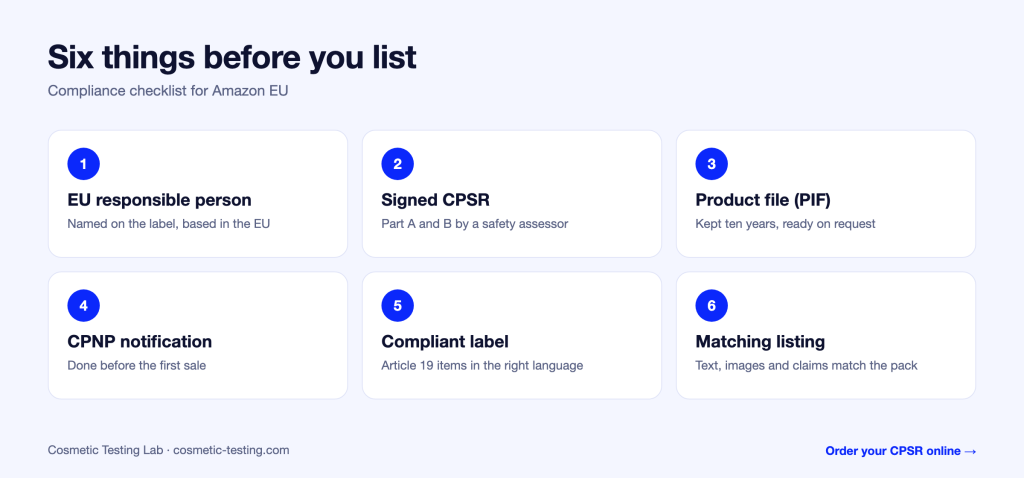
To sell cosmetics on Amazon in the EU, the product needs an EU responsible person, a CPSR, a product information file, a CPNP notification and a compliant label, and your listing must match that label. Marketplaces can also ask for documents such as safety reports or safety data sheets, so keep them ready in digital form.
Does the law treat online sales differently?
No. Regulation (EC) No 1223/2009 applies to cosmetic products placed on the EU market, whether they are sold in a shop, on your own website or through a marketplace. If you sell to consumers in the EU, even from outside, you are placing the product on the EU market, so the product must meet the regulation. Amazon’s role as a platform brings further obligations, mainly under the Digital Services Act, and its own seller policies.
Read also Influencer Beauty Brand Compliance: The Basics
Requirement 1: an EU responsible person
Every cosmetic needs a responsible person based in the EU (or EEA), whose name and address appear on the label. If you manufacture in the EU, that can be you. If you are outside the EU, you need an importer or an appointed responsible person. Without one, the product cannot be lawfully sold, however it is listed.
Requirement 2: a safety assessment and CPSR
Before launch, a qualified safety assessor must evaluate the finished product and sign a CPSR (Part A with the safety information and Part B with the assessment). This is the document marketplaces and authorities most often ask about, and the Commission’s guidelines in Decision 2013/674/EU set out what it should contain. The CPSR relies on the stability, microbiological and preservation data of your finished product.
Requirement 3: the product information file
The product information file (PIF) is your full product dossier: description, CPSR, manufacturing method and GMP statement, proof of claimed effects and animal-testing information. It must be kept for ten years after the last batch is placed on the market and be available at the responsible person’s address. Marketplaces do not usually need the whole file, but authorities can request it at any time, so it has to exist before the first sale.
Read also How to Sell Cosmetics in the EU: Step-by-Step Checklist
Requirement 4: CPNP notification
Before a product is placed on the market, the responsible person notifies it in the Cosmetic Products Notification Portal (CPNP). The portal does not approve products, but notification is mandatory. Marketplaces may ask for the CPNP notification number or other proof, depending on category rules, so store the confirmation with your file.
Requirement 5: a label that meets the law
The label (and often the outer box) must show the information required by Article 19 of the regulation, in the language required by the country where the product is sold for the points national law covers. Typical items:
- name and address of the responsible person, and country of origin for imports;
- nominal content;
- date of minimum durability, or the period after opening symbol;
- batch number;
- function of the product;
- precautions and warnings;
- the ingredient list with INCI names.
If you sell on several Amazon country stores, check the language needs for each country before ordering packaging.
Your listing is part of your labelling and claims
Product pages, A+ content, images and videos are marketing material and must meet the same claims rules as the pack. Regulation (EU) No 655/2013 asks that claims are truthful, supported by evidence and not misleading. For listings, that means:
- Do not claim medicinal effects such as treating or curing a condition.
- Do not use “clinically proven”, “dermatologically tested” or “hypoallergenic” unless your file supports it.
- Make sure the ingredient list, the content and the warnings on the page match the actual label.
- Show the name and address of the responsible person where the marketplace requires product information.
A mismatch between listing and label is a very common reason for complaints and takedowns.
Read also Cosmetic Launch Testing Checklist: Tests to Finish Before You Sell
Safety data sheets and shipping rules
Cosmetics are not usually “dangerous substances” in the way chemicals are, but aerosols, perfumes, nail products and other flammable or pressurised items can fall under transport or storage rules. Marketplaces and carriers commonly ask for a safety data sheet (SDS) to check these items. A REACH-compliant 16-section SDS in the language of your markets can save a long delay. Note that an SDS is a hazard document, not a substitute for the CPSR.

Marketplace duties: the Digital Services Act and product safety rules
Under the Digital Services Act (Regulation (EU) 2022/2065), online marketplaces must collect and check identity information on the traders who sell through them, and you should expect to be asked for it when you register. The General Product Safety Regulation (EU) 2023/988, applicable since December 2024, also sets duties for online marketplaces, but cosmetics are mostly covered by their own sector law, so the cosmetics regulation remains the main rulebook. If you are unsure how these frameworks interact for your product, ask a qualified adviser.
Why Amazon listings get blocked
- No CPSR or PIF available when the marketplace asks.
- The responsible person address is missing or outside the EU.
- The label image on the listing does not match the listing text.
- Unsupported claims or medicinal wording.
- Missing ingredient lists or warnings.
- A formula change after the documents were prepared.
Each of these is avoidable if the documents exist before you register the product.
A practical preparation workflow
- Confirm the EU responsible person and the address on the label.
- Test the finished product: stability, microbiology and, for water-based products, a challenge test.
- Obtain the signed CPSR and complete the PIF.
- Notify the product in the CPNP and save the confirmation.
- Check the label, then build the listing from the label text and images.
- Keep digital copies of the CPSR, test reports, SDS if relevant, and CPNP proof, ready for upload.
- Re-check everything whenever the formula or packaging changes.
Frequently asked questions
Can I sell on Amazon with only a UK or US document set?
No. For the EU the responsible person, CPSR format and CPNP notification follow EU rules. UK and US documents are not interchangeable, so prepare the EU file for EU stores.
Do I need a CPSR for each variant?
If the formula differs, usually yes, or the assessor covers a justified product family. Colours, fragrances and sizes can change the assessment, so ask your assessor how to group them.
Does Amazon check my CPSR itself?
Marketplace procedures vary by category and change over time. Some listings are reviewed by request, and authorities can inspect your file independently. Prepare as if you will be asked.
Key takeaways
- Selling on Amazon EU means placing the product on the EU market with all its rules.
- You need an EU responsible person, a CPSR, a PIF, a CPNP notification and a compliant label.
- Your listing is marketing and must match the label and the evidence.
- Prepare digital copies of the documents, and an SDS where the product type requires it, before registering.