
Many brands ask how to sell cosmetics in Italy without surprises. The product rules are the EU ones; the Italian layer is mostly about who supervises, which label items must be in Italian and a packaging rule that many foreign brands only discover at the first retail order. In short: complete the EU product file, put the required label items in Italian, and prepare the environmental labelling and CONAI position for your packaging. This guide is for brands that comply, or plan to comply, with Regulation (EC) No 1223/2009. It is general information, not legal advice.
Contents
- The short answer
- The EU baseline in brief
- Who supervises cosmetics in Italy?
- Which label items must be in Italian?
- Environmental labelling of packaging
- CONAI and the environmental contribution
- Documents and the product file
- What do Italian retailers and marketplaces expect?
- Common mistakes when selling in Italy
- Checklist: ready to sell in Italy
- Frequently asked questions
- Key takeaways
The short answer
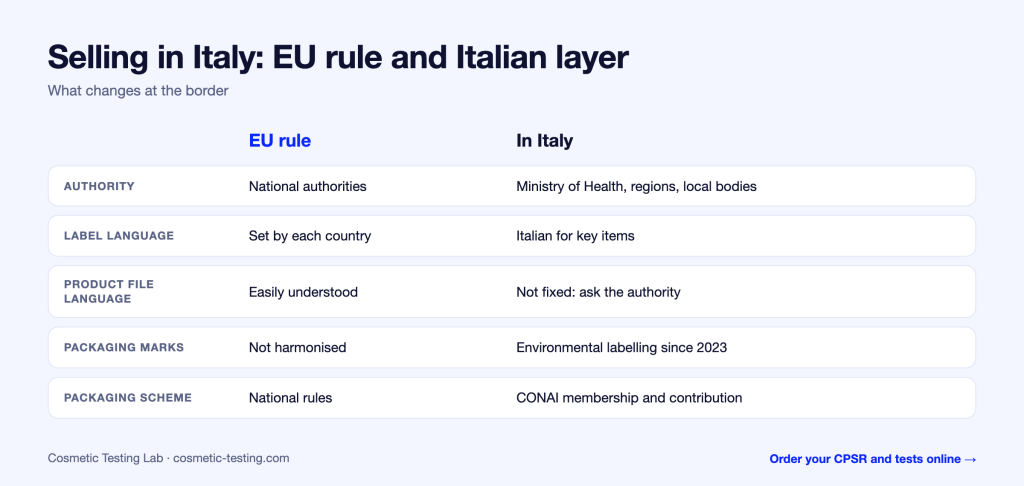
Italy applies the EU Cosmetics Regulation directly and adds national rules for sanctions and for some practical points, in particular the language of the label. The Ministry of Health is the central authority; regional and local health bodies and customs take part in surveillance. Packaging is handled outside cosmetics law, through the Environmental Code and the national packaging consortium, CONAI. We checked the Italian points below on official pages (Ministry of Health, Lombardy Region, the National Institute of Health, the Ministry of the Environment) wherever we could open them, and we mark what remains to be confirmed.
The EU baseline in brief
These elements are the same in every Member State, so we keep the recap short:
- Responsible person (RP): a person established in the EU who answers for compliance; name and address are printed on the label.
- Safety assessment: a qualified assessor signs a CPSR (Part A and Part B) before the product is placed on the market.
- Product information file (PIF): the dossier behind the CPSR, kept for ten years after the last batch is placed on the market, with stability, microbiological and, for water-based products, challenge test reports.
- CPNP notification: filed on the European portal before launch.
- Labelling: the Article 19 information, where the language of certain items is set by each Member State.
Read also Selling Cosmetics in Slovenia: Rules, Authorities and Labels
Who supervises cosmetics in Italy?
The Ministry of Health (Ministero della Salute) is the national authority for cosmetics. A page of the Lombardy Region on cosmetic products, safety, rules and controls names the Ministry of Health, the Regions and the local health agencies (ATS in Lombardy) as the bodies responsible for supervision in their areas, with customs authorities also carrying out surveillance. The same page points to Legislative Decree 204/2015, which sets the sanctions for violations of Regulation (EC) No 1223/2009.
The Ministry also runs the national cosmetovigilance system. According to a page of the National Institute of Health (ISS), it collects reports of undesirable effects from consumers and health professionals, evaluates them, stores them in the Italian database and shares serious cases with other Member States. For you, the practical point is simple: serious undesirable effects linked to your product must reach the competent authority, so make sure that the contact details on your label lead to someone who can act on a report.
Which label items must be in Italian?
Article 19(5) of the Regulation lets each Member State decide the language of certain items: the nominal content, the date of minimum durability or the period after opening, the precautions for use and warnings, and the function. The Ministry of Health labelling page indicates that for products sold in Italy these items must be in Italian. It also indicates that multilingual labels are allowed, as long as the Italian text appears at a character size equivalent to the other languages, and that common international terms such as “shampoo” are accepted. When information has to sit on a leaflet, tag or insert because the pack is small, the same language logic applies.
We could read this guidance only in summary form, because the Ministry site sometimes blocks automated access, and the page itself carries an older update date. Confirm the current text with your safety assessor before you send artwork to print. The ingredient list follows the INCI nomenclature and does not need translating.
Environmental labelling of packaging
This is the Italian rule that surprises foreign brands most. Article 219(5) of the Environmental Code (Legislative Decree 152/2006) requires packaging to carry environmental labelling that helps consumers sort it. The Ministry of the Environment and Energy Security published technical guidelines in 2022, and the obligation has applied since 1 January 2023, with stock already placed on the market or already labelled allowed to be sold until it runs out. In summary, the guidelines:
- cover primary, secondary and tertiary packaging placed on the Italian market, for food and non-food products alike,
- ask for a material identification code, based on the European Commission decision on packaging materials, plus information on separate collection,
- allow digital tools such as a QR code or a website for part of the information, in line with European guidance,
- place the duty on the users of packaging, not only on packaging producers.
For a cosmetics brand this means jars, tubes, cartons and shipping boxes.
Read also Selling Cosmetics in Croatia: Rules, Authorities and Labels
CONAI and the environmental contribution
Italy organises packaging recovery through CONAI and its material consortia. CONAI explains that producers and users of packaging are expected to join, that an environmental contribution is set per packaging material, and that it is charged to whoever first places the packaging, or packaged goods, on the national market and then passed down the chain on invoices. Importers of packaged goods are among those concerned, while foreign companies are not obliged to join but may do so voluntarily. We could read these points only through summaries of CONAI guides, since the CONAI site blocked automated access, so check your own position directly with CONAI or with your Italian importer before the first shipment.
Documents and the product file
When a health authority examines a cosmetic, it typically asks for the label, the CPNP notification, the CPSR and the PIF contents, such as microbiological and stability reports and proof of good manufacturing practice. The Regulation requires the PIF to be available in a language the competent authority can easily understand. We found no Italian rule fixing the language of technical documents, so ask the authority or your importer what it accepts before you translate everything.
What do Italian retailers and marketplaces expect?
Pharmacies, perfumeries, department stores and marketplaces in Italy generally ask for the RP details, the CPNP reference, an Italian-language label or pack photo and the safety report summary. Depending on the claims you make, they may also ask for test reports, for example a patch test for a tolerance claim. These requests come from each buyer’s policy rather than the law, so treat them as a pattern.
Read also Selling Cosmetics in Germany: Rules, Authorities and Labels
Common mistakes when selling in Italy
- Printing warnings or the function only in English.
- Shrinking the Italian text far below the size of other languages on a multilingual label.
- Learning about packaging environmental labelling only when a retail buyer asks.
- Appointing a responsible person outside the EU.
Checklist: ready to sell in Italy
- Responsible person in the EU named on the label.
- Signed CPSR and a complete PIF with finished-product test reports.
- CPNP notification submitted.
- Nominal content, durability or PAO, precautions and function in Italian, at a comparable size.
- Environmental labelling on primary, secondary and tertiary packaging.
- CONAI position clarified with your importer or with CONAI.
- A contact point that can act on undesirable-effect reports.
- Document folder ready for health authorities and buyers.
Frequently asked questions
Do I need an Italian responsible person?
No. The responsible person must be established in the EU, not necessarily in Italy. Their name and address must be on the label.
Can the label be bilingual?
Yes. Multilingual labels are allowed, provided the Italian text is clearly legible and, according to the Ministry of Health guidance, equivalent in size to the other languages.
Does environmental labelling apply to cosmetics packaging?
The Ministry guidelines apply to packaging in general, for food and non-food products, and exempt medicines and medical devices. Cosmetics packaging is therefore expected to be covered; confirm the details for your pack format.
Key takeaways
- The Ministry of Health leads on cosmetics, with regions, local health bodies and customs involved in surveillance.
- Nominal content, durability or PAO, precautions and function are expected in Italian.
- Packaging needs environmental labelling under the Environmental Code, applied since 1 January 2023.
- Check your CONAI position and prepare a document folder before the first Italian order.