

Every cosmetic sold in the EU needs a named person who answers for it in law. That person is the cosmetic responsible person (often shortened to RP). Brands that skip this step are surprised when a distributor, marketplace or customs office asks for it. This guide explains who needs one, who can take the role, what the RP actually does and how to choose well.
Contents
- The short answer
- Who needs a responsible person?
- Who can be the responsible person?
- What does the responsible person do?
- Responsible person versus safety assessor
- What the RP needs from you
- Non-EU brands: the EU responsible person
- What about the UK?
- How to choose a responsible person
- Common mistakes
- Liability: what happens if something goes wrong
- Frequently asked questions
- Key takeaways
The short answer
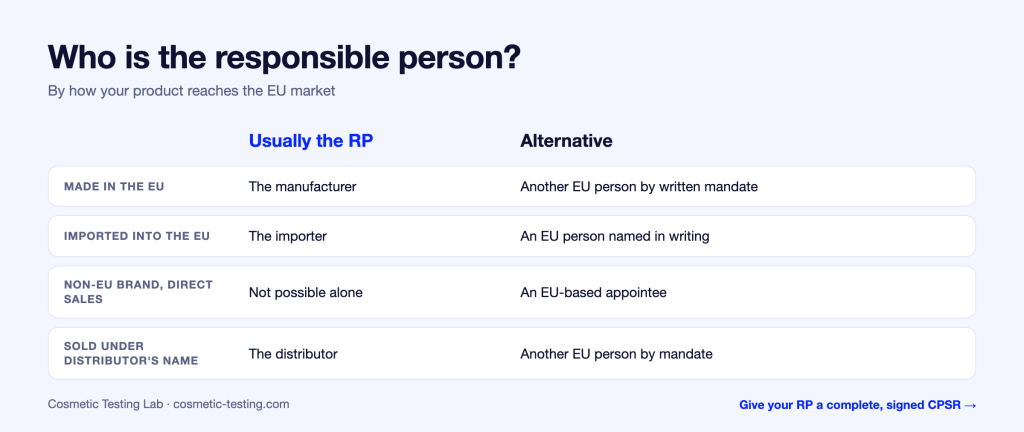
A cosmetic responsible person is a legal or natural person established in the EU who is designated under Regulation (EC) No 1223/2009 and is accountable for the compliance of one or more cosmetic products. Every cosmetic placed on the EU market must have one, and the name and address of the RP must appear on the label. For a product made in the EU this is usually the manufacturer; for an imported product it is usually the importer, unless a non-EU brand appoints an EU-based person in writing.
Who needs a responsible person?
Anyone who places a cosmetic product on the EU market needs a responsible person to be in place first. That includes large brands, start-ups, handmade producers, online-only shops and marketplace sellers shipping to EU consumers. If you are based outside the EU and ship directly to EU customers, you cannot be your own RP, because the RP must be established in the EU. Selling on a third-party marketplace does not change this, and marketplaces increasingly ask for the RP details before they list a product.
Read also Responsible Person vs Safety Assessor: Who Does What
Who can be the responsible person?
The regulation sets out who can take the role:
- EU manufacturer. For a product made in the EU, the manufacturer is the RP, unless it designates another person by written mandate that the other person accepts in writing.
- Importer. For an imported product, the importer is the RP, unless it designates another EU-based person in writing.
- Non-EU manufacturer’s appointee. The importer or the manufacturer outside the EU may designate an EU-based person or company to act as RP.
- Distributor. A distributor becomes the RP if it places a product on the market under its own name or trademark, or if it modifies a product already on the market in a way that may affect compliance.
For the standard private-label case, where a brand buys from a contract manufacturer and sells under its own name, the brand owner is normally the one who takes on the responsibility, even if production happens elsewhere.
What does the responsible person do?
The RP does not need to manufacture anything. The role is about accountability and documents. In practice the RP must ensure that:
- the product is safe and a signed cosmetic product safety report exists before launch;
- the product is made under good manufacturing practice;
- a product information file (PIF) is created, kept up to date and stored for ten years after the last batch was placed on the market;
- the product is notified in the CPNP before it is placed on the market;
- ingredients respect the prohibited, restricted and permitted lists in the annexes;
- labelling and claims meet the regulation and the common criteria for claims;
- no animal testing banned by the regulation was carried out for the product;
- serious undesirable effects are reported to the competent authority;
- corrective action is taken if a product turns out not to comply.
Responsible person versus safety assessor
These two roles are often confused. The safety assessor is a qualified professional, for example in pharmacy, toxicology or medicine, who evaluates the formula and signs the safety report. The responsible person is the legal entity that owns the compliance of the whole product. One company can offer both services, but the roles are distinct, and the RP must make sure the assessor’s report is complete and current. A signed CPSR is always one of the first documents an authority will ask the RP to show.
Read also UK Cosmetic Regulations: SCPN and the UK Responsible Person
What the RP needs from you
An RP can only take responsibility for what it can verify. Expect to be asked for:
- the full formula with INCI names and concentrations;
- specifications and safety data sheets for raw materials;
- stability and compatibility data, and microbiological data, including a challenge test for water-based products;
- proof of good manufacturing practice at the manufacturer;
- draft labels, claims and the evidence behind them;
- a process for complaints and adverse reactions.
The better the file, the faster the RP can sign off, and the fewer corrections you pay for later.
Non-EU brands: the EU responsible person
If you sell from the UK, the US, Asia or anywhere outside the EU, you need an EU-based person to act as RP. Options are an importer you already work with, a distributor who agrees to take on the role, or a specialised service company. Whichever you choose, check that the mandate is in writing, that the RP gets full access to your documents, and that the address printed on the label is the one where the PIF can be inspected by an authority.
What about the UK?
Great Britain has its own system, with a UK-established responsible person, a notification through the UK SCPN service, and the RP address on the pack. UK guidance currently accepts EU or EEA RP details on labels until the end of 2027 if they meet the EU labelling rules, but this is a rule that can change, so check the current government guidance. Northern Ireland generally follows the EU rules for cosmetics. If you sell on both sides, plan the RP arrangement for each.

Read also Selling Cosmetics in Turkey: Responsible Person and ÜTS Notification
How to choose a responsible person
- Check the address. It must be in the EU, and it must be a real establishment, not a mailbox.
- Ask who signs the safety assessment. The assessor should be qualified and named.
- Read the mandate. It should say which products it covers and what happens when the contract ends.
- Look at the response time. Authorities can ask for documents at short notice, so the RP must be able to react.
- Make sure you keep your documents. You should get copies of the PIF and the reports.
Common mistakes
- Using a non-EU address on the label.
- Assuming the contract manufacturer is automatically the RP for your private-label product.
- Changing a formula or supplier without telling the RP.
- Launching before the CPSR is signed.
- Forgetting that the PIF must be kept for ten years after the last batch, even if the product is discontinued.
- Not keeping the supply chain records: the RP and distributors should be able to identify, for three years, who supplied the product and to whom it was supplied.
Liability: what happens if something goes wrong
The RP is the first contact for authorities. If a product is not compliant, the competent authority can require it to be withdrawn from the market or recalled, and national law sets penalties. Because the label names the RP, consumers and authorities know exactly whom to address. This is why many brands treat the RP role as a risk-management decision, not paperwork.
Frequently asked questions
Can I be my own responsible person?
Yes, if your company is established in the EU and you can meet all the obligations. A brand outside the EU cannot, and needs an EU-based appointee.
Can the same company be RP for several brands?
Yes. A person can be designated as RP for many products and brands, as long as each is documented and the RP can verify each file.
Do I need a new responsible person per country?
No. One EU-based RP is enough for the EU market. Separate arrangements apply to the UK and other non-EU markets.
Key takeaways
- Every cosmetic on the EU market needs a responsible person established in the EU, named on the label.
- The RP is accountable for the safety report, the product file, notification, labelling and vigilance.
- The RP and the safety assessor are different roles and should both be clearly named.
- Non-EU brands must appoint an EU-based RP in writing, and the UK has its own separate requirement.