

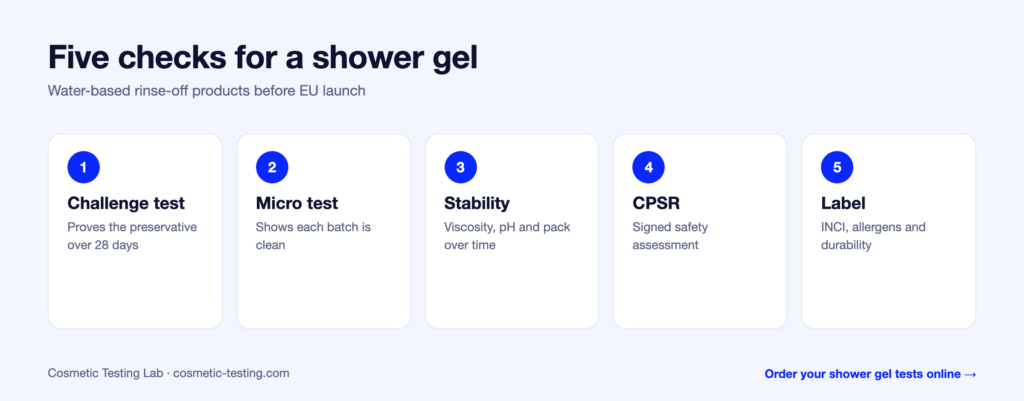
Shower gels and liquid soaps look like the simplest products in the bathroom, yet they are full of water, used every day by the whole family and often sold in large bottles, pumps and refill pouches. That makes shower gel testing less about exotic methods and more about getting the basics right: a water-based body wash or liquid soap sold in the EU typically needs a challenge test, a microbiological check, a stability and packaging test and a signed safety report (CPSR) before it goes on sale. This guide explains each step, what makes rinse-off products different and where brands most often slip.
Contents
- The short answer
- Is a shower gel always a cosmetic?
- Why “rinse-off” does not mean “low risk”
- The challenge test: the core test for a body wash
- The microbiological specification test
- Stability and packaging compatibility
- Do you need a patch test?
- What the safety assessor checks in the CPSR
- Shower gel, liquid hand soap and bar soap: what changes?
- Labelling points specific to washes
- Common mistakes
- A practical testing order
- Frequently asked questions
- Key takeaways
The short answer
Shower gels, body washes, shower creams and liquid hand soaps are cosmetic products under Regulation (EC) No 1223/2009. Being rinsed off lowers the exposure, but it does not remove the obligations. Because these products are mostly water, the preservative system has to be proven with a challenge test, the batch has to be microbiologically clean, the formula has to stay stable in its real pack, and a qualified safety assessor has to sign the CPSR. A patch test is optional and mainly supports skin-friendliness claims.
Is a shower gel always a cosmetic?
A product whose main purpose is cleaning, perfuming or caring for the skin is a cosmetic. That covers shower gels, shower oils, shower creams, 2-in-1 hair and body washes and ordinary liquid hand soaps. The responsible person must keep a Product Information File (PIF), notify the product in the CPNP and label it correctly.
The line moves when the main purpose becomes disinfection. Hand washes presented mainly to kill bacteria or viruses can fall under the Biocidal Products Regulation (EU) No 528/2012 as human hygiene products, which is a different and much heavier regime. Claims such as “kills 99.9% of germs” are the usual trigger, so check the wording with your safety assessor before you print it.
Read also Body Scrub Testing: What Exfoliators Need Before You Sell
Why “rinse-off” does not mean “low risk”
Rinse-off products stay on the skin only briefly, and the safety assessment reflects that. The SCCS Notes of Guidance use a much lower retention factor for rinse-off products than for leave-on products, and several ingredients are allowed only, or at higher levels, in rinse-off products. Methylisothiazolinone, for example, is permitted only in rinse-off products and only up to 0.0015%. Fragrance allergens must be named on the label above 0.01% in rinse-off products, compared with 0.001% in leave-on products.
Still, several features keep the risk real:
- Daily, whole-body use, often several times a day for hand soaps.
- Contact with the eyes and face, especially with 2-in-1 and family products.
- High water content and warm, humid bathrooms, which suit microorganisms.
- Surfactant load, which can dry or irritate sensitive skin.
- Use by children, even when the product is not marketed to them.
The challenge test: the core test for a body wash
Surfactants are not a preservative system. Water-based shower gels and liquid soaps almost always need a challenge test, which deliberately contaminates the product with five reference microorganisms and checks over 28 days whether the preservatives bring them down fast enough. ISO 11930 is the reference most EU safety assessors expect.
Test the final formula, ideally in the final pack, because fragrance, pH, thickener and even the pump can change the result. Products sold as “preservative-free” or “natural” need the test just as much, because the protection then depends on less familiar ingredients. Large refill packs and pump dispensers in shared washrooms are exposed to contamination for weeks, which is exactly what the test simulates.
The microbiological specification test
A challenge test proves the formula can defend itself. It does not tell you whether a specific batch left the factory clean. That is the job of the microbiological specifications test, which counts bacteria, yeasts and moulds and checks for specified pathogens.
ISO 17516 sets the commonly used limits: up to 1,000 colony-forming units per gram for general cosmetics such as shower gels, and a stricter 100 per gram for products for children under three, the eye area and mucous membranes, with E. coli, P. aeruginosa, S. aureus and C. albicans absent in one gram. Test the first production batch and repeat the test periodically. Water quality and equipment hygiene at the manufacturer are the most common sources of problems.
Read also Body Lotion Testing: What Hand and Body Creams Need Before Sale
Stability and packaging compatibility
Shower gels change more than people expect. Salt-thickened surfactant systems can lose or gain viscosity, pearlising agents and oils can separate, fragrances can discolour and the pH can drift, which in turn can weaken the preservative. A stability and compatibility test stores the product under accelerated conditions and checks appearance, odour, pH and viscosity at set points.
The pack matters as much as the formula. PET and HDPE bottles, flip caps, pumps and stand-up pouches can absorb fragrance, leak, stress-crack or clog. The stability data also support the label: products lasting more than 30 months carry a period-after-opening symbol, while products lasting 30 months or less need a “best before” date.
Do you need a patch test?
EU law does not require a patch test. For a rinse-off product it is optional, but it is useful when you claim “dermatologically tested” or “suitable for sensitive skin”, because the Claims Regulation (EU) No 655/2013 requires such claims to be supported by evidence. A patch test applies the product under occlusion for 48 hours; rinse-off products are often tested in dilution, as agreed with the lab and your assessor.

What the safety assessor checks in the CPSR
- Composition: surfactant levels, preservatives and their Annex V limits, fragrance and its allergens.
- Exposure: daily use, whole-body area, rinse-off retention, possible eye contact.
- Impurities: technically unavoidable traces, for example in ethoxylated surfactants, must be shown to be safe.
- Test data: challenge, microbiological and stability results for the exact formula.
- Warnings: such as “avoid contact with eyes” where appropriate.
Most shower gels contain fragrance, so with us they usually fall into the Complex CPSR tier.
Read also Baby Cosmetics Safety Testing: What the File Must Show
Shower gel, liquid hand soap and bar soap: what changes?
- Liquid hand soap: used many times a day and often refilled from bulk packs, so preservation and batch hygiene matter even more.
- Shower oil: an anhydrous oil may be low-risk under ISO 29621, so a documented assessment can sometimes replace the challenge test.
- Bar soap: low water and high pH usually mean low microbiological risk, but the CPSR is still required.
- 2-in-1 hair and body wash: the scalp, hair and eyes are added to the exposure.
Labelling points specific to washes
List all ingredients by INCI name, including fragrance allergens above the rinse-off threshold. Regulation (EU) 2023/1545 added many allergens to the labelling list: products placed on the market from 31 July 2026 must follow the new rules, and products already on the market before that date may stay until 31 July 2028. Refill pouches and bulk containers need full labelling too, not only the bottle on the shelf.
Common mistakes
- Testing a lab prototype and then changing the fragrance or thickener.
- Running the challenge test in a jar when the product is sold in a pump or pouch.
- Skipping the microbiological check on the first production batch.
- Making antibacterial claims that turn a soap into a biocide.
- Assuming a known supplier base needs no testing in your formula.
A practical testing order
- Fix the final formula and packaging.
- Start the stability test and the challenge test in parallel.
- Test the first production batch microbiologically.
- Send all data to the safety assessor for the CPSR.
- Notify the product in the CPNP and finalise the label.
Frequently asked questions
Does every shower gel need a challenge test?
Almost every water-based one does. Anhydrous shower oils may be exempt after a documented ISO 29621 risk assessment, decided by the safety assessor.
Can I reuse test results for different scents?
Sometimes. If the base and preservatives are identical, an assessor may accept a reasoned approach, but a new fragrance can change pH, stability and preservation, so ask before assuming.
Is a liquid hand soap tested differently from a shower gel?
The tests are the same; the exposure, use frequency and dispensing system in the safety assessment differ.
Key takeaways
- Shower gels and liquid soaps are cosmetics; disinfection claims can make them biocides.
- Water-based washes need a challenge test and a clean, tested batch.
- Stability in the real pack supports both safety and the label date.
- Rinse-off lowers exposure but does not remove the CPSR or labelling rules.