

Creams and serums look simple in the jar, but they are among the most heavily tested cosmetics because they stay on the skin and often contain water and active ingredients. If you are planning a launch, this guide explains the skincare testing requirements in the EU and UK: what the law asks for, which laboratory tests usually support it, and how creams and serums differ.
Contents
- The short answer
- What the regulation actually requires
- Creams and serums: why they are different
- Test 1: Stability and compatibility
- Test 2: Microbiological quality
- Test 3: Preservation efficacy (challenge test)
- Test 4: Skin compatibility
- Test 5: Efficacy and claims evidence
- The Cosmetic Product Safety Report
- Packaging choices that change the testing
- Testing a range of creams and serums
- Common ingredient flags in skincare
- A practical checklist
- Frequently asked questions
- Key takeaways
The short answer
The law does not list fixed tests for skincare, but every cream or serum needs a signed safety assessment (CPSR), and the assessor will usually expect stability and compatibility data, microbiological quality data and, for products containing water, a preservation efficacy (challenge) test. Skin-compatibility testing and evidence for any claims are added where relevant. Water-based serums and emulsion creams are the highest priority for preservation and stability testing, while anhydrous oil serums often need less.
What the regulation actually requires
Regulation (EC) No 1223/2009 requires that a cosmetic product is safe under normal or reasonably foreseeable use. The responsible person proves this with a safety assessment based on the formula, the ingredients, the exposure, the stability and the microbiological quality, among other items. The regulation does not name specific laboratory tests; the guidelines for the CPSR and the SCCS Notes of Guidance describe the information expected. In practice, the data below are what a qualified assessor asks for before signing a skincare product.
Read also Body Lotion Testing: What Hand and Body Creams Need Before Sale
Creams and serums: why they are different
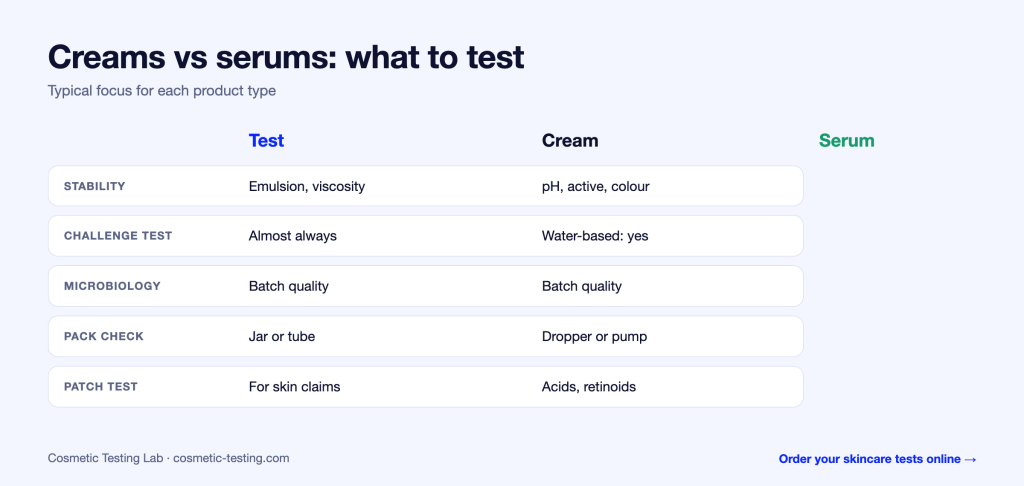
A cream is typically an emulsion of oil and water, thicker, in a jar or tube, applied in larger amounts. A serum is a lighter, more concentrated product, often water-based or oil-based, in a dropper or pump bottle, applied in small amounts but often with actives such as vitamin C, retinoids, acids or peptides. These differences change which risks matter most: creams are exposed to the user’s fingers if the pack is a jar and need a robust preservative system, while serums often face stability and pH challenges from sensitive actives.
Test 1: Stability and compatibility
A stability and compatibility test checks appearance, colour, odour, pH, viscosity and phase separation over time, usually in accelerated conditions at higher temperature and sometimes with freeze-thaw cycles, then confirmed in real time. For creams, emulsion breakdown, creaming and viscosity change are the typical failures. For serums, watch pH drift, discolouration of oxidising actives and loss of clarity. Compatibility with the pack matters just as much: droppers, rubber teats, pumps and airless systems can absorb ingredients, leach substances or react with the formula. Always test in the final packaging.
Test 2: Microbiological quality
A microbiological specifications test confirms that the finished batch is within accepted limits for aerobic bacteria, yeast and mould, and free of specified organisms. Limits are stricter for products used around the eyes, on mucous membranes or on children under three years. A face cream or serum usually falls under the general limits, but the assessor confirms this from the intended use. The test is a snapshot, so it should be repeated for new batches or production sites when the risk assessment requires it.
Read also Baby Cosmetics Safety Testing: What the File Must Show
Test 3: Preservation efficacy (challenge test)
Water-containing creams and serums can support microbial growth. A challenge test adds reference microorganisms and checks that the preservation system reduces them within the defined period, typically 28 days under ISO 11930:2019 or the pharmacopoeia criteria. Emulsion creams, gels and water-based serums almost always need one. Products with very low water activity, such as pure oil serums, may not, but the safety assessor decides based on formula. Packaging affects the result too: a jar is more exposed than an airless pump, so the assessor may consider the pack when evaluating the risk.
Test 4: Skin compatibility
If the product will be used on the face every day, or if you want to claim “suitable for sensitive skin” or “dermatologically tested”, a patch test is a common way to support the wording. A single 48-hour occlusive patch test on volunteers evaluates irritation potential of the finished product. It does not replace the safety assessment, but it adds real data for the file and strengthens the claim. Products containing exfoliating acids, retinoids or high levels of fragrance are good candidates.
Test 5: Efficacy and claims evidence
Skincare claims such as “hydrates for 24 hours”, “reduces wrinkles” or “brightening” need support. Under the Claims Regulation (EU) No 655/2013, claims must comply with common criteria: legal compliance, truthfulness, evidential support, honesty, fairness and informed decision-making. The evidence has to match the claim and the product as sold. Instrumental or consumer studies are typical; ingredient literature alone is not enough for a product-level claim in many cases.

Read also Lip Balm Safety Testing: What Lip Products Need Before Sale
The Cosmetic Product Safety Report
All results go to the CPSR. The assessor evaluates each ingredient, its concentration, purity and impurities, the exposure from your usage pattern and the toxicological profile. Actives and fragrance allergens get special attention, and for serums with high concentrations of an active the margin of safety is checked carefully. The report has two parts: Part A information and Part B assessment, and it is signed by a qualified person. A change of an ingredient or a significant change of concentration normally means an update.
Packaging choices that change the testing
The same formula behaves differently in different packs. A wide-mouth jar lets fingers touch the product at every use, so the preservative system is under constant pressure and the challenge test matters even more. A dropper bottle has a rubber teat that can take up oils and release rubber compounds. An airless pump limits air and finger contact, which helps both preservation and oxidation-sensitive actives, yet it needs its own compatibility check. Tinted glass protects light-sensitive ingredients. If you may switch pack types later, tell the assessor now, because a pack change after testing is a change of the tested product.
Testing a range of creams and serums
Most skincare brands launch a small routine: a cleanser, a serum, a day cream and perhaps a night cream. Treat each formula as its own product with its own file, but plan the tests as one project. Order them together, use one base system where possible, and ask the assessor about grouping similar formulas. This keeps the number of different preservative systems low, which makes both testing and later changes simpler.
Common ingredient flags in skincare
- Retinoids and acids: limits and warnings may apply; check the annexes.
- Botanical extracts: may contain restricted or allergenic constituents.
- Fragrance and essential oils: allergens above set levels must be on the label.
- Preservatives and UV filters: permitted only from the positive lists, at limited concentrations.
- Nanomaterials: need special notification and assessment.
A practical checklist
- Fix formula and final packaging.
- Check every ingredient against the annexes.
- Order stability, microbiological and challenge tests together.
- Add a patch test if you want skin-compatibility claims.
- Collect evidence for each claim.
- Order the CPSR with the reports attached, then complete the PIF and notify.
We collect your samples with free DHL pickup, and every report arrives as a signed PDF ready for the PIF. We do not give legal advice.
Frequently asked questions
Do I have to test every serum variant separately?
Not always. Variants that differ only slightly may be grouped, but the assessor must agree, and changes to actives, preservatives or pH usually need their own data.
Is a challenge test needed for an oil-only serum?
Often not, because anhydrous products do not support microbial growth in the same way. The assessor decides from the formula and the use.
How long until I can sell?
The longest items are the stability plan and the 28-day challenge test. The CPSR needs about 10 business days once its data are complete, so running tests in parallel keeps the timeline short.
Key takeaways
- Every cream and serum needs a signed CPSR, backed by stability, microbiological and (for water-based products) challenge test data.
- Serums stress pH and active stability; creams stress emulsion stability and preservation.
- Skin-compatibility and claim evidence add credibility to your wording.
- Test in the final pack and keep your documents together in the PIF.