

Safety assessors, laboratories and regulators use a lot of shorthand, and it is easy to nod along without being sure what a CPSR, a PAO or an INCI name really is. This cosmetic testing glossary explains the terms every brand meets on the way to market, in plain English, and shows how they fit together so you can order the right tests and documents the first time.
Contents
- The short answer
- Roles and documents
- Terms inside the safety assessment
- Ingredient and formula terms
- Microbiology terms
- Stability terms
- Skin safety terms
- Manufacturing and labelling terms
- Terms for other markets
- How the terms connect in practice
- A quick checklist before you order
- Frequently asked questions
- Key takeaways
The short answer
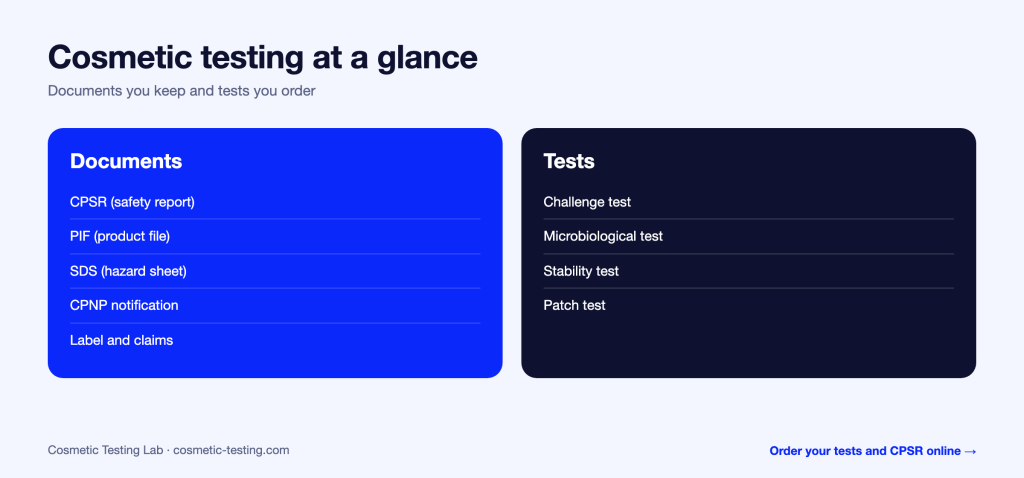
Most cosmetic testing terms fall into five groups: documents (CPSR, PIF, SDS), roles (responsible person), microbiology (challenge test, microbiological specifications), stability (shelf life, PAO) and skin safety (patch test). Learn these five groups and you can read almost any lab report, quote or regulator request. The definitions below follow the EU Cosmetics Regulation (EC) No 1223/2009 and common industry practice; other markets use similar ideas with different names.
Roles and documents
- Responsible person (RP): the legal or natural person established in the EU who is accountable for a cosmetic product placed on the market. Their name and address appear on the label.
- PIF (product information file): the folder of documents the responsible person keeps for each product and makes available to authorities. It is normally kept for ten years after the last batch was placed on the market.
- CPSR (cosmetic product safety report): the signed safety assessment inside the PIF. Our guide to the CPSR explains it in detail.
- CPNP: the EU Cosmetic Products Notification Portal, where the responsible person notifies each product before it is sold.
- SDS (safety data sheet): a 16-section hazard document used mainly for workplace and supply-chain safety. It is not the same as a CPSR; see our page on the SDS.
Read also Advantages of testing cosmetics with us
Terms inside the safety assessment
The CPSR has two parts. Part A collects the safety information: formula, physical and chemical properties, microbiological quality, packaging, exposure and toxicological data. Part B is the conclusion written by a qualified safety assessor, including the assessment of safety, labelled warnings and the assessor’s credentials.
You will also see a few toxicology terms. NOAEL is the no observed adverse effect level, the highest dose of a substance at which no harm was seen in studies. SED is the systemic exposure dosage, an estimate of how much of an ingredient reaches the body from normal use. The margin of safety (MoS) compares the two; assessors typically look for a margin of at least 100 for systemic effects, using a conservative approach.
Ingredient and formula terms
INCI stands for International Nomenclature of Cosmetic Ingredients, the standard naming system used in ingredient lists. Annexes II to VI of the EU regulation list prohibited substances (II), restricted substances (III), colourants (IV), preservatives (V) and UV filters (VI). If an ingredient is on a restricted list, its maximum concentration and conditions of use are set there.
Other words worth knowing: impurities and traces are unwanted substances that are technically unavoidable; CMR substances are carcinogenic, mutagenic or toxic for reproduction and are tightly controlled; allergens are fragrance substances that must be named on the label above set thresholds.
Microbiology terms
Water-based products can grow bacteria, yeast and mould, so microbiology has its own vocabulary.
- Challenge test (preservation efficacy test): deliberately contaminates the product with reference microorganisms and counts how well the preservative system kills or controls them over 28 days. In our lab it uses five reference microorganisms and the standard ISO 11930:2019 or USP 51. Read more about the challenge test.
- Microbiological specifications test: checks the quality of the finished product today, for example total counts and absence of specified pathogens. See the microbiological test.
- Preservative system: the preservatives, and sometimes supporting ingredients, that protect the product from spoilage and from contamination during use.
The two tests answer different questions. One asks whether the product is clean now; the other asks whether it will stay protected when consumers use it.
Read also Cosmetic testing process in Cosmetic Testing Lab (from start to finish)
Stability terms
Stability testing shows how a product changes over time and under stress. Accelerated testing stores samples at raised temperatures, or cycles them between hot and cold, to predict ageing faster than real time. Compatibility asks whether the formula and the packaging suit each other, for example whether the product stains a container or the plastic absorbs an ingredient.
Two label terms come from these results. A date of minimum durability (the “best used before the end of” wording) is required for products with a durability of 30 months or less. The PAO symbol, an open jar with a number of months, shows how long a product stays good after opening and is used for products with a longer durability. Our stability test supports both decisions.
Skin safety terms
An irritant causes a local, non-immune reaction; a sensitiser can trigger an allergic response after repeated contact. A patch test places the product on the skin of volunteers under a patch and records reactions. Occlusive means the patch is sealed against the skin, which increases exposure and makes the test more sensitive. Our patch test is a single 48-hour occlusive patch test. The phrase dermatologically tested is a claim, and what it may say should be backed by documented evidence, not just used as a marketing label.
Manufacturing and labelling terms
GMP means good manufacturing practice. For cosmetics, the harmonised standard is ISO 22716, which covers premises, personnel, production, quality control and records. A batch is a defined quantity produced in one run, and batch numbers let you trace a product back. Claims are statements about what a product does; the EU requires them to be legal, truthful, evidenced, honest, fair and support informed decisions. CLP and REACH are chemical laws that matter mostly for raw materials and for the SDS rather than for the finished cosmetic itself.
Read also Outsource Cosmetic Testing or Test In-House? A Practical Guide
Terms for other markets
If you sell beyond the EU, the same ideas appear under local names. In Great Britain the equivalent of the responsible person is a UK responsible person, and products are notified through a UK system. In the United States the Modernization of Cosmetics Regulation Act (MoCRA) introduced duties such as facility registration, product listing and safety substantiation. Confirm current details with the authority before launch.

How the terms connect in practice
Think of a typical launch as a chain. The formula goes to the lab, where stability, microbiological and (for water-based products) challenge test results are produced. A skin test may follow if you want evidence for gentleness claims. All results feed Part A of the CPSR. The assessor writes Part B and signs. The responsible person then compiles the PIF, notifies the product and finalises the label.
Common mix-ups to avoid:
- Treating an SDS as a safety report. They serve different purposes.
- Thinking a challenge test and a microbiological test are the same thing.
- Assuming a PAO symbol replaces a stability study. It should be justified by data.
A quick checklist before you order
- Write down your final formula with INCI names and percentages.
- Decide who your responsible person will be.
- Check whether the product is water-based; if so, plan a challenge test.
- Match the tests to the claims you plan to make.
- Ask your safety assessor which standard and report format they prefer.
We do not give legal advice, but our free DHL sample pickup and signed PDF reports make each step simple to order online. Create a free account to unlock 10% off your first order and 20% on bundles.
Frequently asked questions
Is a CPSR the same as a PIF?
No. The CPSR is one document, the signed safety assessment. The PIF is the whole file, which contains the CPSR together with the product description, manufacturing method, proof of effect where relevant and other records.
Which test terms matter for a small brand?
Usually the challenge test (for water-based products), the microbiological specifications test and the stability test, because the safety assessor typically needs them for Part A. A patch test is added when you want evidence for tolerance claims.
Do these terms apply outside the EU?
The ideas are shared, but the legal names, deadlines and notification systems differ. Use this glossary as a starting vocabulary and check each target market separately.
Key takeaways
- Group terms into documents, roles, microbiology, stability and skin safety to understand any report.
- The CPSR sits inside the PIF; the responsible person is accountable for both.
- Challenge test, microbiological test and stability test answer three different questions.
- Terms and rules differ by market, so verify each launch country.