

Phenoxyethanol is one of the most widely used preservatives in modern formulas, and one of the most debated online. If you are developing a product, you need facts rather than headlines: what the law allows, what regulators have concluded and what testing you still owe even when you use it. This guide covers phenoxyethanol in cosmetics in plain language.
Contents
- The short answer
- What is phenoxyethanol and why do brands use it?
- What does EU law say?
- What did the SCCS conclude?
- Is phenoxyethanol safe for sensitive skin and babies?
- Why “allowed” does not mean “preserved”
- Where phenoxyethanol fits in a preservation system
- Labelling and claims
- What documents do you need if your formula contains it?
- Common mistakes with phenoxyethanol
- Phenoxyethanol checklist before launch
- Frequently asked questions
- Key takeaways
The short answer
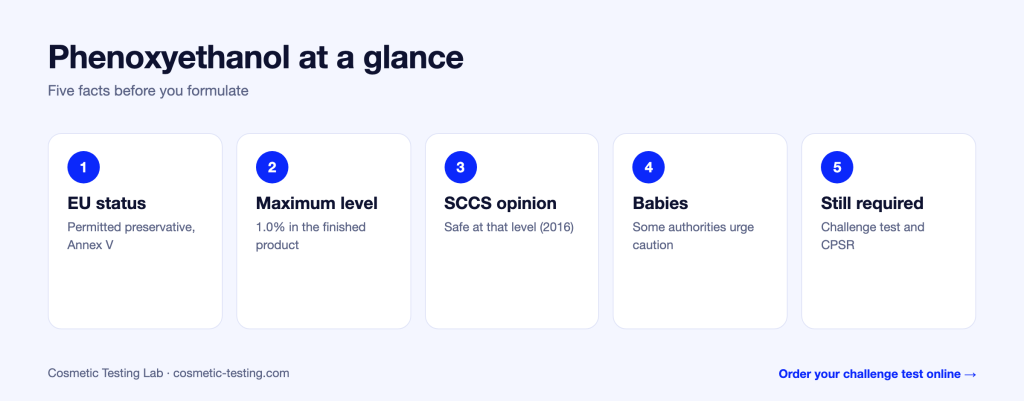
In the EU, phenoxyethanol is a permitted preservative (Annex V of Regulation (EC) No 1223/2009) with a maximum concentration of 1.0% in the finished product. The EU’s scientific committee, the SCCS, concluded in 2016 that it is safe at that level for consumers of all ages, based on the information it reviewed. Using it does not replace a safety assessment or a preservation efficacy test: your formula still has to be shown to be safe and properly preserved.
What is phenoxyethanol and why do brands use it?
Phenoxyethanol is a glycol ether that occurs in tiny amounts in nature (for example in green tea) but is produced synthetically for cosmetics. It is liquid, dissolves well in many formulas, has little scent and does not usually change the colour or texture of a product. It works against many bacteria and some yeasts and moulds, which is why it appears in creams, lotions, shampoos, wipes and make-up.
Brands also choose it because it is an alternative to older preservatives that consumers have come to dislike, including formaldehyde releasers. Its weak point is that no single preservative covers every microorganism, so it is often combined with other ingredients that support its activity.
Read also Essential Oils in Cosmetics: Safety and Legal Limits
What does EU law say?
Preservatives are the most tightly controlled group of cosmetic ingredients. Only substances listed in Annex V of the cosmetics regulation may be added to a product to inhibit the growth of microorganisms, and each entry has its own conditions. Phenoxyethanol is listed with a maximum authorised concentration of 1.0%. If you use more, the product is not compliant, whatever the safety data of your supplier says.
The limit applies to the finished product as sold, not to the raw material. If your formula contains a pre-blended preservative system, check how much phenoxyethanol it delivers at your use level, and add up all sources of the substance in the formula.
What did the SCCS conclude?
The Scientific Committee on Consumer Safety evaluated phenoxyethanol in an opinion adopted in 2016 (SCCS/1575/16). It considered the substance safe as a preservative at a maximum of 1.0%, taking the information provided into account. The committee looked at exposure from different product types and at children, and found an adequate margin of safety. It also noted that its opinion does not cover exposure from sources other than cosmetics.
Not every authority took the same view. The French agency ANSM, for instance, recommended that phenoxyethanol should not be used as a preservative in products for the nappy area of children under three, including wipes. This is a recommendation, not an EU-wide ban, but it shows why many brands of baby products choose another system or a lower level. Always check the current position of the authorities in your target markets.
Is phenoxyethanol safe for sensitive skin and babies?
At the permitted level, the SCCS found it acceptable, and skin irritation or sensitisation from phenoxyethanol at cosmetic concentrations is considered uncommon. Individual reactions can still happen, as with any ingredient, and they often depend on the whole formula, not one substance. For leave-on products designed for babies, damaged skin or the nappy area, the safety assessor will look at exposure closely. Many brands choose lower use levels, or a different preservative strategy, and document the reasoning in the CPSR.
If you want to see how real skin responds to the finished product, a patch test adds human data that supports the assessment, especially for products marketed as suitable for sensitive skin.
Read also Retinol EU Regulation: Limits, Dates and Safety
Why “allowed” does not mean “preserved”
This is the most common misunderstanding. A legal limit says how much you may use. It does not say that the amount is enough. Whether your product is truly preserved depends on water activity, pH, other ingredients, packaging and the microorganisms it meets in use. Some ingredients weaken a preservative, for example certain surfactants, and others support it. The only way to know is to test.
A challenge test contaminates the finished product with five reference microorganisms and follows how they decline over 28 days, according to ISO 11930:2019 or USP 51. A formula with phenoxyethanol at 0.8% may pass, and a similar one may fail. A passing result is the evidence the safety assessor needs to accept the preservation system.
Where phenoxyethanol fits in a preservation system
In practice, formulators build a system rather than relying on one ingredient. A few common considerations:
- Spectrum: check the report for which organisms are slow to decline. If yeasts or moulds lag, a booster is often added.
- pH and water: pH affects many preservatives, and water-based products need the most protection.
- Packaging: airless pumps limit contamination; open jars invite it. The more the consumer touches the product, the harder the system works.
- Other claims: a “preservative-free” claim is only valid if no ingredient has a preserving function, which is rarely the case with water-based formulas.
Labelling and claims
Phenoxyethanol must appear in the ingredient list under its INCI name, in the descending order of concentration, like any other ingredient. Marketing statements such as “phenoxyethanol-free” are allowed only if they are true and do not imply that the ingredient is unsafe. The claims rules require that statements are honest and supported by evidence, and they do not allow a brand to suggest that a legal ingredient is harmful when authorities have assessed it as safe at the permitted level.
Read also Margin of Safety (MoS) in Cosmetics: How It Is Calculated
What documents do you need if your formula contains it?
A responsible person placing a product with phenoxyethanol on the EU market normally keeps these in the product information file:
- The formula with the exact use level of phenoxyethanol and of any other preservative.
- Supplier specification and purity data for the raw material.
- A challenge test report that shows the system works in your finished product and packaging.
- Stability and microbiological quality data that cover the shelf life. Our stability test and microbiological test provide them.
- A signed CPSR where the assessor evaluates exposure, margin of safety and the intended user group.
Raw material suppliers also provide an SDS for the ingredient, which is useful for the workplace but is not a substitute for the product-level safety report.
Common mistakes with phenoxyethanol
- Adding it at 1.0% and assuming the product is preserved without a test.
- Forgetting that a blended preservative already contains phenoxyethanol, so the total exceeds the limit.
- Reformulating (new surfactant, new pH) and reusing an old challenge test report.
- Marketing a baby product without checking the position of authorities on the nappy area.
- Making fear-based claims about competitors’ ingredients.
Phenoxyethanol checklist before launch
- Use level confirmed at or below the Annex V maximum.
- Total contribution from every raw material calculated.
- Challenge test passed on the final formula and packaging.
- Stability and microbiological data on file.
- CPSR signed and the label correct.
Frequently asked questions
Is phenoxyethanol banned in the EU?
No. It is a permitted preservative with a maximum concentration of 1.0% in the finished product. Some authorities recommend restrictions for specific uses, such as nappy-area products for very young children.
Can I use phenoxyethanol in natural cosmetics?
The law does not forbid it, but many natural certification schemes do not accept it. Check the standard you are targeting. Legally, a product can be sold as natural only if the claim is substantiated and not misleading.
Do I need a challenge test if I stay below 1.0%?
Yes. The limit is a ceiling, not proof of efficacy. A challenge test shows that your own formula is preserved, and a safety assessor normally expects it for water-containing products.
Key takeaways
- Phenoxyethanol is allowed in the EU up to 1.0% in the finished product.
- The SCCS judged this level safe in 2016, while some national authorities advise caution for nappy-area products.
- A legal preservative does not guarantee a preserved product: test it.
- Keep the challenge test, stability data and CPSR together in the product file.