
The Netherlands and Belgium sit side by side, share ports and logistics, and are often the first stop for brands expanding beyond their home market. If you want to sell cosmetics in the Netherlands and Belgium, the good news is that the core rules are the same EU rules you already know. The differences are practical: who inspects you, which language the label must use, and which packaging obligations apply. This guide walks through them in plain language for brands that are compliant with Regulation (EC) No 1223/2009 or preparing to be.
Contents
- The short answer
- The EU baseline in brief
- Who supervises cosmetics in the Netherlands?
- Who is responsible in Belgium?
- Which language must the label use in the Netherlands?
- Which language must the label use in Belgium?
- Packaging rules in both countries
- What do marketplaces and retailers expect?
- Checklist for selling in the Netherlands and Belgium
- Common mistakes
- Frequently asked questions
- Key takeaways
The short answer
You need the same EU compliance file in both countries: a responsible person, a signed safety report (CPSR), a product information file and a CPNP notification. On top of that, check three national points: the supervising authority, the language of the label and your packaging obligations. Dutch rules are fairly clear on label language; Belgium has three official languages, so plan the label carefully and confirm the details with the authority. Nothing here is legal advice.
The EU baseline in brief
These four elements apply in every EU country, so they travel with you:
- Responsible person (RP): a company or person established in the EU, named on the label, who is accountable for compliance.
- Safety report (CPSR): Part A (product data) and Part B (the safety assessment), signed by a qualified safety assessor.
- Product information file (PIF): the CPSR, formula, manufacturing information, claim evidence and test reports, kept ready for inspection.
- CPNP notification: the product is notified once in the European portal before it is placed on the market.
One notification and one file cover both countries. You do not need a separate Dutch or Belgian dossier.
Read also Selling Cosmetics in Slovenia: Rules, Authorities and Labels
Who supervises cosmetics in the Netherlands?
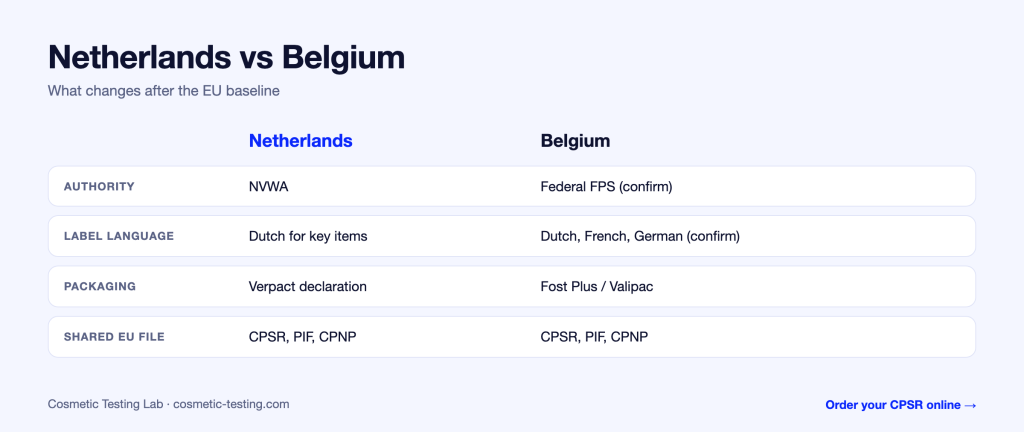
The Netherlands Food and Consumer Product Safety Authority, the NVWA, supervises cosmetics. The Dutch government’s business portal states that the safety assessment must be available for inspection by the NVWA and that, if the authority asks for product information, you must supply it within three working days. In practice this means your file should be complete, organised and quickly reachable, not stored in several places across several people.
The national framework is the Warenwetbesluit cosmetische producten (the Cosmetic Products Commodities Act decree), which supplements the EU regulation. According to a legal guide, the NVWA can issue orders, seize goods and publish warnings, so a missing document is a real risk rather than a formality.
Who is responsible in Belgium?
In Belgium, cosmetics are handled at federal level. Sources commonly name the Federal Public Service (FPS) Public Health, Food Chain Safety and Environment as the competent authority, but some commercial guides mention other federal bodies as well. Because the sources are not fully consistent, check the current contact point on the official federal pages before you launch or when you receive an inspection request. The obligations on your side do not change: the responsible person, the CPSR and the file must be ready on request.
Which language must the label use in the Netherlands?
Article 19(5) of the EU regulation leaves the label language to each member state. According to a legal guide on the Dutch market, the Warenwetbesluit requires the information referred to in Article 19(1)(b), (c), (d) and (f) and Article 19(2) to (4) to appear in Dutch. In plain terms, that covers the nominal content, the minimum durability date or period after opening, the precautions and warnings, the function of the product (unless it is obvious from its presentation) and the rules on leaflets and tags that carry this information. The same guide says that other information may be given in Dutch or English, for example the responsible person details and the ingredient list, which uses INCI names in any case.
Because details can be revised, treat this as a working summary and confirm the current wording of the decree before you print.
Read also Selling Cosmetics in the USA: MoCRA Step by Step
Which language must the label use in Belgium?
Belgium has three official languages: Dutch, French and German. Guides disagree on how strictly this applies to cosmetics. Some say all required information should appear in all three languages; others say the language or languages of the region where the product is sold are what counts, and that using all three is simply common practice. Do not rely on a single blog post. The safest approach for a brand selling across Belgium is:
- Provide the required information at least in Dutch and French, and add German if you want to be fully covered or sell in the German-speaking community.
- Use multilingual labels, or a leaflet or folded label, when space is limited.
- Ask the authority or your distributor which languages they expect for your sales channel.
If your label is printed once for both countries, a combined Dutch and French label also satisfies the Dutch requirement, which is why many brands choose it as the starting point.
Packaging rules in both countries
Packaging is not part of the cosmetics regulation, but it is a typical surprise for newcomers.
- Netherlands: official Dutch government guidance says that businesses placing more than 50,000 kg of packaging on the Dutch market in a calendar year must file a declaration with Verpact (formerly Afvalfonds Verpakkingen). This also applies to foreign companies selling directly online to Dutch consumers. Single-use plastic packaging is reported even below that threshold.
- Belgium: packaging responsibility is organised through Fost Plus (household packaging) and Valipac (commercial and industrial packaging). According to an Austrian chamber of commerce briefing, producers outside Belgium have to appoint an authorised representative based in Belgium, and the national rules are being adapted to the EU packaging regulation. Details and dates are still moving, so confirm them with the organisations directly.
Even if your volumes are small, record how much packaging you ship to each country; the EU packaging regulation is expected to tighten thresholds over time.
What do marketplaces and retailers expect?
Online platforms enforce the label rules before the authorities do. The Dutch marketplace bol.com, for example, requires structured information for cosmetic listings: the full ingredient list with INCI names, the manufacturer name and address, the content in grams or millilitres, the language of the packaging, the country of origin and, depending on the product, the shelf life or period after opening. Listings with missing or placeholder information are taken offline until corrected. Retailers and distributors typically also ask for the CPNP reference, proof of a responsible person in the EU and a statement that a signed CPSR exists.

Read also Selling Cosmetics in Croatia: Rules, Authorities and Labels
Checklist for selling in the Netherlands and Belgium
- Confirm that your responsible person is established in the EU and named on every label.
- Check that the signed CPSR is complete, with stability, microbiological and, for water-based products, challenge test data behind it.
- Notify each product in the CPNP before the first sale.
- Prepare the label in Dutch, plus French (and German where needed) for the required items.
- Keep the product information file in one place and be ready to deliver it quickly.
- Check packaging registration with Verpact and with the Belgian organisations.
- Prepare marketplace listing data: INCI list, content, manufacturer address, packaging language, country of origin.
Common mistakes
- Printing English-only warnings and usage instructions for the Dutch market.
- Assuming that a French label alone is enough for all of Belgium without checking.
- Selling through a webshop to Dutch consumers and ignoring packaging registration because the company is abroad.
- Updating a formula without refreshing the CPSR and the CPNP entry.
- Giving the responsible person a file that cannot be produced within days.
Frequently asked questions
Do I need a separate CPSR for Belgium?
No. A single signed CPSR and product information file serve all EU countries. Only the label language, the local authority and the packaging obligations differ.
Can I use English on my label in the Netherlands?
For the items that must be in Dutch, English alone is not enough. Other information may be given in Dutch or English according to a Dutch legal guide, but check the current decree.
Is a UK or US brand allowed to sell in the Netherlands?
Yes, with an EU responsible person, an EU-compliant safety report and a CPNP notification. The responsible person must be established in the EU.
Key takeaways
- One EU dossier covers the Netherlands and Belgium; the differences are national.
- The NVWA supervises in the Netherlands and expects documents quickly; confirm the Belgian contact point.
- Dutch is required for key label items; in Belgium plan for Dutch, French and possibly German.
- Check packaging registration and marketplace data before the first shipment.