
Not every cosmetic product needs the same microbiological proof. Some products are such poor places for microbes to grow that the law and the standards treat them as low risk; others will spoil quickly without a working preservative. This guide explains which cosmetics need a challenge test, which can usually skip it and how to decide for your own product.
Contents
- The short answer
- Why does a challenge test exist?
- Is a challenge test required by law?
- Products that normally need a challenge test
- Products that may be low risk
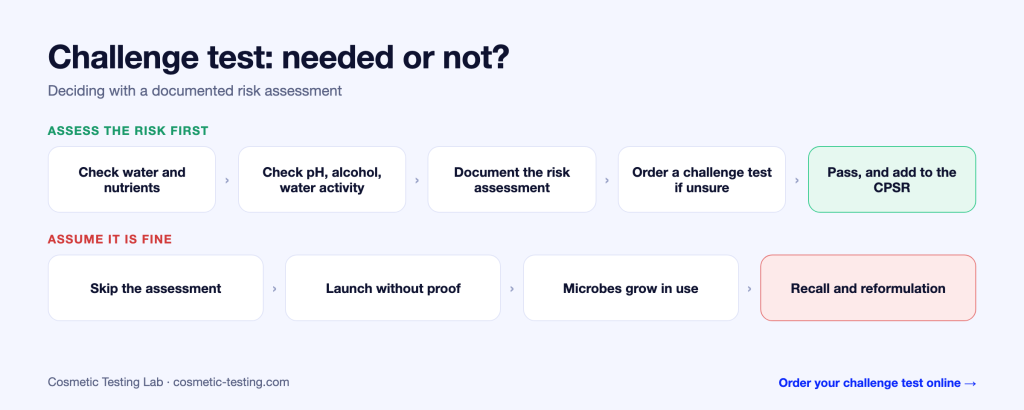
- How to decide for your product
- What if the formula or packaging changes?
- Challenge test, microbiological specifications and stability: how they differ
- Why packaging matters for the decision
- Common mistakes
- Frequently asked questions
- Key takeaways
The short answer
Cosmetics that contain water or are otherwise able to support microbial growth, such as creams, lotions, gels, shampoos, wipes and most liquid make-up, need a challenge test to show the preservative system works. Products with a very low water activity, very high alcohol content, an extreme pH or an anhydrous (water-free) formula can often be classed as low risk after a documented microbiological risk assessment, and may then be exempt. The decision is part of the product’s safety assessment and should be documented in the CPSR.
Why does a challenge test exist?
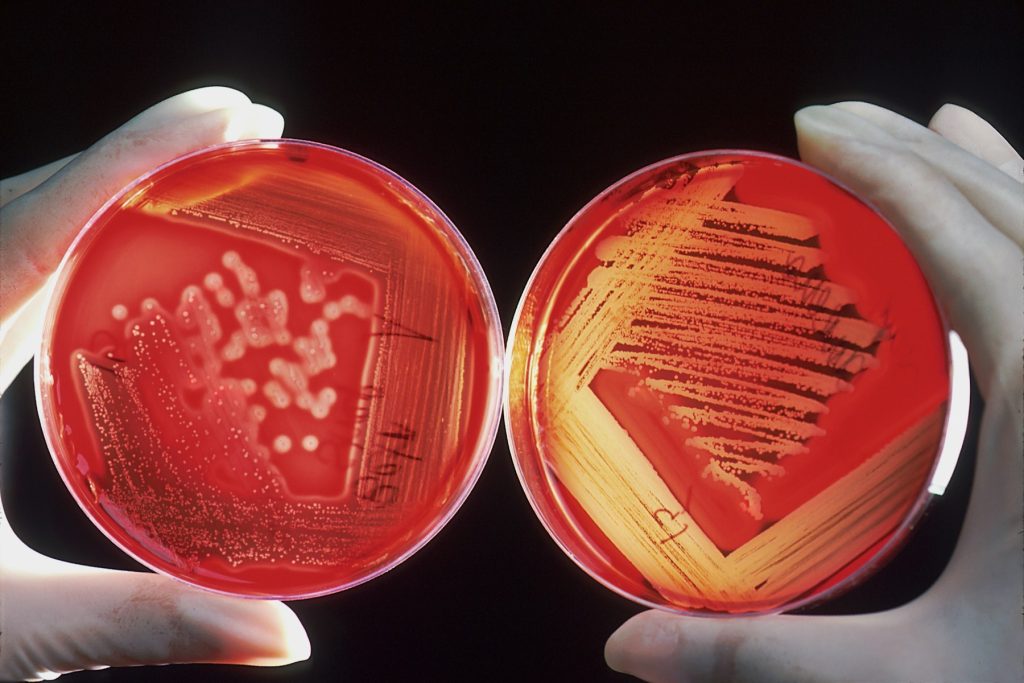
Cosmetics have to stay microbiologically safe not only on the day they are made but throughout their shelf life and while the consumer uses them. Opening a jar, dipping a finger in or squeezing a bottle introduces microbes. A challenge test deliberately adds a known number of reference microorganisms to the product and measures how quickly they die off over 28 days. If the numbers fall as the standard requires, the preservation is effective. Under ISO 11930:2019 and the pharmacopoeial method USP 51, five reference organisms are used: bacteria, a yeast and a mould.
Read also What Is a Cosmetic Challenge Test? Preservative Efficacy Testing Explained
Is a challenge test required by law?
The cosmetics regulation does not name the test, but it requires that the product is safe and that its microbiological quality is part of the safety assessment. The guidelines for the CPSR ask for information on microbiological quality, and in practice the challenge test is the accepted way to show that the preservation of a susceptible product is adequate. Authorities and safety assessors therefore expect it for products that can support growth. For others, the assessor can accept a reasoned low-risk justification instead.
Products that normally need a challenge test
As a rule of thumb, if the product contains water, or a mix of water and oil, or natural ingredients that microbes can feed on, you should plan a challenge test. Typical examples are:
- creams, lotions, serums and gels with a water phase;
- shampoos, conditioners, shower gels and liquid soaps;
- wet wipes and impregnated pads;
- mascara, liquid foundation and other water-based make-up;
- sunscreen emulsions and after-sun products;
- hair masks, styling gels and cream deodorants;
- products with botanical extracts, proteins, sugars or other nutrient-rich ingredients;
- toothpaste and mouthwash that contain water.
Products described as “natural”, “preservative-free” or “self-preserving” need particular care. Without a classic preservative, the formula has to protect itself through other means, and a challenge test is the only way to prove it.
Products that may be low risk
ISO 29621 sets out how to carry out a microbiological risk assessment and which products can be considered microbiologically low risk. The typical examples are products where microbes cannot multiply or survive:
- anhydrous products such as oils, waxes, balms and lipsticks, with no water phase;
- products with a very high alcohol content, such as many perfumes and some sanitising products;
- products with a very low or very high pH, for example certain exfoliants and hair-straightening products;
- powders and other products with very low water activity;
- products filled hot and sealed in packaging that protects them from contamination, or single-use packs that are hermetically sealed;
- solvent-based products such as nail polish.
The exact criteria and limit values are in the standard itself, and they must be met by the actual formula. Being in a category listed above does not guarantee exemption. For example, a balm that picks up moisture from the skin, or a powder that is used wet, may need another look.

Read also Challenge Test Cost: What Affects the Price
How to decide for your product
- List the ingredients and the water content. Does the formula contain free water, even in small amounts?
- Check the key parameters. Look at pH, alcohol content and water activity.
- Look at the packaging and use. A pump bottle protects better than an open jar, and a product used in the shower faces more contamination than a lip balm.
- Do the risk assessment. Document the reasoning as ISO 29621 describes.
- If in doubt, test. A passed challenge test is clear evidence for the safety assessor and the file.
What if the formula or packaging changes?
A challenge test belongs to a specific formula in a specific package. Run it again, or at least ask your safety assessor whether it is needed, when you change the preservative or its level, add a new active or extract, change the fragrance, switch from a tube to a jar or change the supplier of a critical raw material. For a range of very similar products, an assessor can sometimes select the worst case for testing, but this has to be justified and documented.
Challenge test, microbiological specifications and stability: how they differ
These tests are often mixed up. The challenge test measures whether the preservative system works against a deliberate contamination. The microbiological specifications test checks that the finished product itself is clean now, for example for total aerobic count, yeast and mould and specified pathogens. The stability test shows how the product behaves over time and in its packaging. A water-based product usually needs all three for a complete CPSR.
Read also My Product Failed the Challenge Test: What to Do Next
Why packaging matters for the decision
The same formula can behave differently in different packs. An airless pump or a tube with a narrow opening limits contact with air and fingers, so the contamination pressure during use is lower. A wide-mouth jar that is opened daily and touched with fingers is the harder case. ISO 11930 takes this into account, and so does a careful safety assessor. If you move a product from a pump to a jar, treat it as a change that may need a new look, and tell your assessor before you print new packaging.
Common mistakes
- Assuming small batches or handmade products are exempt. Size does not change the biology.
- Relying on an ingredient list. A listed preservative does not prove it works in your formula and package.
- Using a supplier’s test on another formula. Results apply only to the tested composition.
- Skipping the written risk assessment. A “low risk” claim without documentation will not satisfy an assessor.
- Testing too late. A failed result near launch forces a reformulation, so test early.
Frequently asked questions
Do I need a challenge test for a product with a high alcohol content?
Possibly not. Products with very high alcohol content are often low risk, but the assessment should show that the actual formula, with its water and other ingredients, meets the criteria in ISO 29621. If not, test.
Does a challenge test replace the microbiological specifications test?
No. They answer different questions. One shows that the preservative works under challenge; the other shows the finished product is microbiologically clean now.
Do I need a challenge test for every shade or fragrance variant?
Not always. Variants with the same base and preservative system can sometimes be covered by testing the worst case, if the safety assessor agrees and documents it. Variants with a different base need their own test.
Key takeaways
- Products with water, nutrients or other support for microbes need a challenge test.
- Anhydrous, high-alcohol, extreme-pH and very dry products may be low risk, but only after a documented assessment.
- Re-test or re-assess when the formula, preservative or packaging changes.
- When in doubt, a passed challenge test is the strongest proof for your CPSR.