

Not every cosmetic is held to the same microbial standard. A baby lotion and a hand cream are judged against different numbers, and getting the category wrong can make a perfectly good batch look like a failure, or a risky one look fine. This guide explains cosmetics category 1 category 2 microbial limits: who belongs where, what the limits are in practice and how to use them when you plan your tests.
Contents
- The short answer
- Where do these categories come from?
- Category 1: the strictest group
- Category 2: all other products
- The pathogens that must always be absent
- What about yeasts and moulds?
- How do I know which category my product is?
- How the categories affect your testing plan
- Passing the limits is not the whole story
- Common mistakes
- A quick planning checklist
- Frequently asked questions
- Key takeaways
The short answer
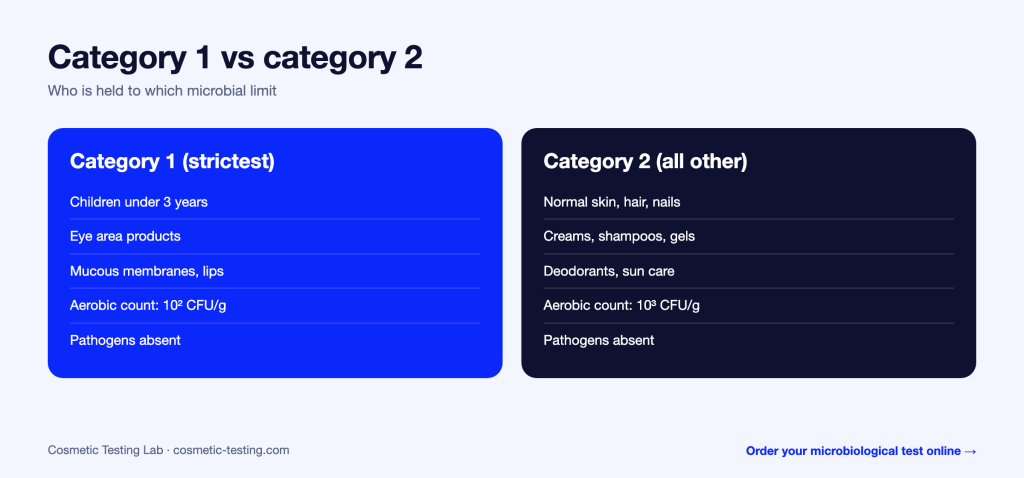
Category 1 covers products intended for children under three years, products used around the eyes and products that come into contact with mucous membranes; they have the strictest limits. Category 2 covers all other cosmetics. Under ISO 17516, the total aerobic mesophilic count is typically limited to 10² CFU per gram or millilitre for category 1 and 10³ for category 2, and specified pathogens must be absent. The same logic is reflected in the SCCS Notes of Guidance used for the safety assessment. Always check the exact wording of the version your safety assessor works with.
Where do these categories come from?
The EU Cosmetics Regulation requires every product to be microbiologically safe, but it does not list numerical limits itself. The numbers used in practice come from two connected sources: the SCCS Notes of Guidance, which the safety assessor follows for the CPSR, and the international standard ISO 17516, which sets out microbiological limits for cosmetics. Both split products into two groups, based on how vulnerable the user or the exposed tissue is. The idea is simple: the more sensitive the skin or membrane, the fewer microorganisms you can tolerate.
Read also ISO 17516 Cosmetics: Microbiological Limits Explained
Category 1: the strictest group
Category 1 is intended for users and body areas where an infection is more likely or more serious. It includes:
- products specifically for children under three years, such as baby creams, wipes and shampoos;
- products applied to the eye area, such as eye creams, eyeliner, mascara and eye make-up removers;
- products that touch mucous membranes, such as lip products, mouthwash and intimate hygiene products.
For these products the aerobic mesophilic count is usually limited to 10² CFU/g or mL (about 100 colony-forming units), and the specified microorganisms must be absent in the sample tested.
Category 2: all other products
Category 2 is everything else that is applied to normal skin, hair and nails: face and body creams, shower gels, shampoos, deodorants, make-up for the skin, sunscreens and similar products. The aerobic mesophilic count is usually limited to 10³ CFU/g or mL, ten times higher than category 1. Specified microorganisms, again, must be absent.
The pathogens that must always be absent
In both categories, certain microorganisms are not accepted at all because they can cause infections even in small numbers. ISO 17516 names Pseudomonas aeruginosa, Staphylococcus aureus, Candida albicans and Escherichia coli, and the test sample is typically one gram or millilitre. Older guidance used smaller sample sizes for some groups, so the exact quantity tested depends on the method and the reference document. This is why the lab report must state which standard and sample size were used, and why you should check this with your assessor before the test, not after.
Read also Total Aerobic Microbial Count in Cosmetics: What It Means
What about yeasts and moulds?
Yeasts and moulds are counted separately from bacteria. The reference documents also set limits for them, and these are in the same order of magnitude as the aerobic count or stricter, so a product can pass on bacteria and still fail on moulds. Because the published figures differ slightly between sources and versions, take the exact yeast and mould limit from the document your assessor applies. Our companion guide on the total aerobic count explains how these numbers are read.
How do I know which category my product is?
Look at intended use and the user, not just the product type. Some borderline cases:
- Lip balm: category 1, because it touches the mucous membrane of the lips and can be swallowed.
- Face cream with a claim for the eye area: category 1 if it is intended to be used around the eyes.
- General baby body wash: category 1 if marketed for children under three.
- Foot cream or body butter: category 2.
- Product used on damaged skin: usually handled with more caution; ask your assessor how to classify it.
When a product could fall into both groups, choose the stricter one. Your label, your marketing and your claims should match the category you test to.

How the categories affect your testing plan
The category determines the limit the lab compares your result against, so give the lab the correct information when you submit samples. With a microbiological specifications test, you receive counts for the total aerobic bacteria and the yeast and mould plus the result for the specified pathogens, judged against category 1 or 2. The category does not change the challenge test, which is about preservation, but both reports end up together in the CPSR. A product aimed at babies or the eye area is also a stronger reason to look closely at hygiene and preservation, because the safety assessor will do so as well.
Read also Yeast and Mould Count in Cosmetics: Limits, Method and Results
Passing the limits is not the whole story
A result that meets the limit on one day does not guarantee the product stays that way. After opening, contamination can enter and grow, and the limits above apply to the product as sold. That is why the safety file combines three things: microbiological quality from the micro test, preservation from the challenge test, and a stability study that checks the product over its shelf life. You can read more in our article on the stability and compatibility test.
Common mistakes
- Testing against the wrong category. Use the stricter category when in doubt.
- Treating a result as a pass without checking the sample size. “Absent” only means something for a stated quantity.
- Using only the aerobic count. Yeasts, moulds and pathogens need to be reported too.
- Testing a single lab batch. Plan testing on production batches in the final pack.
- Ignoring changes. New water supply, new raw material or new filling line can change the picture, so retest after significant changes.
A quick planning checklist
- Decide the intended user and use area, and assign category 1 or 2.
- Agree the reference standard and sample size with your safety assessor.
- Send samples in the final packaging to the lab.
- Check that the report lists the standard, the category and every parameter.
- File the report in your product information file and make sure the CPSR refers to it.
Frequently asked questions
Is a baby product always category 1?
Products specifically intended for children under three years are treated as category 1. Products for older children generally fall into category 2, unless they are used around the eyes or on mucous membranes.
Are the limits legally binding?
The regulation requires products to be safe, and the numerical limits are the accepted way to show microbiological safety. Authorities and safety assessors refer to them, so in practice you should treat them as the benchmark, while the assessor remains responsible for the final judgement.
What if my result is above the limit?
Find the source: raw materials, water, equipment, hygiene or preservation. Fix it, test a new batch and file the corrected report. Do not release the failed batch.
Key takeaways
- Category 1 (children under three, eyes, mucous membranes) has stricter limits than category 2 (everything else).
- Typical aerobic count limits are 10² CFU/g for category 1 and 10³ for category 2, with specified pathogens absent.
- Choose the stricter category if a product could belong to both.
- Make sure the report names the standard, the category and the sample size.