

A lab report lands in your inbox and one line reads “TYMC: 40 CFU/g”. Is that fine? The yeast and mould count in cosmetics tells you how many living fungi are in your finished product, and it is one of the numbers a safety assessor checks before signing off a formula. In short: labs usually count yeast and mould with ISO 16212, the result is given in CFU per gram or millilitre, and together with the bacterial count it must stay within the limit for your product category, typically no more than 100 CFU/g for eye, baby and mucous-membrane products and no more than 1,000 CFU/g for other cosmetics.
Contents
- The short answer
- What does the yeast and mould count measure?
- How do labs run the test?
- Which limits apply to yeast and mould?
- How to read your result
- Which products are most at risk?
- Count today vs protection tomorrow
- When should you test?
- What to do if the count is too high
- Common mistakes
- Where does the result go in your documentation?
- Frequently asked questions
- Key takeaways
The short answer
TYMC (total yeast and mould count) is a plate count of the fungi in your product. It is part of a routine microbiological specifications test, alongside the total aerobic bacterial count and checks for specified harmful organisms such as Candida albicans. A result below the detection limit, usually reported as “<10 CFU/g”, means no yeast or mould was found.
What does the yeast and mould count measure?
Yeasts and moulds are both fungi, but they behave differently. Yeasts are single cells forming smooth, creamy colonies. Moulds grow as threads and form fuzzy colonies with coloured spores; they are the green, black or white spots you may see on a cream or around the neck of a jar.
Fungi are counted separately because they tolerate a lower pH, less available water and high sugar, so a product with few bacteria can still carry fungi. Their spores travel on air and plant material, making botanicals, powders and clays typical entry points.
Results are given in colony-forming units (CFU) per gram or millilitre: an estimate of viable units, not an exact cell count.
Read also ISO 17516 Cosmetics: Microbiological Limits Explained
How do labs run the test?
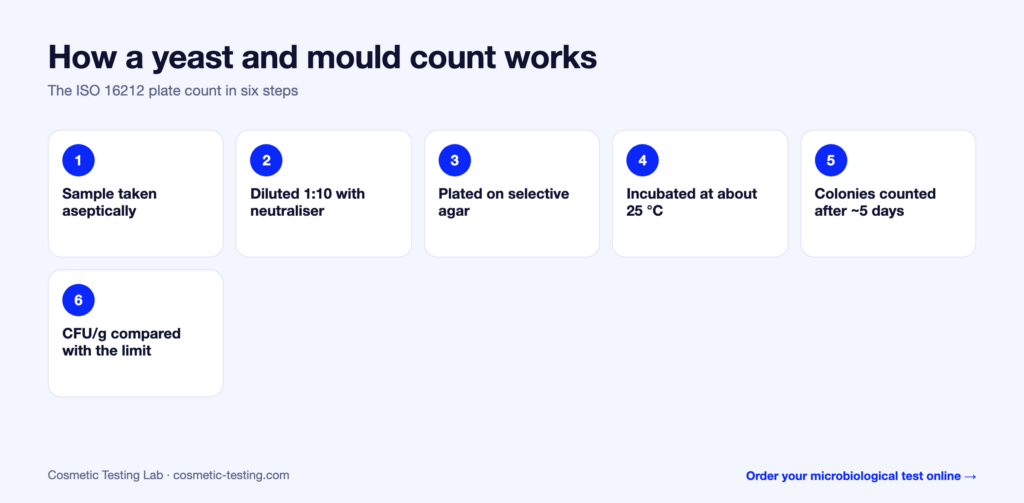
The reference method for cosmetics is ISO 16212, “Cosmetics – Microbiology – Enumeration of yeast and mould”. In outline:
- Sampling. A portion of the product is taken under aseptic conditions, usually from an unopened container.
- Dilution and neutralisation. The sample is typically diluted 1 in 10 in a liquid that also neutralises the preservatives so they cannot hide real contamination.
- Plating. The dilution is spread or poured onto a selective agar, or filtered through a membrane that is then placed on the agar. The medium contains an antibiotic that suppresses bacteria, so mainly fungi grow.
- Incubation. Plates are incubated at around 25 °C for several days, typically up to five, because many moulds grow slowly.
- Counting. Colonies are counted and multiplied by the dilution factor to give CFU/g or CFU/mL.
Before routine testing, a good laboratory checks that the neutraliser actually works for your formula. This matters most for strongly preserved products and formulas with antimicrobial essential oils.
Which limits apply to yeast and mould?
In the EU, the Cosmetics Regulation (EC) No 1223/2009 does not set numeric microbial limits in the text of the law. Safety assessors rely instead on ISO 17516 and the SCCS Notes of Guidance, which use two product categories:
- Category 1: products specifically intended for children under three, for the eye area and for mucous membranes. The total aerobic mesophilic count should not exceed 100 CFU/g or mL.
- Category 2: all other cosmetics. The total should not exceed 1,000 CFU/g or mL.
In ISO 17516, aerobic mesophilic microorganisms means bacteria plus yeast and mould, measured with ISO 21149 and ISO 16212. That is why your report usually shows two lines, TAMC and TYMC, and why the yeast and mould figure counts toward the overall limit. On top of the counts, the yeast Candida albicans must not be detected in 1 g or mL, together with Escherichia coli, Pseudomonas aeruginosa and Staphylococcus aureus. Some retailers set a tighter yeast and mould limit of their own, so ask before testing.
How to read your result
- “<10 CFU/g”: nothing grew at the lowest dilution tested. This is the result you want.
- A low number such as 20 or 40 CFU/g: a few viable units were found. Add it to the bacterial count and compare the total with the limit for your category.
- “Estimated” or “est.”: very few colonies grew; the figure is approximate but valid.
- A result above the limit: the batch does not meet the specification.
A worked example: a body lotion reports TAMC 30 CFU/g and TYMC 40 CFU/g. The total, 70 CFU/g, is well within the 1,000 CFU/g limit for a category 2 product. The same numbers on an eye cream are also acceptable, because 70 is below 100. But an eye cream with TYMC 150 CFU/g fails, even if no bacteria grew at all.
Read also Category 1 vs Category 2 Cosmetics: Microbial Limits
Which products are most at risk?
- Water-based creams and lotions with a mild or “free-from” preservative system.
- Products rich in plant extracts, botanical powders, clays or starches, which can bring spores in with the raw material.
- Formulas preserved with organic acids, such as sorbic or benzoic acid, when the pH drifts too high for the acid to work.
- Jars and wide-necked packs that customers dip their fingers into.
Products with a very low water activity, a high alcohol content or an extreme pH may be classed as low microbiological risk under ISO 29621. For them, a documented risk assessment can replace routine counts, but that decision belongs to your safety assessor.

Count today vs protection tomorrow
A low yeast and mould count shows that the batch was clean when it was tested. It does not show that the product will stay clean once a customer opens it. That is the job of the challenge test, in which the product is deliberately inoculated with microorganisms, including the yeast Candida albicans and the mould Aspergillus brasiliensis, and followed for 28 days. Moulds are often the hardest to control, so a perfect count does not guarantee a pass. Most water-based products need both results.
When should you test?
- On the batch used for the safety assessment, before the CPSR is signed.
- On production batches before release, at a frequency set in your quality system.
- At the start and end of a stability study, to see whether counts rise during storage.
- After a new botanical supplier, water system or production site.
Read also Total Aerobic Microbial Count in Cosmetics: What It Means
What to do if the count is too high
- Quarantine the batch. Do not sell it and do not blend it with clean batches.
- Ask the lab about identification. Knowing whether it is a yeast or a mould, and which one, points to the source.
- Check the usual suspects. Botanical raw materials, purified water, filling equipment, gaskets and the filling room.
- Review the preservative. Check the pH, the preservative dose and whether the system covers fungi as well as bacteria.
- Retest after corrective action and keep the investigation in your quality records.
Common mistakes
- Sending a sample from an opened, used container.
- Testing bacteria only and forgetting fungi in a botanical-rich product.
- Comparing a baby or eye product with the 1,000 CFU/g limit instead of 100.
- Ignoring visible mould. If you can see it, the product is not acceptable, whatever an older report says.
Where does the result go in your documentation?
The microbiological quality of the finished product is one of the items in Part A of the cosmetic product safety report, as set out in Implementing Decision 2013/674/EU. Your safety assessor uses the yeast and mould count, the bacterial count and the specified organisms to confirm that the product meets its limits, and refers to the challenge test for preservation. Keep the signed report in your Product Information File with the batch number and formula version.
Frequently asked questions
Is any yeast or mould acceptable in a cosmetic?
Yes, within limits. Cosmetics are not sterile, and a low count of harmless fungi is accepted as long as the total stays within the category limit, Candida albicans is absent and the count does not rise over the product’s life.
How long does a yeast and mould count take?
Incubation alone takes several days because moulds grow slowly. Our microbiological specifications test delivers a signed PDF report about five days after we receive your samples.
Do anhydrous products need a yeast and mould count?
Often yes, especially with botanical powders or water contact during use. Some qualify as low risk under ISO 29621; your assessor decides.
Key takeaways
- The yeast and mould count (TYMC) measures viable fungi in CFU/g, usually with ISO 16212.
- It counts toward the total limit: typically 100 CFU/g for eye, baby and mucous-membrane products and 1,000 CFU/g for others.
- A clean count shows today’s quality; the challenge test shows protection during use.
- A high count calls for quarantine, identification and a check of raw materials, water, equipment and preservative.