
Sooner or later a customer, a salon or a carrier asks for a safety data sheet, and the question becomes how to write an SDS for a cosmetic product. The document looks like a form, yet every line depends on the formula, on test data and on rules for classifying mixtures. This guide walks you through the work step by step, shows where mistakes creep in and explains when to hand the job to a competent author.
Contents
- The short answer
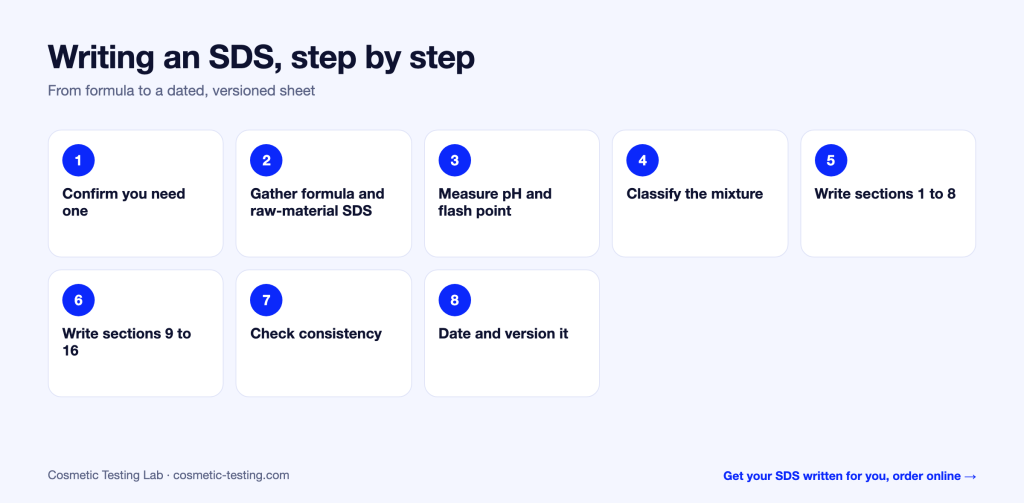
- Step 1: Confirm that you need one
- Step 2: Gather the inputs
- Step 3: Classify the mixture
- Step 4: Sections 1 to 3, identity and composition
- Step 5: Sections 4 to 8, handling and protection
- Step 6: Sections 9 to 11, properties and toxicology
- Step 7: Sections 12 to 16, environment, disposal, transport and regulation
- Step 8: Check, date and version the sheet
- Who should write it?
- A worked example: an alcohol-based body mist
- Common mistakes
- When to review the sheet again
- Frequently asked questions
- Key takeaways
The short answer
To write an SDS for a cosmetic product, collect the full formula and the current SDS of every raw material, classify the mixture under CLP, then complete all 16 sections in the order set by REACH Annex II (as amended by Regulation (EU) 2020/878), and give the document a version number and revision date. The classification and the physical data are the hard part. Because the sheet is a legal document, most brands have it written by a competent person or service rather than from a template.
Step 1: Confirm that you need one
A finished cosmetic sold to consumers does not normally need an SDS, and the CPSR is the document that proves consumer safety. You typically need an SDS when the product is classified as hazardous, when you supply it in bulk to other businesses, or when a customer, distributor or carrier asks for one. Our guide on whether cosmetics need an SDS covers the decision in detail, and the SDS page lists what we offer.
Read also SDS vs CPSR: Which One Do You Need?
Step 2: Gather the inputs
You cannot write a good SDS from a product name. Prepare:
- The complete formula with percentages, INCI names and CAS or EC numbers.
- The current SDS of every raw material, including fragrance and colourants.
- Physical and chemical data: appearance, pH, density, viscosity and, for products with alcohol or propellants, flash point.
- Pack sizes and types, intended use and any use restrictions.
- Company details and an emergency telephone number.
Data from your stability test, such as pH and viscosity over time, is a useful source for several sections.
Step 3: Classify the mixture
Classification under the CLP Regulation drives sections 2, 3, 9, 11, 12 and 14. For a mixture you normally calculate from the classification and concentration of each hazardous ingredient, using the generic concentration limits and calculation methods in CLP, or you rely on test data for the mixture itself. Physical hazards such as flammability need measured data, not estimates. Write down the reasoning, because it is the part a customer or authority may ask about.
Step 4: Sections 1 to 3, identity and composition
Section 1 names the product, the identified uses, the supplier and an emergency number. Section 2 gives the classification, label elements (pictograms, signal word, H and P statements) and other hazards. Section 3 lists the hazardous ingredients with identifiers, concentration or range and their classification. Include every ingredient that is classified as hazardous and present above the relevant cut-off, plus any with a workplace exposure limit, and remember that an ingredient that is harmless alone can still contribute to a mixture classification.
Read also Do Cosmetics Need a Safety Data Sheet (SDS)?
Step 5: Sections 4 to 8, handling and protection
These sections tell the reader what to do: first aid, firefighting, spills, safe handling and storage, and exposure controls. Take the content from the hazards of the formula, not from a generic template. Typical entries include rinsing eyes with water, extinguishing media suited to the solvent, how to collect a spill, storage away from heat and the personal protective equipment that makes sense for the quantity handled. Where raw-material SDS documents list occupational limits or derived no-effect levels for ingredients, carry the relevant ones across.
Step 6: Sections 9 to 11, properties and toxicology
Section 9 lists physical and chemical properties from your measurements. Section 10 covers stability and incompatible materials. Section 11 summarises toxicology, normally built from ingredient data and, for cosmetics, supported by the information already in the safety assessment. The current Annex II format, introduced by Regulation (EU) 2020/878, also asks for information on endocrine-disrupting properties where relevant, so an old template may be out of date.
Step 7: Sections 12 to 16, environment, disposal, transport and regulation
Section 12 describes ecological effects, section 13 disposal, and section 14 transport classification. Section 14 should follow directly from the classification and flash point, and it should agree with sections 2 and 9. Section 15 lists regulatory information specific to the product, and section 16 holds the abbreviations, sources, a list of changes and the revision date. Section 16 is where a reader looks first to see whether the sheet is current.

Read also SDS for Cosmetic Raw Materials: What Suppliers Must Provide
Step 8: Check, date and version the sheet
- Consistency: hazard statements in section 2 must match section 3, flash point in section 9 must match transport in section 14.
- Completeness: no section left empty; write “not applicable” or “no data available” where that is the truth.
- Language: the language must suit the market where the product is sold; plan translations early.
- Version and date: include a version number and revision date, and keep earlier versions.
- Independent review: have a second person read it against the formula.
Who should write it?
REACH expects an SDS to be prepared by a competent person with suitable training, because the information drives safety decisions for workers, carriers and emergency services. You may write it yourself if you have that competence, but for a first sheet most brands choose a qualified author or a service. Do not just copy a raw-material SDS and relabel it: its classification belongs to a different substance at a different concentration.
A worked example: an alcohol-based body mist
A body mist contains a high share of ethanol, a citrus fragrance and a little glycerin. The classification step flags the alcohol, so the flash point is measured. A low value leads to a flammable liquid classification, a flame pictogram and an H225 or H226 statement in section 2. The fragrance adds sensitiser and aquatic-hazard information to sections 2, 3 and 12. Section 7 then says to keep the product away from heat and ignition sources, section 9 reports the measured flash point and section 14 lists a flammable liquid transport entry. One measurement therefore changes several sections, which is why the data comes first.
Common mistakes
- Copying a competitor’s or an ingredient’s SDS. The classification will not fit your formula.
- Skipping the flash point. Without a measured value, section 14 and the flammability classification cannot be defended.
- Listing only one ingredient. Section 3 must reflect every classified ingredient.
- Using the pre-2023 layout. Check the template against the current Annex II.
- Forgetting the revision date. An undated sheet cannot be shown to be current.
When to review the sheet again
Review the SDS when the formula changes, when a raw-material supplier issues a new version, when a classification or restriction changes, and whenever new hazard information becomes available. The sheet is a living document.
Frequently asked questions
Can I write my own SDS?
Yes, if you have the competence and the data. The risk lies in the mixture classification and in sections 9 to 14, so many small brands buy a professional sheet and update it themselves only for minor changes.
What data do I need from the laboratory?
At minimum the pH and, for alcohol-based or aerosol products, the flash point or flammability data. Stability data gives appearance and viscosity. Toxicology normally comes from ingredient data rather than new animal tests, which are banned for cosmetics in the EU.
Do I send the SDS to ECHA?
No. The SDS travels down the supply chain to your customers, free of charge, on paper or electronically. It is not submitted to ECHA.
Key takeaways
- Start with the formula, current raw-material SDS documents and measured physical data.
- Classify the mixture first; the 16 sections follow in the order set by REACH Annex II.
- Check that hazards, flash point and transport entries agree, and date and version the sheet.
- Use a competent author, and review the sheet whenever the formula or classification changes.