

The ingredient list is the most checked part of a cosmetic label, and the easiest to get wrong. Whether you make a single soap or a full skincare range, the INCI list rules decide the order, the names and the symbols you must use. This guide walks through them step by step, with examples you can copy into your own artwork.
Contents
- The short answer
- What does INCI mean?
- Step 1: start from the formula, not the marketing
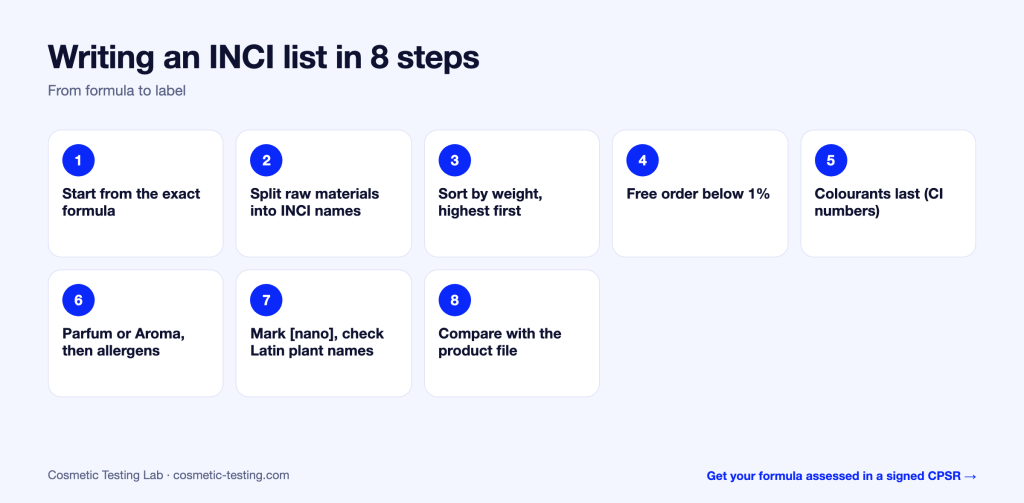
- Step 2: order by weight
- Step 3: the 1% rule
- Step 4: colourants go last
- Step 5: fragrance, flavour and allergens
- Step 6: plant ingredients
- Step 7: nanomaterials, preservatives and processing aids
- Step 8: format and placement
- A worked example
- Common mistakes
- Checklist before printing
- Frequently asked questions
- Key takeaways
The short answer
An EU ingredient list starts with the word “Ingredients” and names every ingredient with its INCI name, in descending order of weight at the time of adding. Ingredients below 1% may follow in any order, colourants come last, fragrance is declared as Parfum, flavour as Aroma, and nanomaterials are marked [nano]. The list may be placed on the container, the outer packaging or a leaflet when it does not fit. The legal basis is Article 19 of Regulation (EC) No 1223/2009.
What does INCI mean?
INCI stands for International Nomenclature of Cosmetic Ingredients. It is a shared naming system so that a consumer, a doctor or an authority anywhere can identify the same substance, whatever the language of the pack. In the EU, the names come from the Commission’s common ingredients glossary, which you can search in the CosIng database. Do not invent your own names or use trade names such as a supplier’s brand: “Aqua”, not “purified water”, and “Glycerin”, not “vegetable glycerine”.
Read also Non-Comedogenic Claim: What Testing and Proof You Need
Step 1: start from the formula, not the marketing
Take the exact formula (the same data the safety assessor uses for the CPSR) and list every raw material with its percentage. Then break each raw material down into its own INCI names. A raw material is rarely one substance: an emulsifier blend, a preserved plant extract or a pre-made colour dispersion may contain several declarable ingredients. Take them from the supplier’s specification or the safety data sheet, and keep this data on file with the SDS for each material.
A practical habit is to keep one master spreadsheet per product, with the raw material, its percentage, and the INCI names and shares of its components. When a supplier changes a blend, only one line has to be updated, and the label, the safety report and the product file stay consistent. Brands that skip this step usually discover the mistake when an inspector or a retailer asks for the supporting data.
Step 2: order by weight
List ingredients in descending order of weight at the time they are added to the product. For most creams, that means Aqua first, then oils, emulsifiers and humectants. Water counts as an ingredient with its weight. Volatile ingredients, such as alcohol or solvents that evaporate, are still ranked by the weight at which you added them, not by what remains in the jar. Percentages are never printed in the list.
Step 3: the 1% rule
Once you reach ingredients that make up less than 1% of the formula, you may list them in any order. Many brands still keep a logical order, but the law does not require it. The 1% line is useful: it means a preservative at 0.5% and a fragrance at 0.3% can swap positions without a problem. Be careful, though: you must still place everything above 1% in the strict descending order, so check the percentages in your formula again after any reformulation.
Read also Ophthalmologically Tested: Claim Requirements Explained
Step 4: colourants go last
Colourants in decorative products come after all other ingredients, in any order. They are named with the Colour Index number, such as CI 77891, or with the name from Annex IV of the regulation. For products sold in multiple shades, you may list all colourants of the range, provided each is preceded by the symbol “+/-” or the words “may contain”, so that one list covers every shade.
Step 5: fragrance, flavour and allergens
A perfume or aromatic composition is declared as Parfum. A flavouring composition, such as in lip balms or toothpaste, is declared as Aroma. The individual components of the composition are not listed, with one important exception: fragrance allergens that exceed 0.001% in leave-on or 0.01% in rinse-off products must be named with their INCI name, as listed in Annex III. Regulation (EU) 2023/1545 extended this list considerably, and our article on fragrance allergens explains the new deadlines.
Step 6: plant ingredients
Plant ingredients use the Latin botanical name plus the part and the form, for example “Aloe Barbadensis Leaf Juice” or “Camellia Sinensis Leaf Extract”. Common names such as “aloe vera” or “green tea” are not INCI and should not be used instead. For essential oils, the INCI normally follows the pattern of the Latin name and the word Oil. If the plant extract delivers fragrance allergens, remember to count them separately.
Read also Multilingual Cosmetic Labels for EU Markets
Step 7: nanomaterials, preservatives and processing aids
- Nanomaterials: add [nano] in brackets after the name, for example “Titanium Dioxide [nano]”.
- Hidden functional substances: a substance that arrives inside another raw material, such as a preservative in an extract, is an ingredient if it still has a function in the finished product.
- Impurities and processing aids: impurities in raw materials and technical substances used during manufacture but not present in the finished product are not ingredients.
An ingredient that works as a preservative must still be shown to do its job, and a challenge test is how the finished formula proves it.
Step 8: format and placement
Start with “Ingredients”, followed by a colon or a line break, and separate names with commas. The text must be indelible, easy to read and visible. Capital letters at the start of each word are common practice and help readability, but the law does not require it. If the pack is too small, the list can be on an enclosed leaflet, label, tape, tag or card, with the hand-pointing-at-a-leaflet symbol on the pack. For the other mandatory items, see our checklist on EU cosmetic label requirements.
A worked example
A simple lotion might read: Ingredients: Aqua, Glycerin, Caprylic/Capric Triglyceride, Cetearyl Alcohol, Glyceryl Stearate, Parfum, Phenoxyethanol, Limonene, Linalool. Here the weight order runs from Aqua to Glyceryl Stearate. Parfum, the preservative and the two named allergens sit below 1%, so their order is free. If the lotion contained a mineral pigment, it would appear after them, for example CI 77891. Note that the same formula must be copied into the product file, so that an authority can compare the printed list with the documentation in minutes.
Common mistakes
- Common names instead of INCI. “Vitamin E” instead of Tocopherol.
- Marketing order. Putting the hero ingredient first to look rich, when it is at 0.1%.
- Forgotten components. Ignoring preservatives that arrive inside an extract or blend.
- Missing allergens or [nano]. Two of the most checked details.
- Using old lists. Printing a list copied from a previous batch after the formula changed.
Checklist before printing
- Start from the current formula with percentages.
- Break every raw material into its INCI components.
- Sort by weight, using the 1% rule below that point.
- Place colourants last, with CI numbers.
- Add Parfum or Aroma, then allergens above the thresholds.
- Mark [nano] and check the Latin names of plant ingredients.
- Compare the printed list with the safety report and product file.
Frequently asked questions
Do I need to print percentages in the list?
No. The order carries the information, and percentages are not shown on the label.
Is water listed as Aqua or Water?
Aqua is the INCI name. Many brands print “Aqua (Water)” in markets where the translation helps consumers, which is acceptable.
Who checks the ingredient list?
The responsible person is accountable. Authorities compare the list with the product file, and the safety assessor uses the same formula in the CPSR.
Key takeaways
- Use INCI names from the Commission glossary, never trade names.
- Descending weight above 1%, free order below, colourants at the end.
- Declare Parfum or Aroma and name allergens above the thresholds.
- Rebuild the list from the real formula every time it changes.