

Norway, Iceland and Liechtenstein are not EU members, so many brands wonder whether their EU compliance file works there, or whether a whole second dossier is needed. The answer is mostly reassuring. If you want to sell cosmetics in Norway, Iceland or Liechtenstein, the cosmetics rules are essentially the same as in the EU, because all three belong to the European Economic Area (EEA). The differences are practical: national authorities, language rules, and customs and tax handling. This guide explains what carries over, what to check, and how to avoid the mistakes that block shipments.
Contents
- The short answer
- What the EEA is, in one paragraph
- What stays exactly the same?
- What changes: the national layer
- Language of the label
- CPNP and the product file
- Customs, VAT and shipping
- Ingredient updates and timing
- Do you need extra tests for Nordic markets?
- Checklist for selling in the EEA countries
- Common mistakes
- Frequently asked questions
- Key takeaways
The short answer
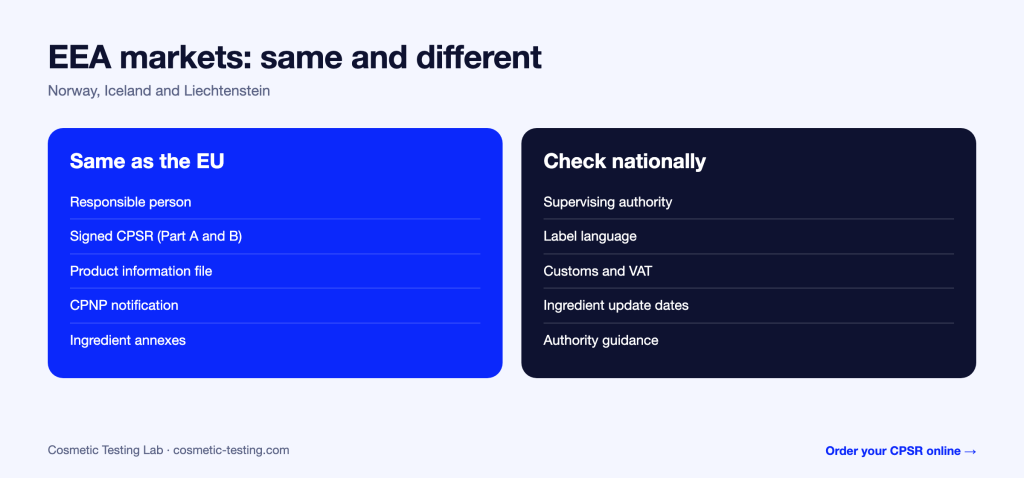
Regulation (EC) No 1223/2009 applies in the EEA through the EEA Agreement, so the same core dossier is expected in Norway, Iceland and Liechtenstein as in the EU: a responsible person, a product information file, a signed CPSR, a CPNP notification and compliant labelling. You normally do not prepare a second safety assessment. What you do check is the national layer: which authority supervises the market, which label information must be in the local language, and how customs and VAT apply, because these three countries are not part of the EU customs territory in the same way as EU members. Confirm the specifics with the national authority or a local adviser before shipping.
What the EEA is, in one paragraph
The EEA joins the EU Member States with Norway, Iceland and Liechtenstein in the internal market for most goods. EU product legislation is made part of the EEA Agreement by decisions of the EEA Joint Committee. The Cosmetics Regulation was incorporated by Joint Committee Decision 049/2013 and has been in force in the EEA since April 2013, according to the EFTA database. That is why the legal text you work with is the same one used in Brussels, Dublin or Ljubljana.
Read also Sell Cosmetics From the UK to the EU: What Changed
What stays exactly the same?
- The responsible person. Every product needs one, with a name and address on the label. Authorities in the EEA describe the requirement as a responsible person established in the EU/EEA, so a responsible person based in an EU country can normally serve the whole area. Check the wording that applies to your set-up.
- The safety assessment. The CPSR follows the same structure (Part A and Part B) and the same Annex I requirements.
- The product information file. It is kept for ten years after the last batch is placed on the market and must be available to the authorities on request.
- Ingredient rules. The annexes on prohibited, restricted, colourant, preservative and UV-filter ingredients are the same legal framework.
- Good manufacturing practice, where ISO 22716 is the usual reference.
- Claims and labelling content, including the INCI list, batch number and nominal content.
What changes: the national layer
Although the rules are shared, enforcement is national. Each country has its own authority and its own implementing law.
- Norway. The Norwegian Food Safety Authority (Mattilsynet) is generally the body that supervises cosmetics, and the Cosmetics Regulation is implemented in Norwegian law through national cosmetics legislation.
- Iceland. The Environment Agency of Iceland (Umhverfisstofnun) describes itself as the competent authority for cosmetics, and Icelandic Regulation No 577/2013 implements the EU regulation.
- Liechtenstein. It is an EEA member, but its practical arrangements differ, partly because of its close ties with Switzerland. Ask the national office for the current position rather than assuming.
National authorities may also publish guidance, for example on borderline products or on substances they follow closely. Read it when you enter a market.
Language of the label
The Cosmetics Regulation leaves it to each country to decide which language(s) are used for some of the information on the pack, such as warnings and the function of the product. In practice, Norway and Iceland typically expect certain information in Norwegian and Icelandic respectively, and Norway may accept closely related Scandinavian languages for some items. This is one of the points where national rules change and where guessing is risky. Before printing, ask the authority or a local importer which items must be translated, and keep a translated label in the product file.
Read also Selling Cosmetics in Slovenia: Rules, Authorities and Labels
CPNP and the product file
Notification is done once, in the EU Cosmetic Products Notification Portal (CPNP), by the responsible person or an authorised user acting for them. The Commission explains that once a product is notified in the CPNP, no further national notification is needed within the EU, and EEA authorities use the system in practice, but you should confirm the current arrangement for each EEA country before launching. Your product information file should be available in a language easily understood by the authority, and for Nordic markets an English file is often workable, though this is a point to verify with the authority.
Customs, VAT and shipping
Because Norway, Iceland and Liechtenstein are outside the EU customs territory, goods that cross the border are generally treated as exports and imports, with declarations, duties where applicable, and national VAT handling. These are not cosmetics-specific rules, but they cause delays when brands ignore them. Practical steps:
- ask your courier which customs documents and codes they need;
- prepare a commercial invoice with accurate product descriptions;
- keep a safety data sheet ready for products such as perfumes or aerosols, which carriers may classify as dangerous goods;
- check the VAT and import rules of the destination with a customs adviser;
- consider a local importer if you sell business-to-business in volume.

Ingredient updates and timing
When the EU amends the annexes, for example through an Omnibus act, the change reaches the EEA through the EEA procedure. That can mean a gap between the EU date and the EEA date, and the national authority may publish its own transition guidance. For a brand selling in both areas, the safe approach is to follow the stricter date, and to use the same compliant formula everywhere. Fragrance allergen labelling under Regulation (EU) 2023/1545 and similar changes should be planned in the same way.
Read also Selling Cosmetics in the USA: MoCRA Step by Step
Do you need extra tests for Nordic markets?
No separate test programme is required for Norway, Iceland or Liechtenstein. The data in your CPSR should reflect the real use and conditions of the market, and Nordic customers sometimes buy products for cold, dry weather or for high exposure to wind and sun. A stability test that includes cold storage and temperature cycling is useful for a product shipped in winter, and a patch test supports skin-tolerance claims on all your markets. Preservation efficacy is checked in the same way as in the EU; see our guide to the challenge test.
Checklist for selling in the EEA countries
- Confirm that you have a responsible person established in the EU/EEA and a complete product information file.
- Keep the signed CPSR and the supporting stability, microbiological and challenge test reports in the file.
- Check that the product is notified in the CPNP, and ask the national authority how it handles the notification.
- Identify which label elements need the local language and prepare translated labels.
- Check the national authority’s guidance for your product type.
- Plan customs, VAT and carrier requirements for each shipment.
- Follow the EEA timing for ingredient changes.
Common mistakes
- Assuming that Norway, Iceland or Liechtenstein are part of the EU customs union and shipping without export papers.
- Selling without a responsible person because the brand is based in the UK or the US.
- Printing labels in English only for markets that require the local language for some items.
- Preparing a separate safety report for each country, which is unnecessary.
- Forgetting that ingredient changes may enter the EEA on a different date.
Frequently asked questions
Is my EU CPSR valid in Norway?
The CPSR follows the same regulation that applies in the EEA, so it normally serves as the safety assessment for Norway, Iceland and Liechtenstein too. Labelling and national requirements still need checking.
Do I need a Norwegian responsible person?
Usually not. The rule refers to a responsible person established in the EU/EEA, so one in an EU country can generally act for all of them. Confirm this with the authority for your set-up.
Do UK and Swiss brands need anything else?
Brands based outside the EU/EEA need a responsible person established in the EU/EEA, who is named on the label and notified in the CPNP.
Key takeaways
- The EU Cosmetics Regulation applies in Norway, Iceland and Liechtenstein through the EEA Agreement.
- One CPSR and one product file serve the whole EEA; the differences are national.
- Check authorities, label language, customs and VAT for each country before shipping.
- Follow the EEA dates for ingredient updates and keep one compliant formula.