

You sell in the EU and now a retailer, a marketplace or a customer in Great Britain wants your product too. Do you commission a second safety report? The question behind CPSR UK vs EU is a practical one, because the answer decides how much of your existing safety file you can reuse. This guide separates what is the same on both sides of the border from what the two systems ask for separately, so you can extend an existing CPSR to the UK instead of starting from zero.
Contents
The short answer
You usually do not need two separate scientific assessments, but you do need a safety report that is valid under each legal system you sell in. The science of your formula (ingredients, toxicology, stability, microbiology) does not change at the border. What changes is the law the assessor has to check it against, who may sign it, and which responsible person and notification sit on top of it. Many brands therefore use one report that covers the EU and Great Britain, with market-specific checks, or an EU report that is extended for the UK. Always confirm the approach with your safety assessor before you rely on it.
Two legal systems built on the same text
The EU Cosmetics Regulation, Regulation (EC) No 1223/2009, applies in the EU. After Brexit, Great Britain kept a retained version of that text, usually called the UK Cosmetics Regulation, and Northern Ireland continues to apply the EU Regulation under the Windsor Framework. The structure of the safety report is therefore familiar on both sides: GOV.UK describes a report with Part A, supplied by the responsible person, and Part B, supplied by the safety assessor, just as in the EU.
Because the two texts started identical and are now amended separately, they can drift apart over time. That is the reason one assessment is not automatically enough.
Read also How Much Does a CPSR Cost in 2026? Price Factors Explained
What stays the same
- The formula and its data. Composition, ingredient functions, impurities, packaging information and exposure assumptions are facts about the product.
- Laboratory results. Challenge test, microbiological specifications, stability and patch test results describe how the product behaves, not where it is sold, and are normally reused as they are.
- The toxicological evaluation. The profile of each ingredient and the margin of safety calculation rest on the same scientific evidence.
- The overall logic. A qualified assessor evaluates the product and concludes in writing whether it is safe under normal or reasonably foreseeable use.
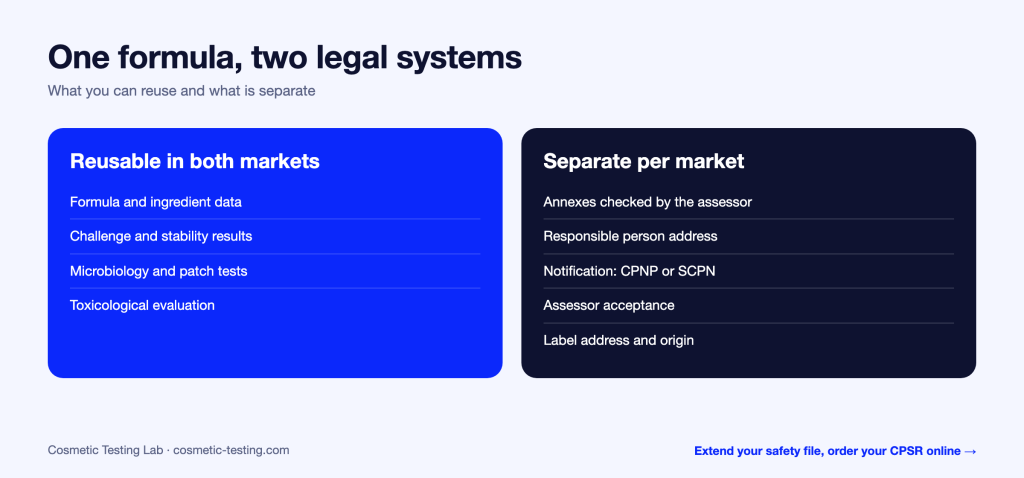
What differs between the UK and the EU
- The rules the assessor checks against. The annexes of prohibited and restricted substances, colourants, preservatives and UV filters are amended in each system separately. An ingredient allowed or limited in one may be treated differently in the other, depending on the date.
- The responsible person. For Great Britain, GOV.UK requires a responsible person with a UK established address; mail forwarding addresses and PO boxes do not count. An EU responsible person serves the EU, not Great Britain.
- Notification. The EU uses the CPNP. Great Britain uses the Submit cosmetic product notifications service (SCPN), and a CPNP notification alone is not accepted as the route for Great Britain.
- The product information file. GOV.UK states that the file must be kept in English for products in Great Britain and retained for 10 years after the last batch is made available.
- Labelling. The responsible person’s name and address on the pack have to match the market, and imported products need the country of origin. A label for both markets may need two addresses.
Details change, so treat this list as a map of where to look, not as a final legal answer. Check the current GOV.UK guidance and the official lists before you launch.
Who can sign the report?
For Great Britain, GOV.UK describes the safety assessor as someone with a university degree in pharmacy, toxicology, medicine or a similar discipline, and makes the responsible person accountable for checking that the assessor is suitably qualified. Part B has to include the assessor’s name, address and proof of qualification. The guidance page we reviewed does not say whether the assessor must be based in the UK or whether an assessment carried out in the EU is accepted, so do not assume either way. For Northern Ireland, GOV.UK states that the report must be signed by an assessor recognised in the EU. Ask your assessor in writing which markets their signature is meant to cover.
Read also What Is a CPSR? Cosmetic Product Safety Report Explained
Northern Ireland: the third case
Northern Ireland sits on the EU side of the line for cosmetics. The responsible person must be established in Northern Ireland or the EU, the notification goes through the CPNP, and a product that is also sold in Great Britain needs both routes: the CPNP for the EU and Northern Ireland, and the UK SCPN service for Great Britain. If you ship to Northern Ireland and Great Britain, your file has to support both.

Three practical setups
- EU only. One CPSR, one EU responsible person, notification on the CPNP.
- EU and Great Britain. One combined report, or an EU report plus a UK extension, in which the assessor confirms the formula against both sets of annexes. You need a UK responsible person and an SCPN notification next to the EU responsible person and the CPNP entry.
- EU, Northern Ireland and Great Britain. As above, with the EU route also serving Northern Ireland and the UK route serving Great Britain. Make sure the assessor and the report cover all three.
In every setup the formula is the same file; what multiplies are the legal wrappers.
A checklist before you launch in both markets
- Ask the assessor whether the report can be marked as valid for the EU and for Great Britain.
- Run the ingredient list against the current EU annexes and the current UK annexes.
- Appoint a responsible person in the UK and, for the EU, one in an EU member state.
- Notify on the CPNP for the EU and on the SCPN service for Great Britain.
- Prepare the file in English, with the safety report, evidence of good manufacturing practice and proof of the claimed effects.
- Check that the label carries the right responsible person address and the country of origin where needed.
Read also SDS vs CPSR: Which One Do You Need?
Common mistakes
- Assuming that an EU notification on the CPNP also covers Great Britain.
- Using an EU responsible person address on a label for Great Britain.
- Reusing an old report without re-checking the ingredients against the UK annexes.
- Assuming that an assessor who works for the EU market is automatically accepted for the UK, or the other way round.
- Updating the formula for one market and forgetting the other file.
Frequently asked questions
Can I use my EU CPSR for the UK?
The data can usually be reused, but the report should be assessed against UK law and the assessor’s signature should be acceptable for Great Britain. Many brands solve this with a report that covers both. Confirm with your assessor.
Do I need to notify the product twice?
Yes, if you sell in both markets. The EU uses the CPNP, and Great Britain uses the SCPN service. A product sold in Northern Ireland follows the EU route there.
Do I need to repeat the lab tests for the UK?
Usually not. Challenge, stability, microbiological and patch test results describe the product, not the market. What may need updating is the assessment around them.
Key takeaways
- One formula and one set of data can support both markets; two legal frameworks still apply.
- The safety report must be assessed against the rules of each market and signed by an assessor accepted there.
- Great Britain needs a UK responsible person and an SCPN notification; Northern Ireland follows the EU route.
- Plan one combined safety file with market-specific checks, and verify current rules before launch.