

The Gulf is a rewarding market for beauty brands, but it is not one rulebook. If you want to sell cosmetics in the UAE and Saudi Arabia, you will meet a federal conformity certificate, a municipal product registration in Dubai, a Saudi listing system and a shared Gulf standard. This guide separates them, shows what the official sources say today and flags where you must check again. Rules and portals in the region change frequently, so treat this as a map, not as legal advice.
Contents
- The short answer
- Why “the Gulf” is several systems
- UAE federal level: MoIAT and the ECAS certificate
- Dubai: registering products in Montaji
- Saudi Arabia: SFDA notification and listing
- Arabic and English labelling
- Halal expectations
- What your EU documents give you
- Gulf market checklist
- Common mistakes
- How Cosmetic Testing Lab helps
- Frequently asked questions
- Key takeaways
The short answer
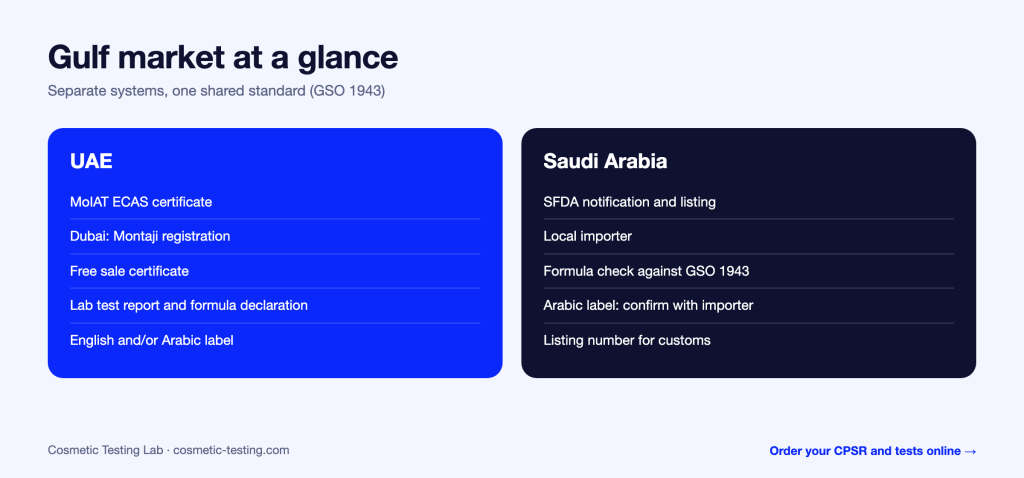
In the UAE, cosmetics are typically covered by a MoIAT conformity certificate (ECAS) and, for Dubai, by registration of each product in the Dubai Municipality’s Montaji system; in Saudi Arabia, the SFDA runs a notification and listing system for cosmetic products. All of these refer to the Gulf standard GSO 1943 on cosmetic safety requirements, and your EU documentation is a strong base. Details such as who may apply, how long certificates last and which documents are accepted change often, so verify each with the authority before you ship.
Why “the Gulf” is several systems
There are three layers. At federal UAE level, the Ministry of Industry and Advanced Technology (MoIAT) runs conformity assessment; the scheme was formerly associated with ESMA, and MoIAT still points to the old ESMA service for earlier applications. At emirate level, Dubai Municipality controls products placed on the Dubai market. In Saudi Arabia, the Saudi Food and Drug Authority (SFDA) is responsible. Other emirates and other Gulf states have their own authorities, so a launch in one place does not automatically cover the rest.
Read also Selling Cosmetics in Slovenia: Rules, Authorities and Labels
UAE federal level: MoIAT and the ECAS certificate
MoIAT describes ECAS as a conformity certificate showing that a product meets approved technical requirements. For cosmetics, MoIAT publishes a regulation card. Reading it, the requirements for a certificate include, among others:
- a valid UAE trade licence;
- a test report from an accredited and recognised laboratory, according to the Gulf standard GSO 1943, per category;
- a formula declaration with ingredients and percentages, issued by the manufacturer;
- for imported products, a free sale certificate on the manufacturer’s letterhead, a distributor agreement and evidence of good manufacturing practice;
- label artwork and a product safety report, both referring to annexes of UAE Cabinet Resolution No. 18 of 2014;
- a certificate of analysis and an electronic declaration of conformity.
The card also states that one certificate covers one combination of brand, country of origin and category, with a maximum number of SKUs. Conformity bodies commonly report that certificates are issued for a limited period and must be renewed. Treat the card as a snapshot: its date is not shown, so confirm the current list with MoIAT or a notified body.
Dubai: registering products in Montaji
Dubai Municipality’s technical guideline for cosmetics and personal care products (version 2.1, September 2025) says that no cosmetic may be manufactured, imported, advertised, sold or distributed in Dubai unless it is registered in Montaji. It rests on Local Order No. 11 of 2003. Points from the guideline include:
- the importer or local manufacturer applies, and foreign manufacturers work through an importer or agent;
- the applicant should be a company incorporated in Dubai, or have a warehouse in Dubai, with a Dubai trade licence covering cosmetics;
- documents include a free sale certificate, an ingredient report with chemical names and CAS numbers signed by the manufacturer, and a laboratory test report from a certified lab with accredited methods;
- other documents may be requested, such as a halal certificate, an organic or vegan certificate, clinical studies for claims or a safety assessment report;
- registration is valid for five years, and later changes to the details must be notified.
The guideline’s test annex lists microbiology tests: total aerobic count, yeast and mould, and absence of Escherichia coli, Staphylococcus aureus, Pseudomonas aeruginosa and Candida albicans. It also lists fragrance allergens above 0.001% in leave-on and 0.01% in rinse-off products.
Saudi Arabia: SFDA notification and listing
The SFDA publishes a list of cosmetic products for which importers or manufacturers have submitted a notification of marketing, and says that the notifiers take responsibility for those products. Its 2025 user guide for the GHAD system describes services for cosmetic product listing, updates, deactivation and kits, as well as factory and warehouse licences. Testing bodies often call the earlier system eCosma. One SFDA FAQ, last updated in 2024, said that registering cosmetics before import was not yet mandatory but that an electronic system would eventually become an import condition. That wording is dated, so ask the SFDA or your Saudi importer what is required for your shipment today. Practically, assume you need a local importer, the product listed and the listing number available for labelling and customs.
Read also Selling Cosmetics in the USA: MoCRA Step by Step
Arabic and English labelling
Dubai Municipality’s guideline says required label components must be in clear English and/or Arabic. They include brand and product name, manufacturer or agent details, country of origin, ingredients (INCI or botanical names), pack size, and production and expiry dates in non-removable print. For Saudi Arabia, older SFDA clearance documents refer to Arabic labelling of imports in general. We could not confirm a cosmetics-specific Arabic rule on the pages we read, so ask your importer and have the artwork checked before printing.

Halal expectations
From the sources we read, halal certification is not a general condition for registering a cosmetic. Dubai Municipality lists a halal certificate from a recognised Islamic body among the documents that may be requested, and says it is mandatory if a halal logo appears on the label. Beyond the rules, retailers and consumers in the region often pay attention to alcohol and animal-derived ingredients. If you plan to use a halal claim, check the certificate holder and its recognition early, and keep the certificate in the file.
What your EU documents give you
Dubai Municipality’s own references include the EU Cosmetics Regulation and GSO 1943, so an EU-compliant file is a good fit. Specifically:
- The CPSR can support the product safety report, the ingredient information and the safety assessment that authorities may request.
- A microbiological specifications test covers the kind of microbial quality limits the Dubai annex lists, subject to the laboratory-accreditation expectations of the authority.
- A stability test supports shelf life in hot climates and during transport.
- A challenge test shows that the preservative system works, which matters for water-based products.
- A safety data sheet is useful for importers and logistics, especially for flammable or alcohol-based products.
Read also Selling Cosmetics in Croatia: Rules, Authorities and Labels
Gulf market checklist
- Identify the target: UAE federal, Dubai, another emirate or Saudi Arabia.
- Appoint a local importer or agent who holds the required licence.
- Obtain the free sale certificate and a manufacturer’s formula declaration.
- Collect the CPSR, test reports and GMP evidence.
- Check the formula against GSO 1943 and the national restricted-substance lists.
- Prepare English and Arabic labels with dates, origin and ingredients.
- Apply for the MoIAT certificate, Montaji registration or SFDA listing as relevant.
- Diary renewals and notify authorities about formula changes.
Common mistakes
- Assuming a free sale certificate and CPNP number are enough.
- Printing labels before the authority has accepted the artwork.
- Using a halal logo without the certificate behind it.
- Treating Dubai registration as valid for all emirates and Saudi Arabia.
How Cosmetic Testing Lab helps
We do not apply for MoIAT, Dubai Municipality or SFDA approvals, and we do not act as your agent. What we produce is the evidence behind them: stability, microbiological, challenge and patch tests, a CPSR signed by a qualified safety assessor and a REACH-compliant 16-section SDS in more than 30 languages. DHL collects samples free from your door and you order online. Create a free account to unlock 10% off your first order and 20% on bundles.
Frequently asked questions
Do I need separate approvals for the UAE and Saudi Arabia?
Yes, in general. The UAE and Saudi Arabia have separate authorities and systems, even though both refer to the Gulf standard GSO 1943. Confirm each route with the authority.
Does my product need to be halal?
Not as a general condition in the sources we read. A halal certificate becomes mandatory in Dubai if the label carries a halal logo. Check the buyer’s own requirements as well.
Can I reuse my EU CPSR?
It is a very useful base, but format and content expectations differ by authority. Ask what the product safety report must contain before you submit.
Key takeaways
- The Gulf has several routes: MoIAT certificate, Dubai Montaji registration and SFDA listing.
- All refer to GSO 1943; formula and label checks matter more than speed.
- Use a local importer and expect English and/or Arabic labels.
- Rules change frequently, so verify on the official pages before every shipment.